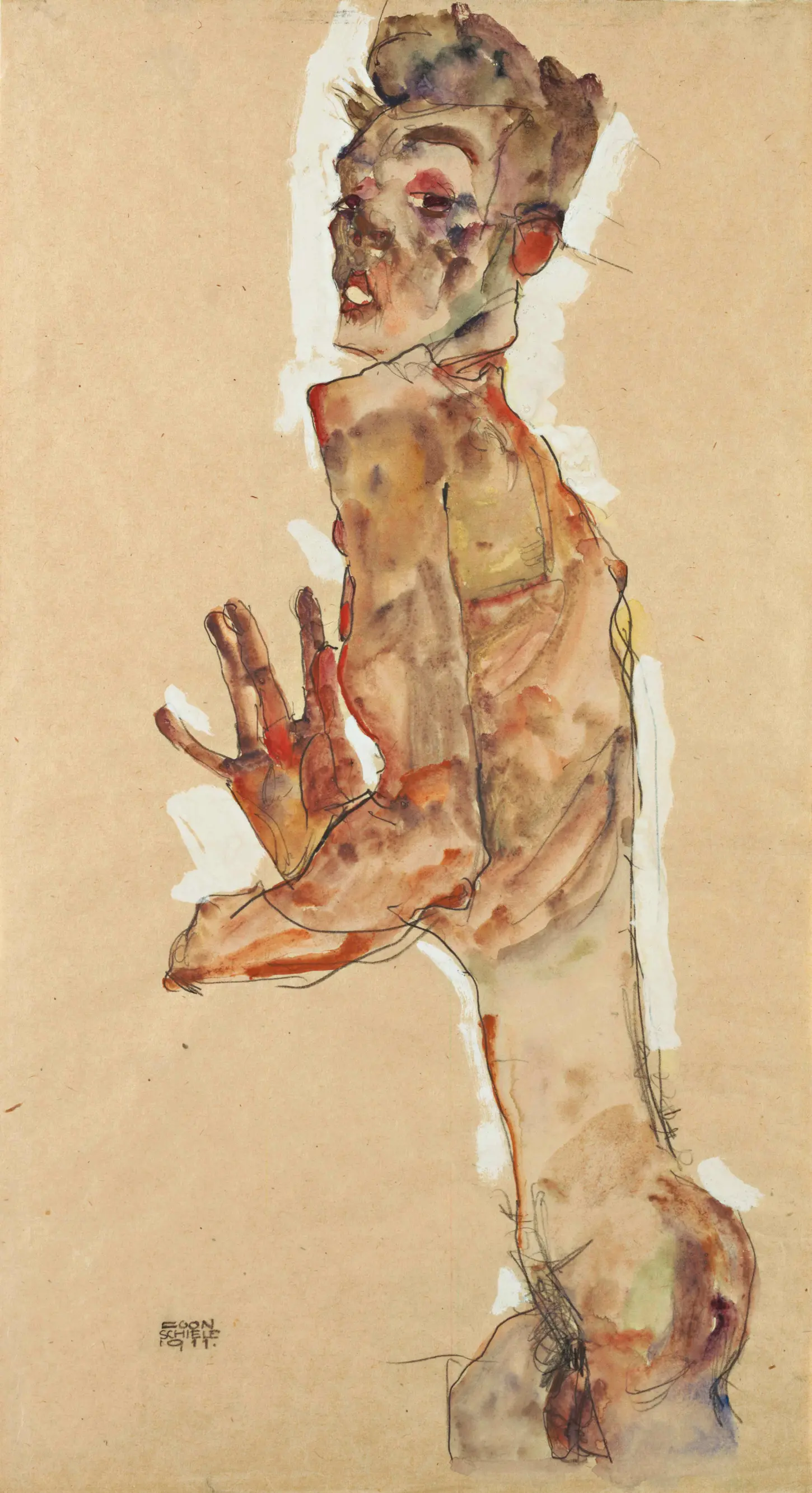
Egon Schiele:
Self-Portrait with Splayed Fingers (Selbstbildnis mit gespreizten Fingern), 1911
Pencil, gouache, heightened with white, on paper
53 × 29.1 cm
©Leopold Museum, Vienna (Inv. 1383)
(Kallir d952)
Egon Schiele’s Self-Portrait with Splayed Fingers remains a definitive example of his break from traditional European portraiture. Created in 1911, this paper-based work highlights the exact moment the twenty-one-year-old artist rejected the decorative aesthetics of his mentor, Gustav Klimt, to pursue an aggressive and confrontational style that frequently scandalized the Viennese public. Rather than presenting a flattering depiction of the bourgeois individual, Schiele turned the mirror onto himself to reveal a raw, disjointed anatomy.
The Invention of a New Genre
This drawing represents a fundamental shift in the history of Western self-portraiture. Before Schiele’s emergence in 1910, traditional portrait drawing relied heavily on academic modeling—gradual shading, soft charcoal blending, and precise proportional balance to replicate physical reality. Schiele systematically abandoned this formula. He treated the self-portrait not as a tool for vanity or likeness, but as an independent, radical laboratory to investigate human isolation. This direct approach was entirely unprecedented in its frequency and vulnerability. Over a century later, his method remains distinctly modern, predating contemporary concepts of raw self-image and aggressive identity presentation.
Polarization and Public Reaction
This drawing serves as a primary source for the intense polarization that defines Schiele’s legacy. To a significant portion of the public, both in 1911 and today, this depiction is viewed as grotesque, jarring, and deliberately ugly. Conversely, admirers of early Austrian Expressionism view the work as a sharp, uncompromised piece of psychological truth. The inherent tension of the drawing relies on this exact divide; it refuses to offer middle ground or aesthetic comfort. By replacing classical beauty with a harsh, defensive posture, Schiele forced a permanent split between viewers who reject the distortion and those who accept its structural intensity.
Technical Lines Over Academic Modeling
The artwork is executed using a combination of pencil and gouache on paper. Instead of blending tones to create realistic skin textures or muscle structures, Schiele relied on sharp, irregular pencil lines to outline his torso and face. He applied patchy, dark gouache colors and added prominent white highlights directly along the outer borders of his silhouette. This specific technical choice functions as an artificial contour, isolating the figure entirely from the blank, neutral background. Archival evidence shows that Schiele utilized this white halo effect to elevate his body into space, forcing the viewer to confront a physical form that early twentieth-century Viennese critics routinely dismissed as diseased.
Gestures and Physical Distortion
The central feature of this drawing is the deliberate and unnatural separation of the fingers on the right hand. Archival correspondence from September 1910 confirms that Schiele viewed hands as raw entities that carried the same expressive weight as a human face. The scissor-like positioning of the fingers in this 1911 drawing was a calculated stylistic tool, potentially influenced by the sharp movements of contemporary Expressionist dancers. By pulling his left shoulder up and fixing the viewer with red eyelids and thick, raised eyebrows, Schiele establishes a posture of defense. This heavy contortion of the body was a core method of Austrian Expressionism designed to reject academic beauty in favor of physical tension.
Ownership and Archival History
Unlike many expressionist works that vanished or were destroyed during the political upheavals of mid-century Europe, the legal and commercial trail of this specific sheet is thoroughly documented. Archival records from the Leopold Museum state that the drawing remained in Schiele’s personal estate following his death from the Spanish flu in 1918. In 1919, it was acquired by the Viennese collector Arthur Stemmer, who preserved the work through his subsequent relocation to London until 1954. The prominent collector Dr. Rudolf Leopold purchased the artwork in 1956, and it was officially transferred to the permanent collection of the Leopold Museum-Privatstiftung upon its establishment in 1994.
Leave a Reply