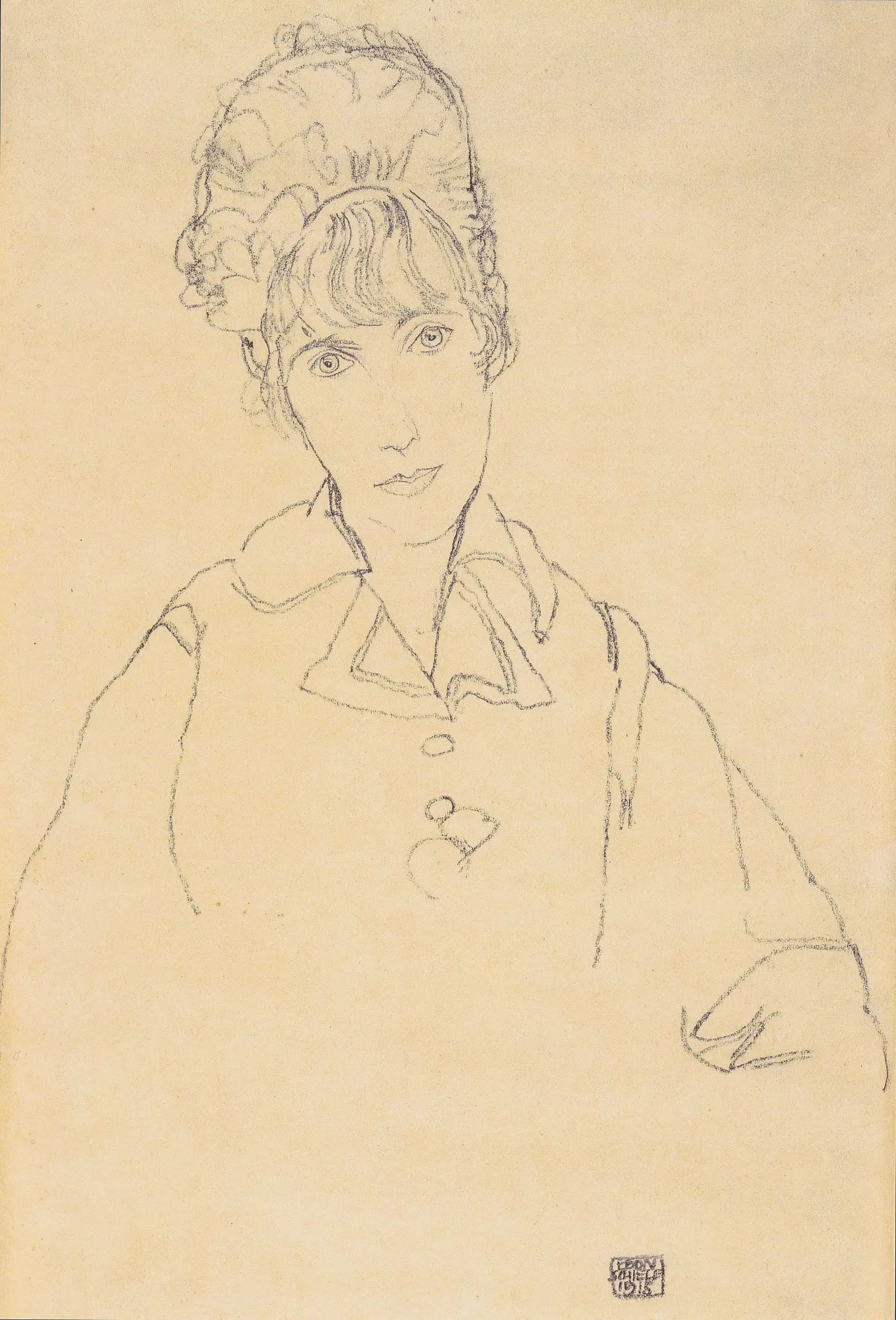
Egon Schiele:
Edith Schiele, 1915
Pencil on primed Strathmore Japan paper
48.4 cm x 31.2 cm
©Albertina, Vienna
(Kallir d1718)
This portrait study is one of the few graphic works executed by Egon Schiele in the second half of 1915. Following his conscription into military service in June of that year, his artistic production was heavily restricted. The work serves as a preliminary study for his life-sized painted portrait of his wife, Edith Schiele, which is currently housed in the Kunstmuseum Den Haag.
The 1915 Hiatus: Conscription and Routine
The year 1915 represents one of the least productive periods in Schiele’s career. In May 1915, a medical re-examination overturned his previous exemption, declaring him fit for army duty. Conscripted into the Austro-Hungarian army, he reported for basic training in Prague on June 21, exactly four days after his wedding.
The sudden integration into a strict, uniform military apparatus curtailed his studio access. Assigned to administrative duties and the guarding of Russian prisoners of war, he had little time or physical space for independent fine art. Aside from a series of drawings depicting the captured soldiers, his output during the second half of the year ground to a near-total halt. Brief resubmissions to drawing only occurred during rare breaks, such as an August sick leave that facilitated this study.
A Bourgeois Marriage under Strain: The “Trostbuch”
Schiele’s domestic life experienced a rapid transformation alongside his military enlistment. He married Edith Harms (1893–1918) on June 17, 1915, choosing her bourgeois conventionality over his bohemian past. The haste of the wedding was tied to his impending draft notice, ensuring social security for Edith.
The early months of their marriage were marked by deep isolation. Compelled to remain behind or follow her husband to provincial military posts—including Prague and Neuhaus—Edith struggled heavily with the sudden separation and the realities of war.
This profound anxiety was long known through their letters, but it was fully illuminated by the presentation of Edith’s private diary at the Leopold Museum. Kept in a sketchbook gifted by Egon, she recorded her feelings between 1915 and 1918, famously labeling the notebook on its first page as a “Trostbuch in Zeiten des Umbruchs” (Book of Consolation in Times of Upheaval). Her entries offer a direct record of the marital loneliness and melancholy that Schiele subsequently captured in the heavy, downturned expression of this Albertina sheet.
The Shift from Wally Neuzil to Edith Harms
The transition to Edith required an emotional and logistical break from Walburga “Wally” Neuzil (1894–1917), Schiele’s primary model and partner since 1911. Intent on securing a socially advantageous marriage with the neighboring Harms family, Schiele finalized his separation from Wally in the spring of 1915.
While later biographical accounts by Arthur Roessler heavily romanticized and fictionalized the breakup—inventing a dramatic confrontation at Café Eichberger—recent archival research shows that Wally remained financially connected to Schiele’s collectors and retained ownership of several of his works post-1915.
Levelling out the narrative, the departure of Wally forced a distinct stylistic shift in Schiele’s work. The raw, intense psychological intimacy and explicit eroticism that defined his graphic sheets of Wally vanished. In their place came the more formal, modest, and volumetrically structured naturalist portraits of Edith, mirroring Schiele’s newfound desire for middle-class respectability.
There is a disconnect, however, between the initial sensitivity of this drawing and the formal oil painting that followed. In this sheet, Schiele uses a delicate, soft pencil to capture a deeply sympathetic and animated look at his young bride, allowing her vulnerable melancholy to dominate her features. It remains a personal observation that vanishes in the final canvas in The Hague, where this responsive, human warmth is replaced by a more rigid composition, a mask-like stare, and a doll-like intellectual vacancy.
Leave a Reply