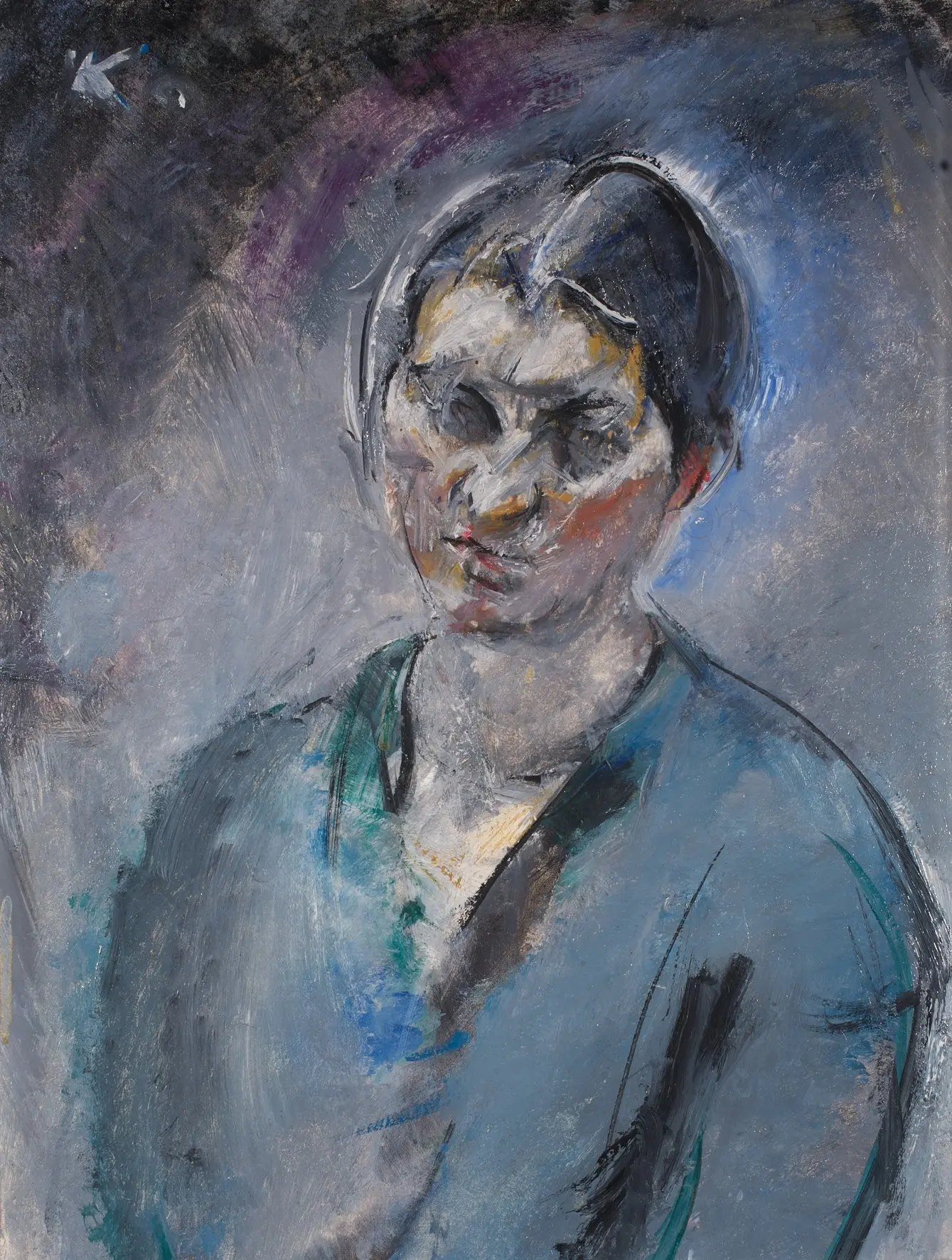
Die Neukunstgruppe and Friends of Schiele: Anton Kolig:
The Artist’s Wife (Die Gattin des Künstlers), 1914
Oil on canvas
55 x 43.5 cm
©Österreichische Galerie Belvedere, Vienna
Can a portrait capture the quiet friction of a world on the brink of collapse? In 1914, while living in France right before the outbreak of the First World War, Anton Kolig painted this private study of his wife, Katharina Wiegele. Instead of offering a comfortable, predictable likeness, this canvas forces us to question what a portrait is actually supposed to achieve. Kolig approaches the space with a strong structural focus, building the figure through rich, broad blocks of paint that create an unsettlingly solid presence.
Look closely at how the muted clothing and unformed background operate. They do not decorate; they aggressively push the face forward. By rejecting a polished or flattering studio pose, Kolig relies on thick, rough paint layers to highlight her serious gaze. It is a direct confrontation with the viewer, valuing raw psychological weight over superficial beauty.
Context and the Neukunstgruppe
This 1914 canvas captures a moment of major transition for both the modern art movement and Kolig’s own life. Born in 1886, Kolig studied in Vienna and quickly became involved with pioneering young artists who challenged traditional academic rules. Out of deep discontent with these conservative institutions, he took part in founding the radical Neukunstgruppe (New Art Group) in 1909.
His marriage to Katharina in 1911 connected him even deeper to this specific avant-garde network. She was the sister of the Austrian painter Franz Wiegele, a close companion who was also a founding member of the Neukunstgruppe alongside artists like Egon Schiele. The group’s shared mission was to break away from decorative conventions to expose a deeper psychological reality. This formative period in France was cut short that very year when the war forced the family to flee back to Austria.
The visible, raw brushstrokes on the canvas show an absolute refusal to smooth over the surface, mirroring the quiet gravity of an era under structural transition.
Erasure and Preservation
Kolig’s dedication to this unpolished, expressive style later put his career in severe danger. During the 1930s, the National Socialist regime labeled his modern art “degenerate,” removing his works from public galleries and systematically destroying his large-scale public frescoes. He spent his later years in the village of Nötsch. Near the end of the Second World War, in 1944, a devastating Allied bombing raid hit his home, leaving Kolig and his family severely injured and destroying a massive portion of his remaining life’s work. He continued to paint until his death in 1950.
This surviving 1914 portrait, preserved in the permanent collection at the Belvedere, remains a clear example of his vision. By keeping the composition focused entirely on Katharina’s quiet stance, Kolig demonstrates how paint can be used as a physical material to construct real human identity rather than simply decorate a canvas.
Leave a Reply