Egon Schiele:
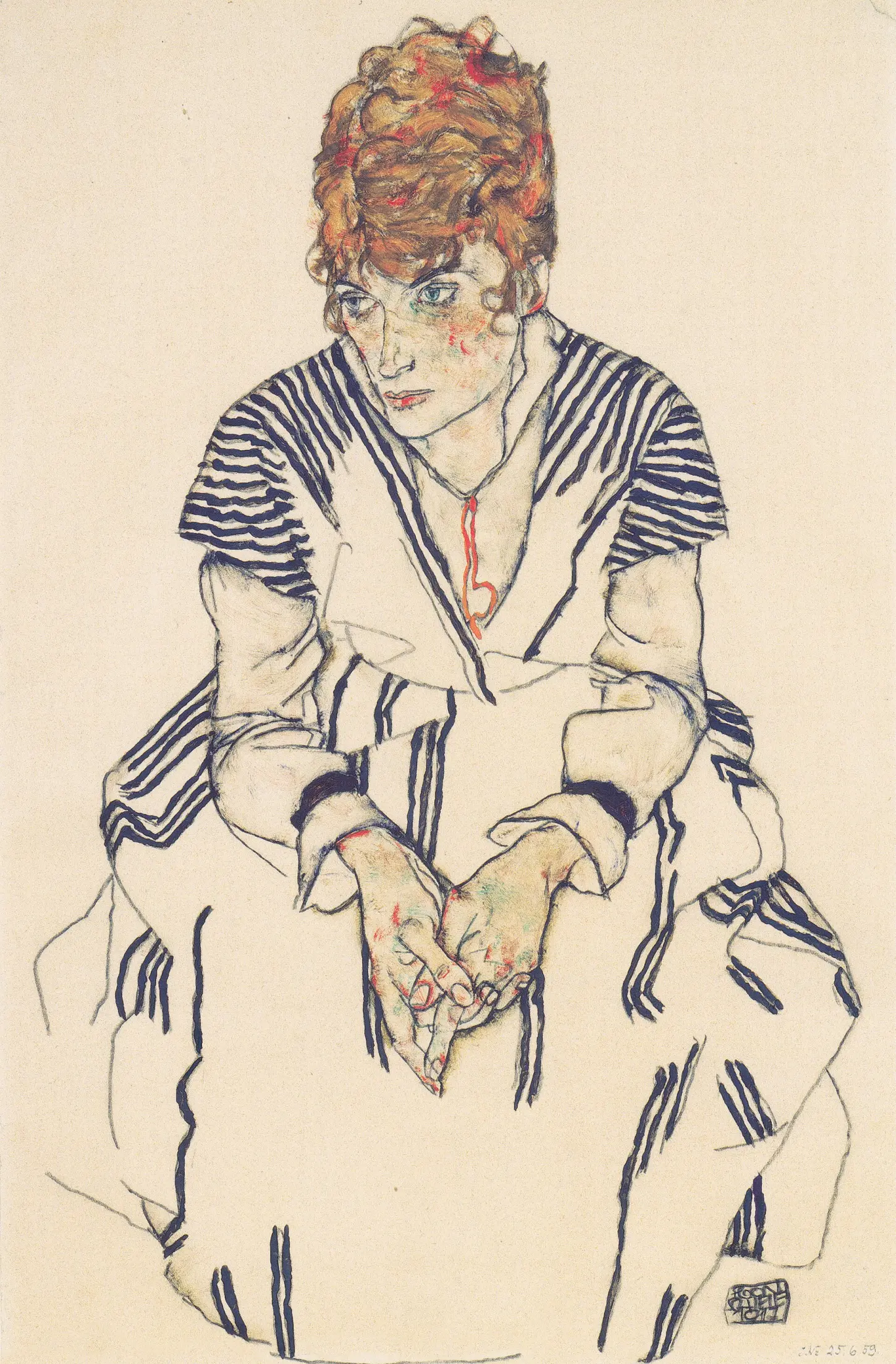
Adele Harms, the Artist’s Sister-in-Law (Adele Harms, die Schwägerin des Künstlers), 1917
Black chalk, brush, opaque color on Japanese paper
43.8 x 28.5 cm
©The Albertina Museum, Vienna
(Kallir d1911)
Following the portrait of his wife from the previous day, this closely related 1917 study focuses on her older sister, Adele Harms. Egon Schiele continues his look into the friction between realism and graphic simplification, transforming the portrait into an exploration of a quiet, internal mood rather than a standard studio pose.
The sheet balances a highly detailed, naturalistic treatment of the face against the bold geometric structure of the dress. The dark, rhythmic stripes crossing over her shoulders and skirt dominate the composition, anchoring her form to the page. By contrasting this heavy pattern against the light texture of the blank Japanese paper, Schiele centers all attention on her presence.
The Identity Game within the Studio
Within Schiele’s work from 1917, separating the individual features of the two Harms sisters on paper remains an ongoing puzzle. Although Adele had dark hair and Edith was blonde, their strong family resemblance is complicated by Schiele’s studio habits. He regularly detached his coloring process from nature, adding the red highlights to her hair and the faint blue and red marks on her skin from pure artistic intuition long after the model had left the room.
Furthermore, both sisters famously constructed matching garments from a single black-and-white striped curtain found in Schiele’s studio, which is directly visible in the lines of this dress. Rather than seeking a literal, photographic likeness of his sister-in-law, Schiele utilizes Adele’s features to explore a shared interior landscape, turning her posture into an expression of quiet withdrawal.
Technique and Structure
Schiele’s use of black chalk on Japanese paper demonstrates a sharp mastery of edge and economy. The jagged, structural lines defining her shoulders break away from traditional academic rendering, keeping the form raw. The heavy linear patterns block out the mass of her dress, while her tightly interlocked fingers add a sense of uncertainty to her pose. Left entirely without a background or domestic setting, the figure remains isolated in an empty space, forcing a direct encounter with her introspective stance.
Leave a Reply