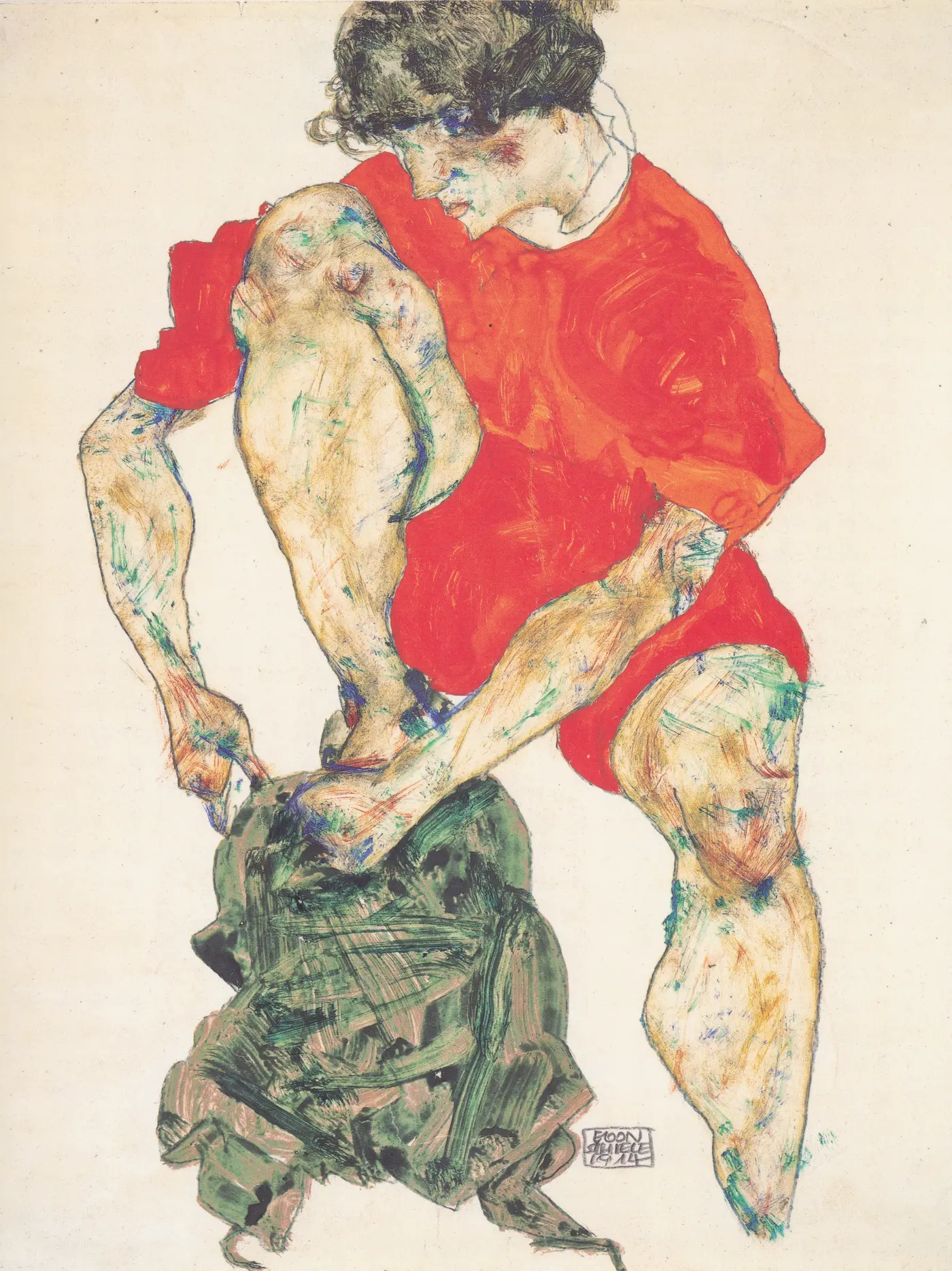
Egon Schiele:
Female Model in a Red Dress (Weibliches Modell in rotem Gewand), 1914
Pencil and opaque colors on Japan paper
48.1 x 31.5 cm (18.9 x 12.4 in.)
©Albertina, Vienna
(Kallir d1593)
This piece catches Schiele in a radical turnaround, proving he could create intense friction through static, blocky shapes instead of his usual frantic lines. After the raw, highly expressive emotional outbursts of his 1910–1912 period, his draftsmanship became more structural and composed. The composition shows a greater focus on flat, decorative geometric forms, moving away from deep spatial perspective. Overall, the drawing feels more deliberate and stylized, while still maintaining his signature use of intense body contours.
The Stylistic Shift of 1914: Evolution or Retreat?
By 1914, Schiele’s artistic environment was shifting away from the erratic, fluid nerve-lines that defined his early Expressionism. The wild, trembling strokes that made his subjects look as if they were vibrating on the paper began to settle. Instead, Schiele became preoccupied with construction and containment.
Critics often debate whether this was an evolution toward maturity or a retreat from the raw danger of his earlier work. Was he taming his style to chase international recognition, or did he simply exhaust the limits of pure distortion? In Female Model in a Red Dress, the body is no longer a site of fluid contortion; it is treated as a solid, blocky architectural form, built out of interlocking planes of color and graphite.
Breaking the Academic Standard
Look closely at how Schiele uses this piece to push hard against traditional art school standards. In classic academic life drawing, a clothed or semi-nude model was used to demonstrate a mastery of anatomy, realistic fabric folds, and believable depth.
Schiele completely subverts this expectation and asks the viewer a direct question: does fabric have to reveal the body, or can it conceal it entirely? Here, the red garment acts as a rigid armor that flattens the figure completely. The limbs and hands are highly stylized and simplified into block-like extensions. This geometric treatment forces the viewer to confront the drawing as a flat, calculated graphic arrangement rather than a window into a three-dimensional room. It locks the subject into the plane of the paper, creating a tension that is arguably more unsettling than his wildest nudes.
Technical Analysis: Look Beyond the Red
A close inspection of the sheet reveals Schiele’s the handling of his materials, challenging the idea that his process was purely chaotic or instinctual. He began by laying down a firm, unwavering graphite skeleton to establish the boundaries of the figure. Unlike his earlier drawings where the pencil line was constantly broken and re-established, the outlines here are continuous, heavy, and thick.
He then filled these enclosed fields with opaque gouache and white highlighting on delicate, fibrous Japan paper. Notice the dry brush technique used on the red jacket and pants, leaving the pigment opaque, matte, and dense. This flat color blocks out the negative space around the model, emphasizing the stark outline of the silhouette. The contrast between the bare paper, the dark graphic line, and the unyielding red shape shows a refined, mature graphic mastery.
Leave a Reply