
Gustav Klimt:
Death and Life (Tod und Leben) (1908–1911 / reworked 1915–1916)
Oil on canvas
180.5 x 200.5 cm
©Leopold Museum, Vienna
(Natter no. 193)
The completion of this painting took Klimt several years. During its development, he used different titles, including Death and Life (Tod und Leben), The Fear of Death (Die Angst vor dem Tod), and simply Death (Der Tod). The changes to the canvas mark a transition in Klimt’s career. After finishing The Kiss (1907/1908) and Judith II (1909), Klimt left his ‘Golden Phase’ behind. He found the heavy use of gold leaf and flat patterns too restrictive. Following travels to Paris and exposure to the vibrant color palettes of the French Fauves and Vincent van Gogh, he began working with a more painterly style and a darker palette. This change led him to rework the entire canvas years after its first public display.
The First Version (1908–1911)
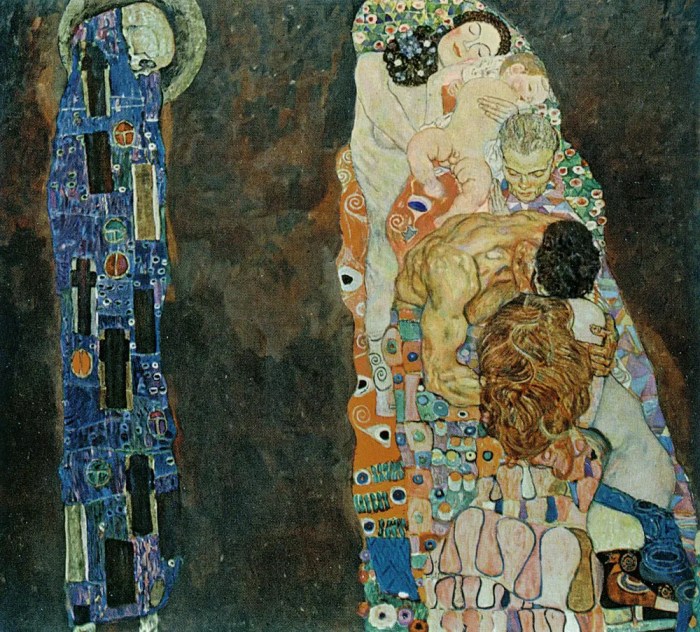
Klimt started sketching the composition in 1908 and finished the first oil version in 1911. In this original state, shown here in the top image of the collage and above this text, the background was a warm, textured, gold-colored surface instead of a solid dark color.
The figure of Death on the left was less prominent. It wore a blue robe decorated with small, multi-colored rectangles and had a light, halo-like crescent around its skull. The human group on the right was lighter and contained fewer figures, focusing mostly on the central man and woman.
This initial version was important for Klimt’s international reputation. He brought the painting to the 1911 International Art Exhibition in Rome, where it was displayed in the pavilion of the Austrian Secession. The artwork won first prize and a gold medal, securing Klimt’s standing as a leading figure in European modernism. Afterward, it was shown in major exhibitions in Dresden, Munich, and Budapest.
The Revisions and Final Version (1915–1916)
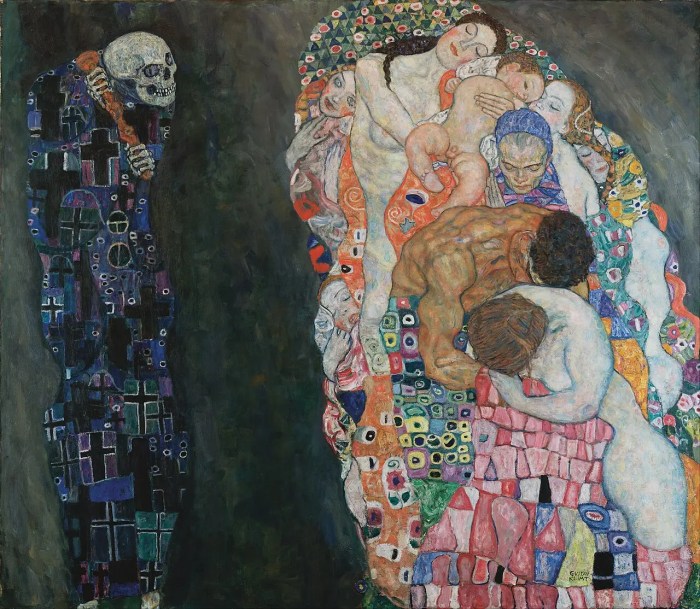
Despite its international success, Klimt remained dissatisfied with the painting after seeing it again at the 1913 Secession exhibition in Vienna. In 1915, after the artwork returned to his studio from its European tour, he began reworking it. A direct comparison between the 1911 version (top) and the 1916 final version (bottom) shows the exact changes he made:
- The Background: Klimt completely painted over the golden backdrop. He replaced it with a cold, dark greenish-gray matte surface. This created a sharper contrast between Death and the human group, removing the decorative warmth of his earlier style.
- The Figure of Death: He changed Death’s appearance significantly. He replaced the multi-colored rectangles with a dark blue robe covered in large black crosses and circles. The posture was sharpened, the skull became more defined, and the halo-like crescent was removed to give the figure a more menacing appearance.
- The Life Group: Klimt expanded the human cluster on the right. Influenced by the intense color contrasts of modern French art, he added several female faces, particularly in the upper right and middle left sections. He also added dense floral ornaments and bright, mosaic-like patterns to contrast against the new dark background.
Through these changes, Klimt transformed a work from his decorative period into a modern, high-contrast allegory. He completed the final version in 1916.

Leave a Reply