Vienna Secession: Koloman Moser
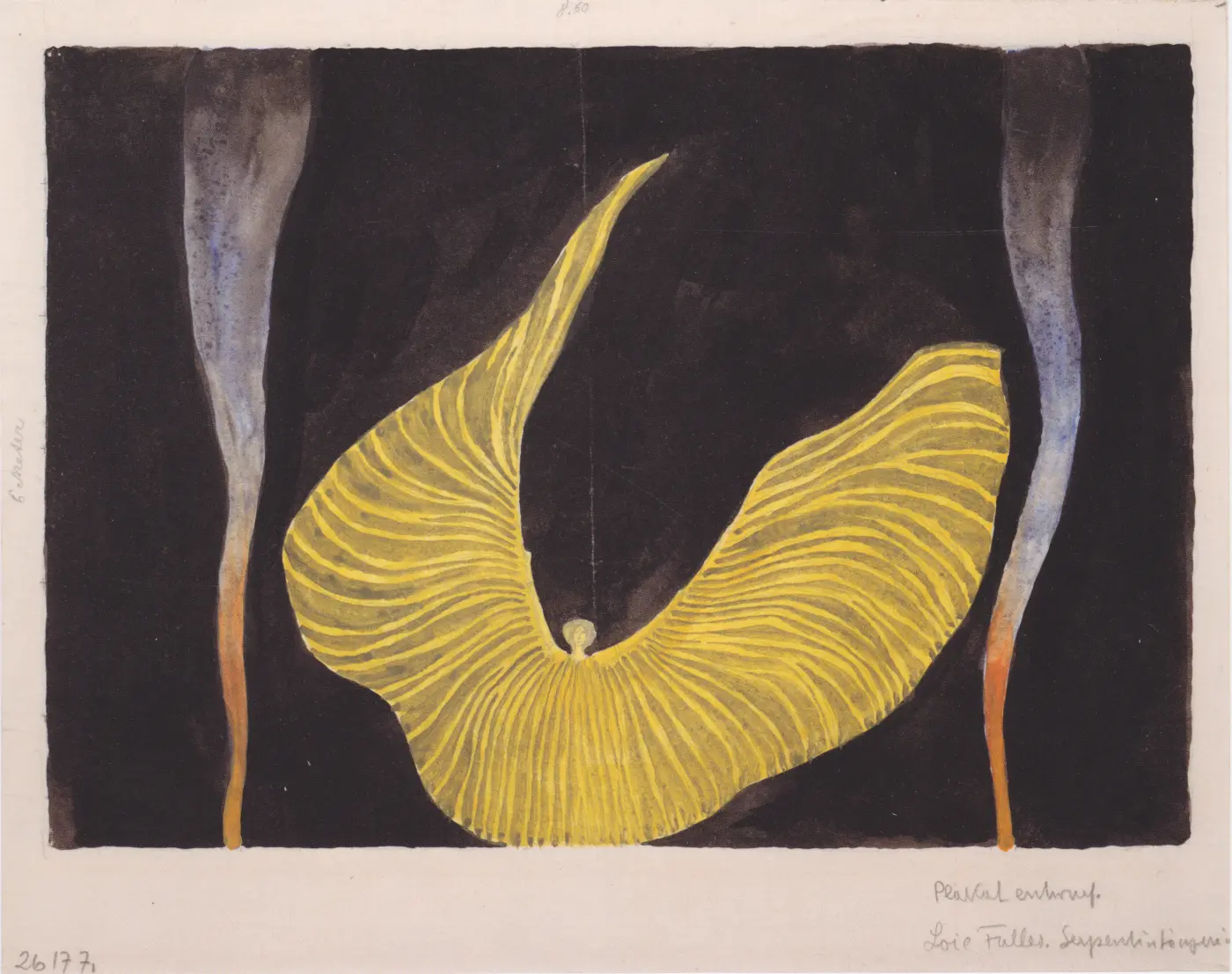
Loïe Fuller in the Serpentine Dance “The Archangel” (Loïe Fuller im Serpentinentanz “Der Erzengel”), c. 1902
Ink and watercolor on graph paper
18.2 x 22.9 cm
©Albertina Museum, Vienna (Acquired in 1931)
In February 1902, the Viennese avant-garde found a new obsession. The American pioneer of modern dance, Loïe Fuller, arrived in the city to perform at the Theater an der Wien alongside a visiting Japanese theater company led by Sada Yacco. Among the transfixed audience members was Koloman Moser, a co-founder of the Vienna Secession, who immediately set out to capture her performance on paper.
The Subject
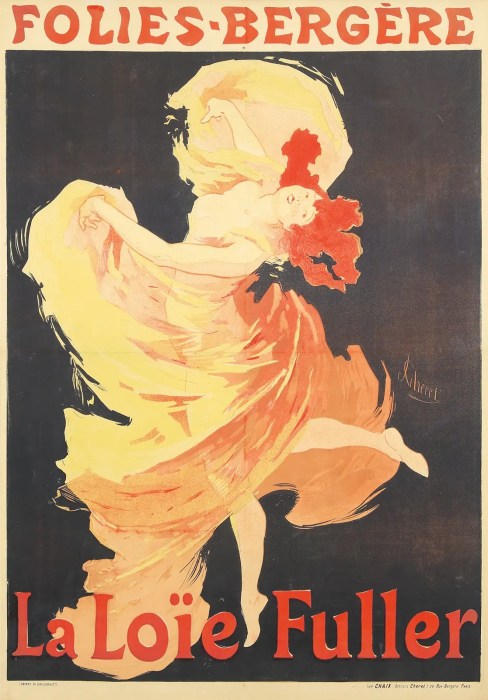
Loïe Fuller (1862-1928) was an American actress and dancer, a pioneer of both modern dance and theatrical lighting techniques. Alongside Isadora Duncan and Ruth St. Denis, she was one of the earliest founders of a new, expressive form of dance. She developed her own natural movement and improvisation techniques. In multiple shows, she experimented with a long skirt, choreographing its movements and playing with the ways it could reflect light. By 1891, Fuller combined her choreography with silk costumes illuminated by multi-coloured lighting of her own design and created the Serpentine Dance.

The Composition
While most painters and sculptors chose to depict Fuller in a chaotic blur of spinning fabrics, Moser took a highly structured approach. He captured her at the exact moment of her widest physical extension. Using long batons hidden inside her sleeves to extend her reach, Fuller opens her costume into a flat, butterfly-like silhouette. Standing out against a stark black background and flanked by stage torches, the yellow figure balances strict geometric order with the fluid texture of thousands of tiny fabric folds.
The Blueprint
The most telling detail of Moser’s artwork is the paper itself. He drew the composition on a grid pattern, scrawling specific dimensions directly onto the sheet, including “6 meters” and “8.60”. These grid lines indicate that this small sketch was never meant to be a standalone drawing or a simple poster design. It was a blueprint designed to be scaled up to a massive, monumental size—likely for a theatrical backdrop, a giant illuminated transparency, or a stage curtain. History does not record if the final, massive installation was ever realized.


Leave a Reply