Egon Schiele:
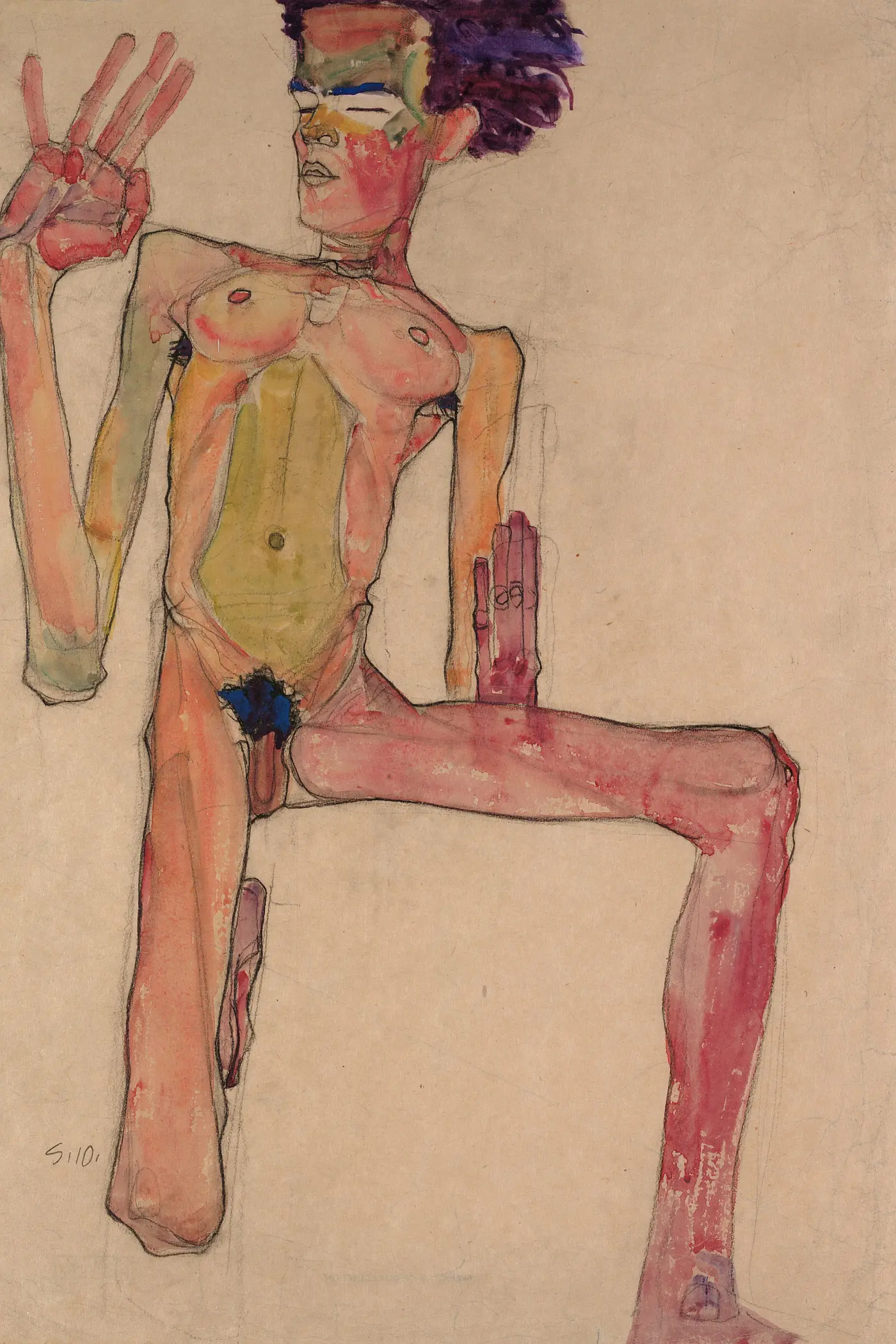
Self-Portrait as Kneeling Nude (Kniender Selbstakt), 1910
Black chalk and gouache on brown paper
63 × 45 cm
©Leopold Museum, Vienna, Inv. No. 1380
(Kallir d692)
The Break with the Academy
Created in 1910, this work marks the period when Schiele distanced himself from the traditional teachings of the Vienna Academy and the decorative style of Gustav Klimt. The drawing represents his transition toward Expressionism, using the human body to convey an intense psychological state.
The composition is defined by sharp, angular lines. Schiele depicts his own body with emaciated limbs, an omitted right foot, and prominent joints, altering anatomical proportions to increase the graphic tension. The figure is isolated against the unprimed brown paper base, which eliminates any spatial context or background narrative, focusing all attention directly on the subject.
Context of the 1910 Male Nudes
In 1910, the twenty-year-old Schiele began experimenting extensively with the male nude, creating a large series of drawings and a small group of life-sized oil paintings. This sudden focus was driven partly by the intellectual climate in Vienna, where contemporary psychoanalysis questioned traditional social and sexual norms.
While drawings like Kniender Selbstakt are confirmed self-portraits, recent research by scholar Jane Kallir has revealed that several other male nudes from this specific series — long categorized as self-portraits — actually depicted his friends. To protect their identities in the conservative Viennese society, Schiele masked their facial features or substituted his own likeness, making this entire body of work an exploration of male anatomy and identity rather than pure autobiography.
Color and Gesture
The application of white and tinted gouache creates a direct contrast with the dark chalk. This treatment outlines the skeletal structure and highlights the angular posture of the torso.
A central element is the detailed gesture of the hand with splayed fingers, a recurring motif in Schiele’s work from this year. The tousled hair and the tilt of the head reinforce the concentrated, introspective character of the sheet. The work remains one of the foundational examples of Schiele’s early anatomical studies and self-portraiture.
Leave a Reply