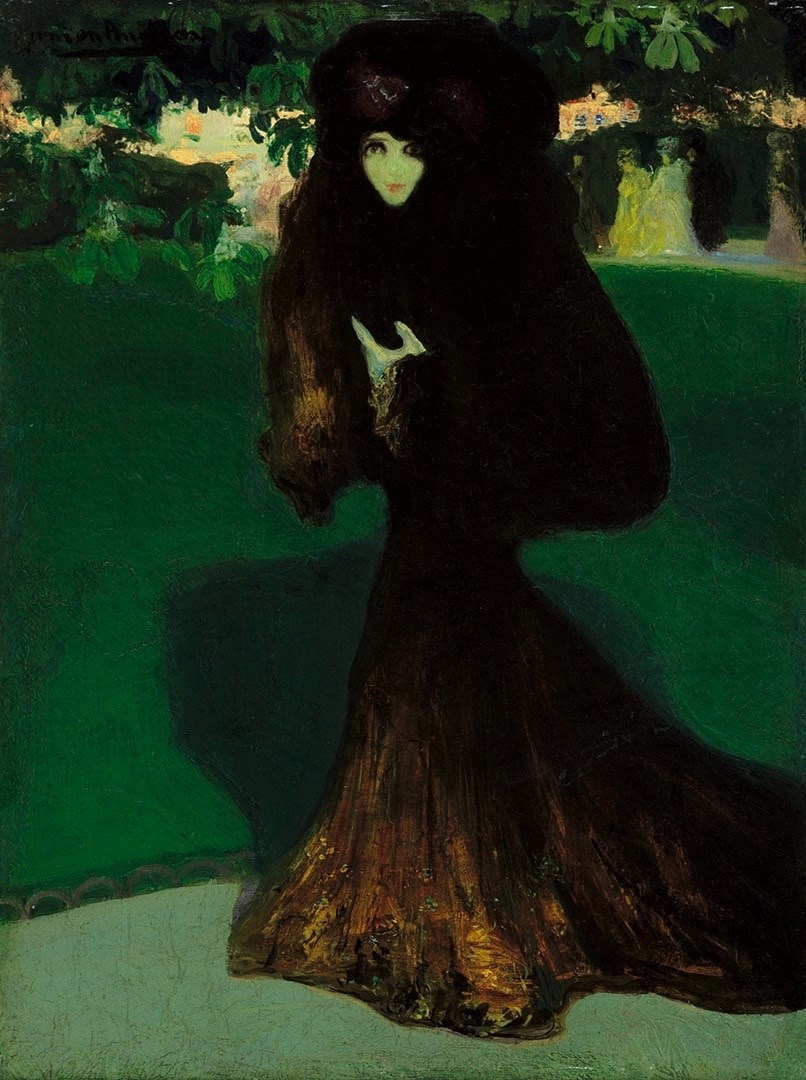
Catalan Modernisme: Hermenegildo Anglada-Camarasa
Woman in a Garden (Mujer en el Jardín, 1902)
Oil on wood
35 x 26.5 cm
©Colección de Arte ABANCA
While the focus on this site usually brings us to the coffeehouses of Vienna, the spirit of the Secession was a pan-European phenomenon. One of its most fascinating figures was the Catalan painter Hermenegildo Anglada-Camarasa (1871–1959). As a leading voice of Catalan Modernisme, his work from his Parisian period provides an unexpected bridge between Barcelona, France, and Austria.
For anyone drawn to the work of Gustav Klimt (and Egon Schiele), this specific small-scale panel offers an intriguing parallel in technique, atmosphere, and the psychological portrayal of women.
The Parallel Paths: Matisse, Paris, and a Shift in Style
In the early 1900s, Paris served as a shared source of inspiration for the European avant-garde. During his first major artistic phase, Anglada-Camarasa immersed himself in the French art scene. Looking closely at Woman in a Garden, one can trace a bold energy that shares roots with Henri Matisse and the emerging Fauves. The expressive use of color and texturized paint application marked a clear departure from academic realism.
This French connection creates a compelling parallel with Gustav Klimt. Just as Anglada-Camarasa absorbed these Parisian developments, Klimt himself traveled to Paris in 1910. Encountering the works of Matisse and the Fauves had a significant impact on the Austrian master’s trajectory. It pushed him away from the rigid ornamentation of his iconic ‘Golden Phase’ toward a more painterly, fluid, and color-saturated style in his later years. Both artists looked to France to liberate their palettes from traditional constraints.
Deep Dive: Analyzing the Artwork
Despite its intimate dimensions of just 35 x 26.5 cm, the panel establishes a clear psychological atmosphere through a deliberate composition. In the foreground stands a pale figure wrapped in heavy, dark garments, physically separated from the world behind her. In the background, a sun-drenched green space is filled with secondary figures strolling in light dresses. This sharp division reflects the Decadent movement of the era, which often contrasted individual melancholy with the bright elements of nature.
Anglada-Camarasa applied the oil with a rich, fluid density that creates surface effects resembling glazed ceramics. This gives the small wooden support a textured quality that recalls Gustav Klimt’s mosaic surfaces. The subject’s intense gaze, emphasized by dark made-up eyes and lips, reflects the bohemian nightlife of the era. Working within the Fin de Siècle tradition, the artist stepped away from traditional, innocent representations of women in nature. Instead, he used color to capture psychological depth, exploring the same themes of identity, tension, and vulnerability that Klimt and Egon Schiele were investigating in Vienna.
Captivating the Vienna Secession (1904)
Anglada-Camarasa’s blend of vibrant color and Catalan mysticism quickly caught the attention of the Austrian avant-garde. While his early Parisian canvases initially bewildered conservative art critics back home in Catalonia, they found a receptive audience in Central Europe.
His transition into his “second stage” (roughly 1904–1914) saw him integrate folklore, traditional textiles, and highly decorative visual structures. This stylized approach resonated with Austrian artists. In 1904, his work was accepted and exhibited at the Vienna Secession. For the Viennese public, these canvases aligned with the Gesamtkunstwerk (total work of art) philosophy championed by Klimt’s circle. Towards the end of his life, Anglada-Camarasa returned to his birthplace, moving to Mallorca in 1948, where he continued to paint color-saturated landscapes until his death in 1959.

Leave a Reply