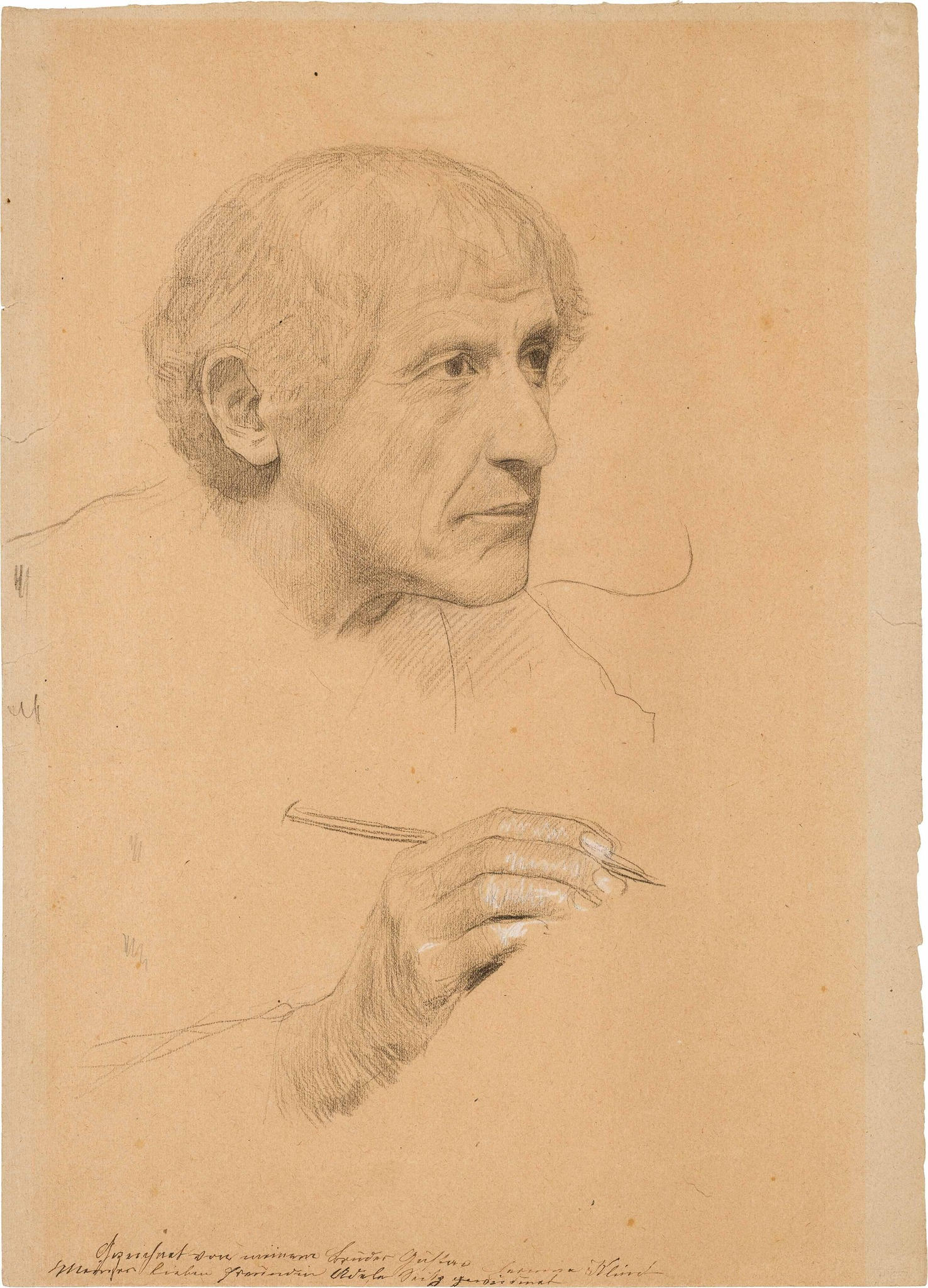
Gustav Klimt:
Bust Portrait of a drawing Man in three-quarter Profile from the Right (Brustbild eines zeichnenden Mannes im Dreiviertelprofil von rechts), 1879
black chalk, heightened with white on paper
Auctioned at im Kinsky in 2024 for € 22,000 (€ 28,000 incl. premium)
(Strobl s31)
This early portrait by Gustav Klimt sits firmly within the academic discipline that shaped his formative years. In 1879, Klimt was in his third year at the Kunstgewerbeschule, where he studied from 1876 to 1880. His training was conventional, focused on drawing from plaster casts, anatomy, ornament, and applied arts. Klimt himself later described this period in a multi‑page autobiographical text written in 1893, noting the four-year course and the strict academic framework that shaped his early development. He would only begin his professional career several years later, around 1881–82, working with his brother Ernst and Franz Matsch in what became the Künstler‑Compagnie.
The man in three‑quarter profile is simply a quiet subject rendered with precision. Klimt uses black chalk and subtle white heightening to build the volume of the head and shoulders, keeping the contrasts soft and the modelling restrained. The drawing is an exercise in tonal control and anatomical clarity.
The sheet was made for his sister Hermine, possibly intended for her friend Adele Seitz. That context reinforces how early this moment is: Klimt drawing for people close to him, not yet for patrons, institutions, or a public audience. His hand is cautious, the lines clean but never forceful, the shading gentle, and the whole composition remains close to the academic expectations of the time. It is a glimpse into Klimt’s development before he became Klimt — a study from the years when he was still becoming.

Leave a Reply