Egon Schiele
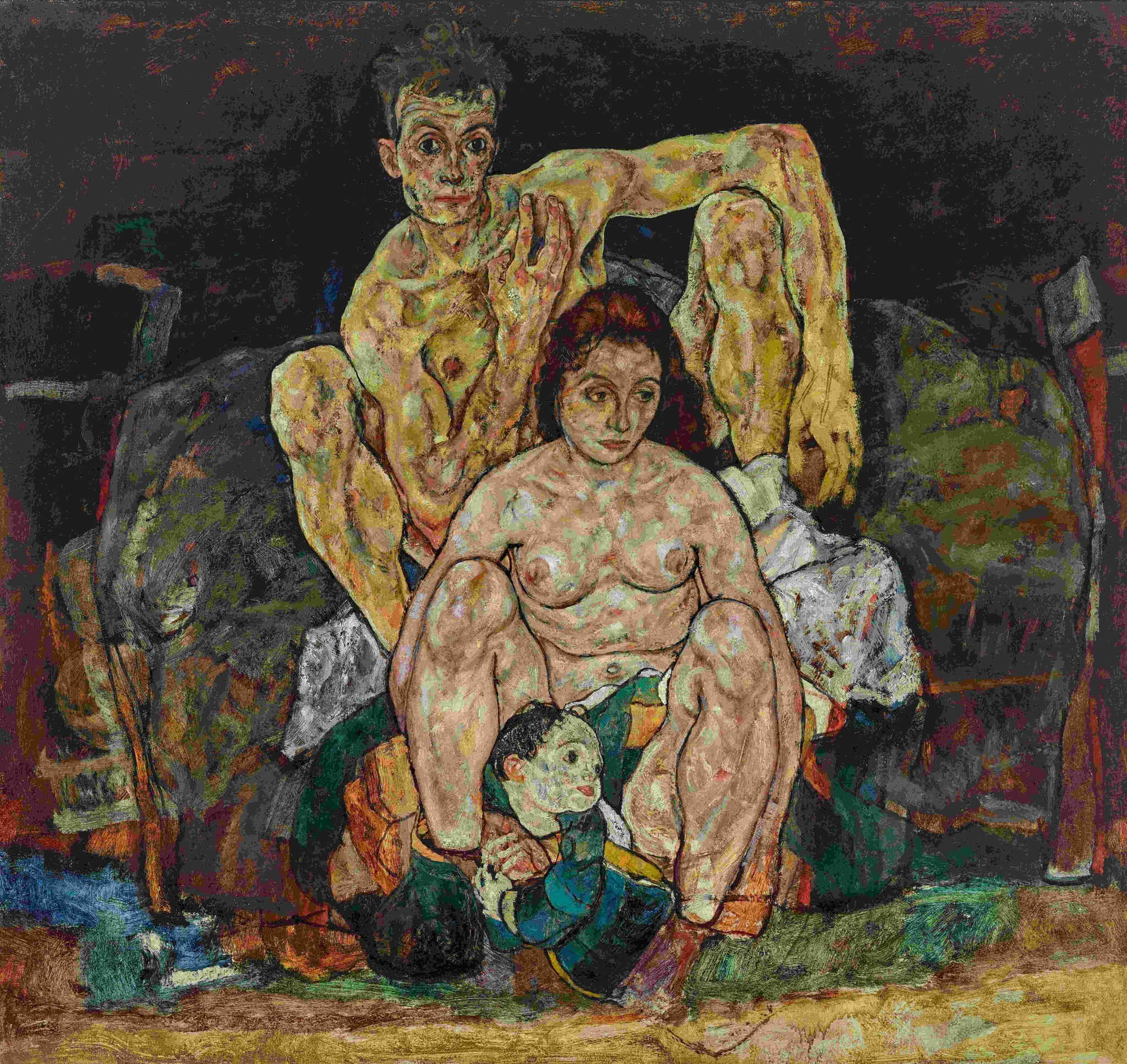
The Family (Die Familie) / Squatting Couple (Kauerndes Menschenpaar) (1918)
Oil on canvas
152.5 x 162.5 cm
© Belvedere, Vienna
(Kallir P326)
We tend to read Egon Schiele’s final major canvas as a tragic psychic prophecy, but the cold timeline of the object tells a much less sentimental story. The common biographical narrative surrounding this work clings to a tidy romantic drama: the artist painting his impending fatherhood, capturing his unborn child and his pregnant wife Edith right before the Spanish flu wiped out the entire household in October 1918. It is a comforting, heartbreaking package that has been repeated in art historical circles for over a century. The actual data compiled by scholars like Jane Kallir, however, strips away this posthumous myth-making and grounds the work in a much larger, darker architectural concept.
Schiele did not sit down in 1918 to paint a prophetic family portrait; the physical canvas was begun in 1917, months before Edith conceived in the spring of the following year. Furthermore, the female figure is explicitly not his wife. Schiele utilized a model whose physical features carry a deliberate pictorial code linking her to earlier, separate subjects rather than a direct autobiographical record. Even the child between her legs has been the source of domestic rumor, with claims that a bouquet of flowers originally occupied that space and was only later replaced by the infant. Modern X-rays have completely debunked this story, revealing absolutely no such alterations beneath the pigment. The child was part of the plan from the beginning, but not as an announcement of Schiele’s own fatherhood.
The real friction of the work emerges when you look past the family diary narrative and examine the structural group to which this canvas belonged. The alternate title, Squatting Couple, connects this piece directly to a series of other 1918 nudes, including Squatting Women and Two Squatting Men. Evidence suggests these massive canvases were never intended to be viewed as individual, domestic snapshots hanging in a standard gallery. They were designed to function as a unified group inside a massive, planned mausoleum project. This specific canvas was intended for the outer promenade of that monument—a space dedicated to confronting the raw, unprotected reality of earthly existence.
When the layers of historical sentimentality are removed, the psychological weight of the canvas changes entirely. You are no longer looking at a protective family unit, but at three naked human bodies crouching in the dark corner of a studio setting. Unlike Schiele’s other late nudes that float in empty, neutral voids, these figures are heavily anchored to a real, tight floor, yet they remain profoundly isolated from one another. Their physical proximity is undeniable, but their gazes never meet. The man sits alert, staring out with Schiele’s own sharp facial features, while the woman stares downward into her own thoughts. By relying on the facts of the canvas rather than the romance of the tragedy, the painting ceases to be a sad biographical note. It becomes exactly what Schiele intended before his sudden death cut the project short: a raw, monumental, and uncomfortable testament to human isolation within a fragile existence.
Leave a Reply