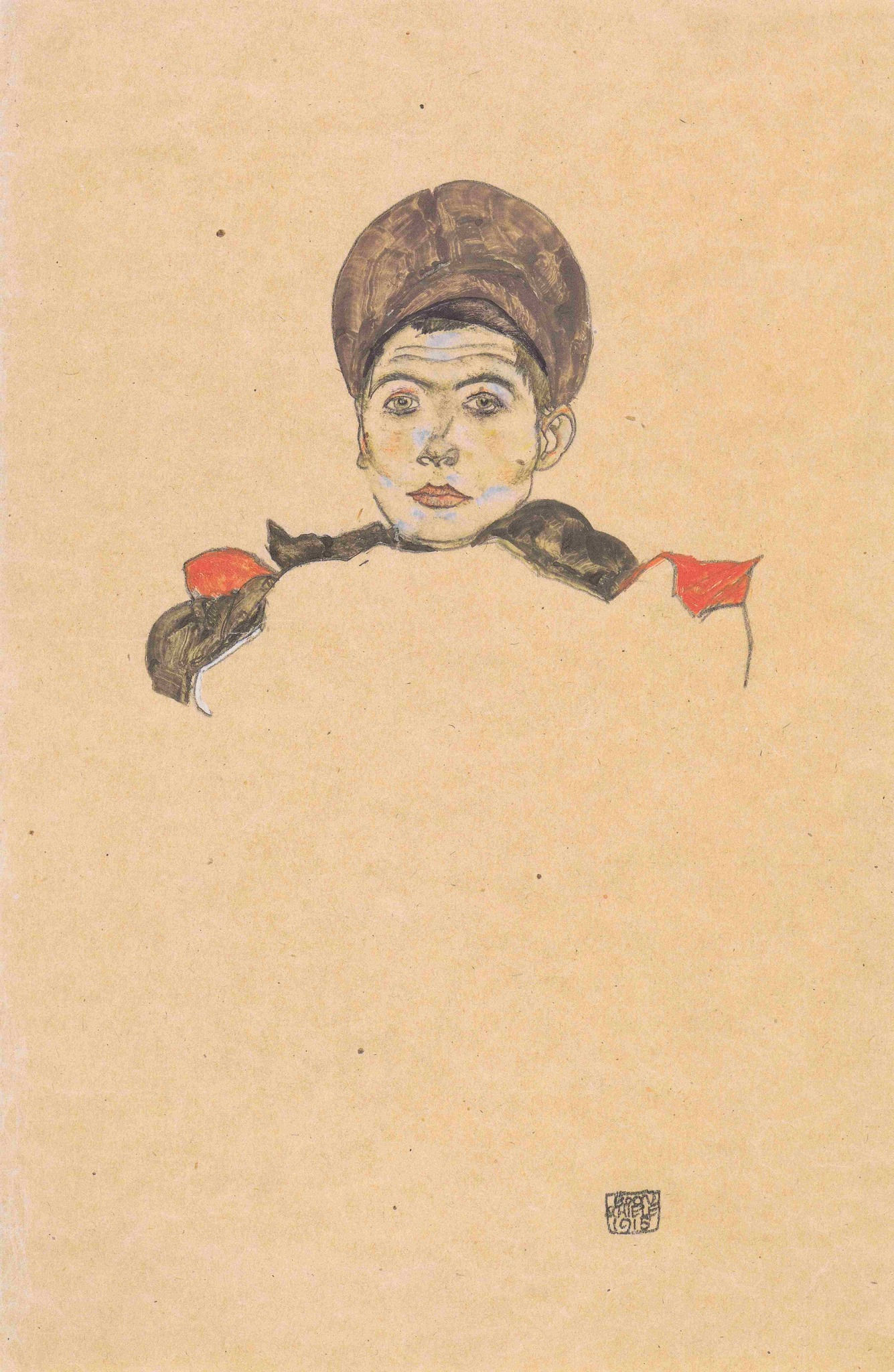
Egon Schiele
Portrait of a Russian Soldier (Russischer Kriegsgefangener), 1915
Gouache and black crayon
44.8 × 29.5 cm
© Staatliche Graphische Sammlung Munich
(Kallir d1773)
War rots a man. It strips your identity and shoves you into a uniform that doesn’t fit, locking you into a rhythm that isn’t yours. In 1915, Egon Schiele’s world froze over. No more Viennese salons, no more provocative nudes to shock the bourgeoisie. Instead: the claustrophobic reality of military service and prisoner-of-war camps. Schiele is suddenly a conscripted clerk and a guard. On the other side of the desk: Russian prisoners of war. Men dragged thousands of miles from home just to wait. And then there is this sheet of paper: Portrait of a Russian Soldier.
Look at the paper. Normally, Schiele hacks his figures into the canvas. His lines are nervous, aggressive, trembling with a frantic sexual or destructive energy. But here? The friction lies in the absolute, almost painful restraint. Schiele forces his restless impulses into a quiet, deliberate focus. The black crayon is tight, disciplined, and calm. The soldier’s massive outline dominates the sheet, locked down by a line that feels less like an artistic choice and more like a physical confinement. There is an unsettling power imbalance built into this line; Schiele used his position of authority to make this exhausted man stand still. This is a fellow casualty trapped in World War I, but seen through the eyes of his guard.
The gouache Schiele applies to the face has a muted, chalky presence. It carries the tone of a man surviving on stale rations, worn down by the long uncertainty of captivity.The soldier sits upright—military discipline forces his spine straight—but his shoulders carry the leaden weight of captivity. The heavy creases in his coat aren’t heroic drapes; they are the physical wrinkles of endless, crushing routine.
There is a suffocating intimacy in this drawing. You can practically hear the silence in that camp room. Two men who would never have crossed paths in a normal world are now locked close together. The soldier stares past Schiele, looking out into a foggy, endless uncertainty. Schiele observes with a precision that becomes almost uncomfortable. He asks that you look at this anonymous individual without turning away, offering no narrative comfort. This is Schiele at his sharpest: when the boundary between artist and captor is blurred.

Leave a Reply