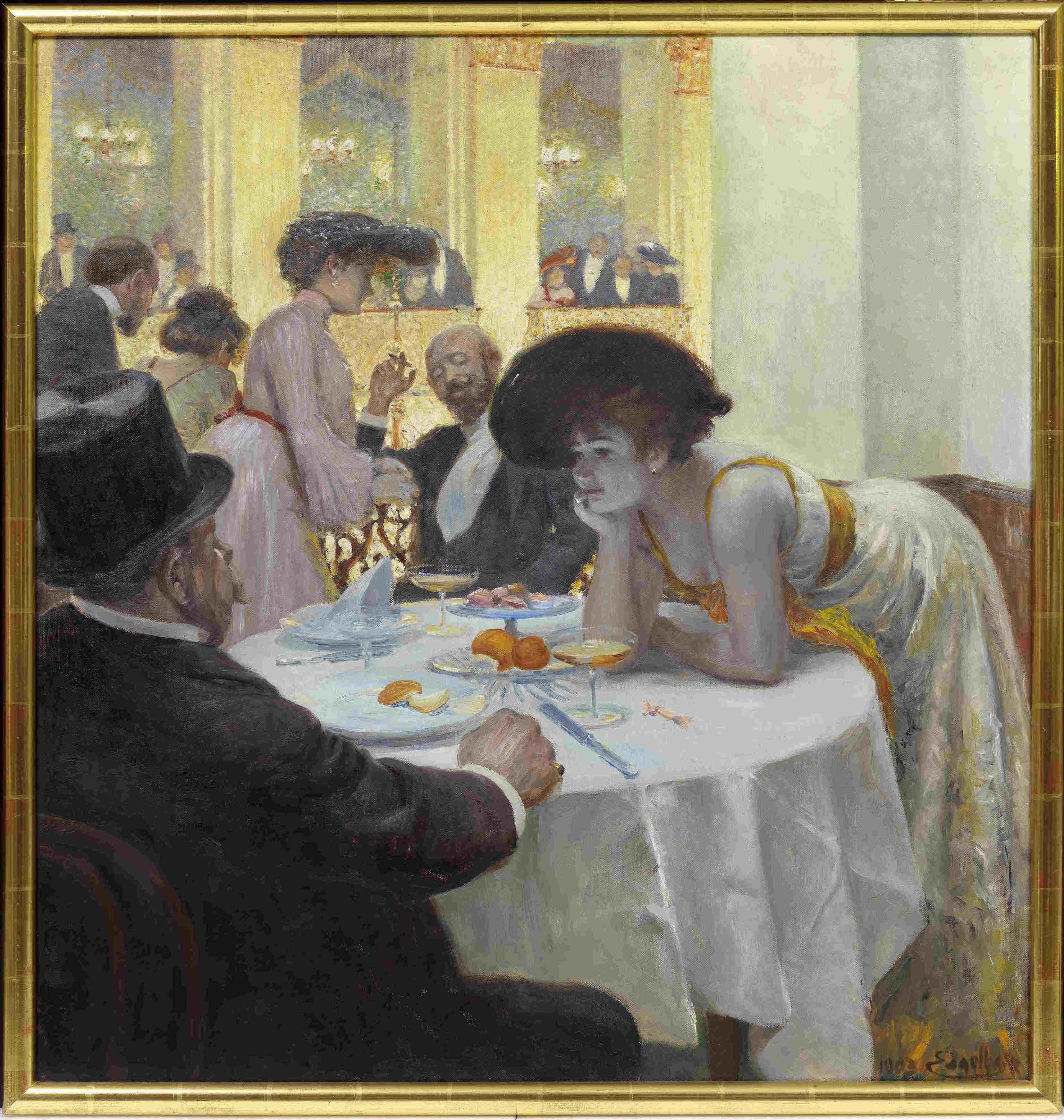
Vienna Secession: Josef Engelhart
Loge in the Sofiensaal (Loge im Sofiensaal), 1903
Oil on canvas
100 × 95 cm (39.3 × 37.4 in.)
©Wien Museum, Vienna
In Loge in the Sofiensaal, Engelhart captures a typical Viennese evening, showing a moment where social elegance and private attention meet. The woman in the yellow dress leans forward across a white-clothed table filled with fruit and wine, while the man in the foreground sits back, watching her intently. Around them, the Sofiensaal is filled with movement—guests passing by, waiters moving through conversations, and the light of chandeliers reflecting across mirrors and glass.
The Sofiensaal, located in Vienna’s third district (Landstraße), was a famous 19th-century concert and ball venue that still exists today as a restored event location. While it attracted a wealthy audience, it also held a more complex social reality. During events, high-class courtesans and prostitutes often mingled discreetly among the guests, creating an underlying tension between upper-class decorum and the reality of the Viennese night. Engelhart does not state this directly. Instead, he chooses a close, snapshot-like perspective, capturing the subtle contrast between social poise and what happened behind the scenes.
His use of warm tones and soft contrasts gives the painting an inviting glow. The diagonal line between the woman leaning in and the man leaning back creates a natural rhythm that guides the eye through the room. It is a brief, carefully observed moment that shows how well Engelhart understood the gestures and moods of Viennese life around 1900.
This focus on modern life also defined Engelhart’s leading role in the avant-garde. In 1897, he co-founded the Vienna Secession alongside prominent figures like Gustav Klimt, Koloman Moser, and Carl Moll. Engelhart put much of his own artistic work aside during those early years, dedicating his energy entirely to the organization and economic development of the new association. Using his international connections, he traveled across Europe to recruit renowned foreign artists, opening up Vienna’s art scene to international influences.
His leadership within the group was established early on, when he took over the presidency of the Secession from Gustav Klimt from the spring of 1899 until April 1900. When ideological rifts deeply split the movement in 1905, Klimt and his closer artistic circle broke away. Engelhart remained to lead the remaining group of artists, who held more conservative, naturalist views. Although the more radical Klimt group ultimately captured the mainstream art world’s attention, recent re-examinations of Engelhart’s work reveal just how sensitively and accurately he recorded both the visual and social layers of fin-de-siècle Vienna.
Leave a Reply