Egon Schiele:
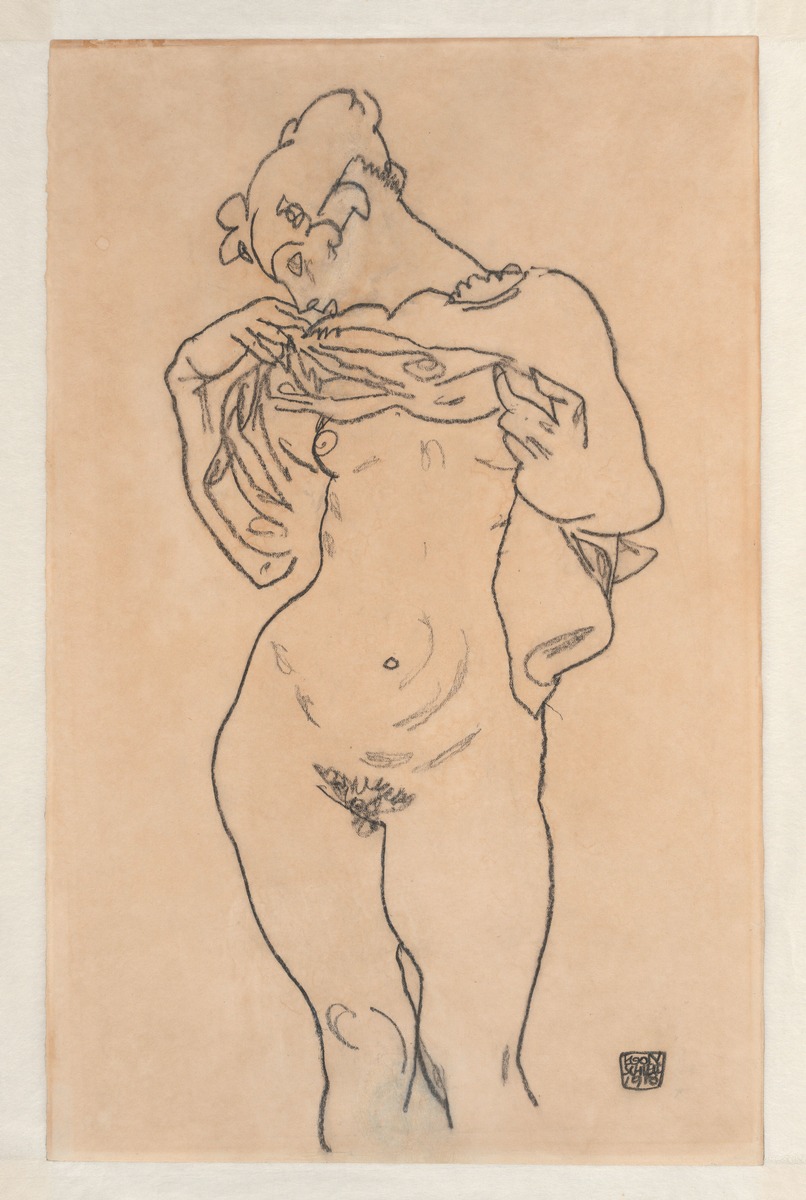
Standing Female Nude (Stehender weiblicher Akt), 1918
black chalk on paper
47.1 × 29.9 cm
©Akademie der bildenden Künste, Wien
(Kallir d2366)
Anyone who loves Schiele will immediately spot how different this 1918 work feels from his earlier, raw outbursts. Created in the final months before his sudden death at twenty-eight, this drawing captures a fascinating stylistic pivot. The jagged, restless lines and hyper-nervous energy from 1910 have largely settled. Here, Schiele operates with a much broader, continuous sweep of black chalk. He starts carving real physical volume out of the blank page, giving the female form a heavy, three-dimensional presence that feels almost sculptural rather than flat and emaciated.
This newfound calm on paper mirrored a major grounding period in his personal life. His marriage to Edith Harms brought a steady domestic routine that softened the sheer desperation of his earlier, destitute years. Meanwhile, the death of his mentor Gustav Klimt in February 1918 left a void that the Viennese avant-garde expected Schiele to fill. His massive commercial and critical triumph at the Secession exhibition that March transformed him into a celebrated figure. This institutional respect fueled his ambition to look past his own inner neuroses and explore a more universal, structured approach to anatomy, letting his lines flow with deliberate control.
The year 1918 also saw an immense explosion in the sheer number of nudes Schiele drew, driven by a very practical reality: he needed to keep bread on the table. Even with his rising fame, wartime Vienna was facing brutal inflation and severe material shortages. Quick works on paper were far more viable than slow oil paintings, and more importantly, they were highly lucrative. A private network of bourgeois Viennese collectors eagerly snapped up these intimate sheets. Schiele was fully aware of this demand, turning his studio into a highly productive space to generate the steady cash required to maintain his new middle-class lifestyle.
Yet, this high output wasn’t just a financial strategy; it served a deep creative purpose. Schiele was planning a massive, ultimate cycle of monumental paintings focused on the grand themes of earthly existence. He used these countless daily life studies as a laboratory, testing a standardized vocabulary of poses—standing, bending, crouching—to see how raw anatomy alone could carry the weight of human connection without any narrative distractions.
Despite the commercial focus and stylistic evolution, Schiele never sanitizes his subject. The model stands entirely exposed, stripped of any comforting domestic context or idealized grace. That blunt directness brings its own quiet, lingering discomfort. The tension hasn’t been erased; it has simply migrated beneath the skin. By abandoning his usual watercolor washes and relying strictly on black chalk on plain paper, he forces an incredibly honest, unvarnished confrontation with the body.
It is this exact intersection of financial necessity, artistic ambition, and technical mastery that makes his 1918 drawings so captivating. They capture an artist outgrowing youthful shock value to claim a grounded, mature command of his medium, without ever sacrificing the raw psychological truth that made him vital. This specific sheet, which moved from the Neue Galerie to the Akademie in 1948, remains a powerful glimpse of the trajectory Schiele was charting just before the Spanish flu cut his journey short.
Leave a Reply