The Danish Connection: Gerda Wegener
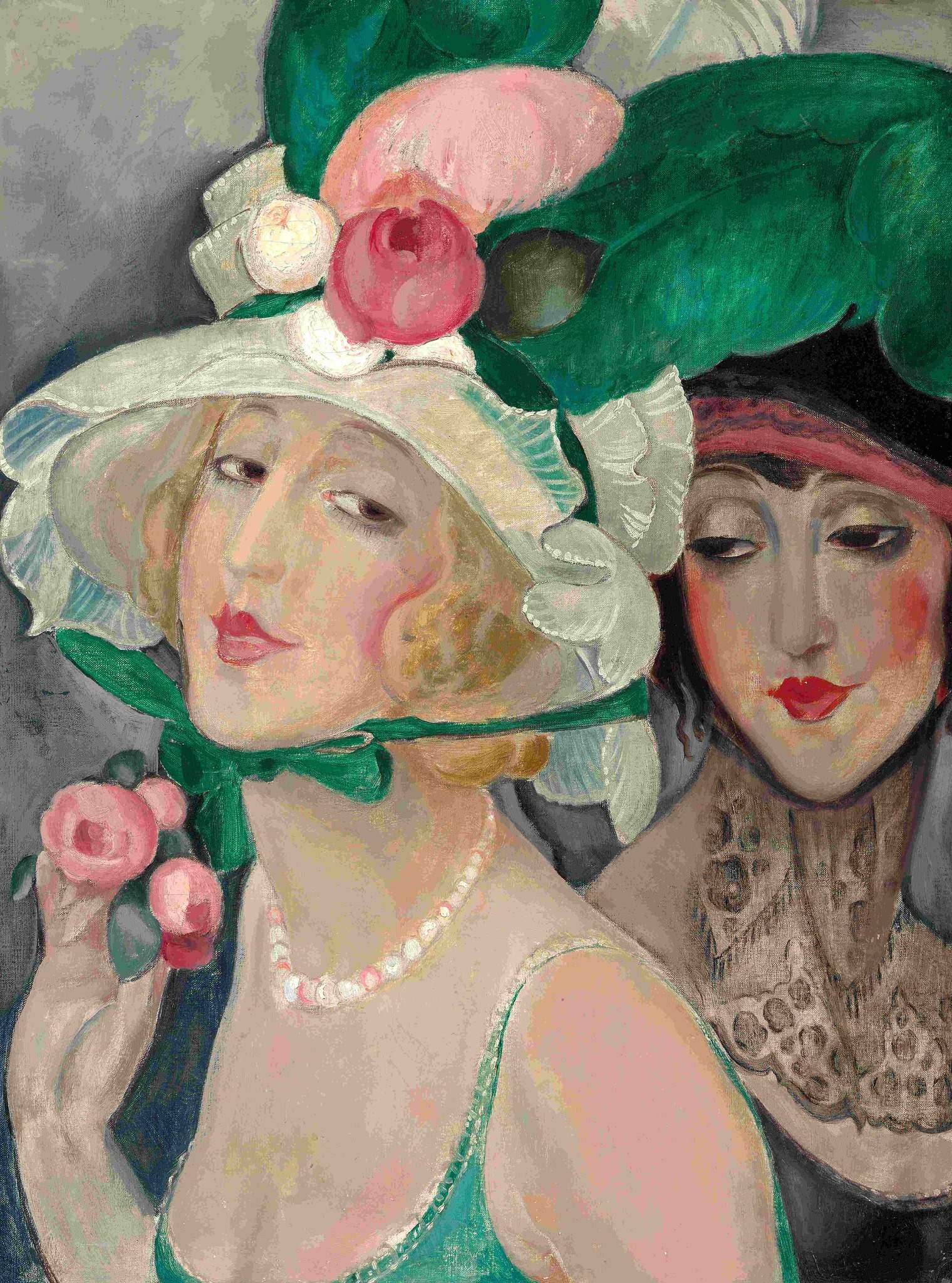
Cocottes with hats (Lili and friend), c. 1920
Oil on canvas
62 × 46 cm
Auctioned at Bruun Rasmussen on September 20, 2023, for approx. €64,320
Gerda Wegener paints these two women with the quiet confidence that defined her Paris years, giving them an elegance that feels both staged and intimate. The blonde figure—almost certainly Lili, wearing a wig softened with flowers and a small spray of feathers—meets our gaze with a calm, practiced allure. Her eyes are half‑lidded, shaped with care rather than drama, as if she is letting us into a private moment without breaking the spell. The rose she holds becomes a gentle point of attention, something fragrant and lightly offered, drawing the other woman toward her.
What makes this composition particularly intriguing is the unspoken dynamic between the two figures. While Lili looks directly at the viewer, her companion remains turned inward, creating a tension between public performance and private connection. Wegener subtlely leaves it to the viewer to decide whether we are witnessing a chance encounter in a Parisian café or a carefully orchestrated moment of theatrical play.
Wegener’s life and work moved between Copenhagen and Paris, but it was in Paris that her style found its fullest voice. She had married Einar Wegener in 1904, long before Einar became Lili Elbe, and their partnership—personal, artistic, and deeply intertwined—left a clear imprint on her art. In the early years she showed regularly at Charlottenborg, but Paris embraced her most readily. Her illustrations appeared in Vogue, La Vie Parisienne, and the major newspapers, where her line became synonymous with elegance and modernity. Alongside this public success, she produced a more erotic body of work, signed with a small eye mask to keep it separate from her mainstream commissions. Paris admired this boldness; Denmark, more cautious, did not.
Her paintings from this period carry the clarity and decorative rhythm of Art Deco without losing their warmth. She returned often to images of women—self‑possessed, stylish, and aware of their own presence. Lili appears frequently, not as a conventional muse but as someone Wegener understood with unusual closeness. That intimacy shows here: two women leaning toward one another, their expressions shaped by curiosity and quiet pleasure. Wegener captures them with affection and precision, offering a glimpse of a world where femininity is lived from within.
Take a closer look at the brushwork and the expressions. What kind of conversation do you think is unfolding between these two women?

Leave a Reply