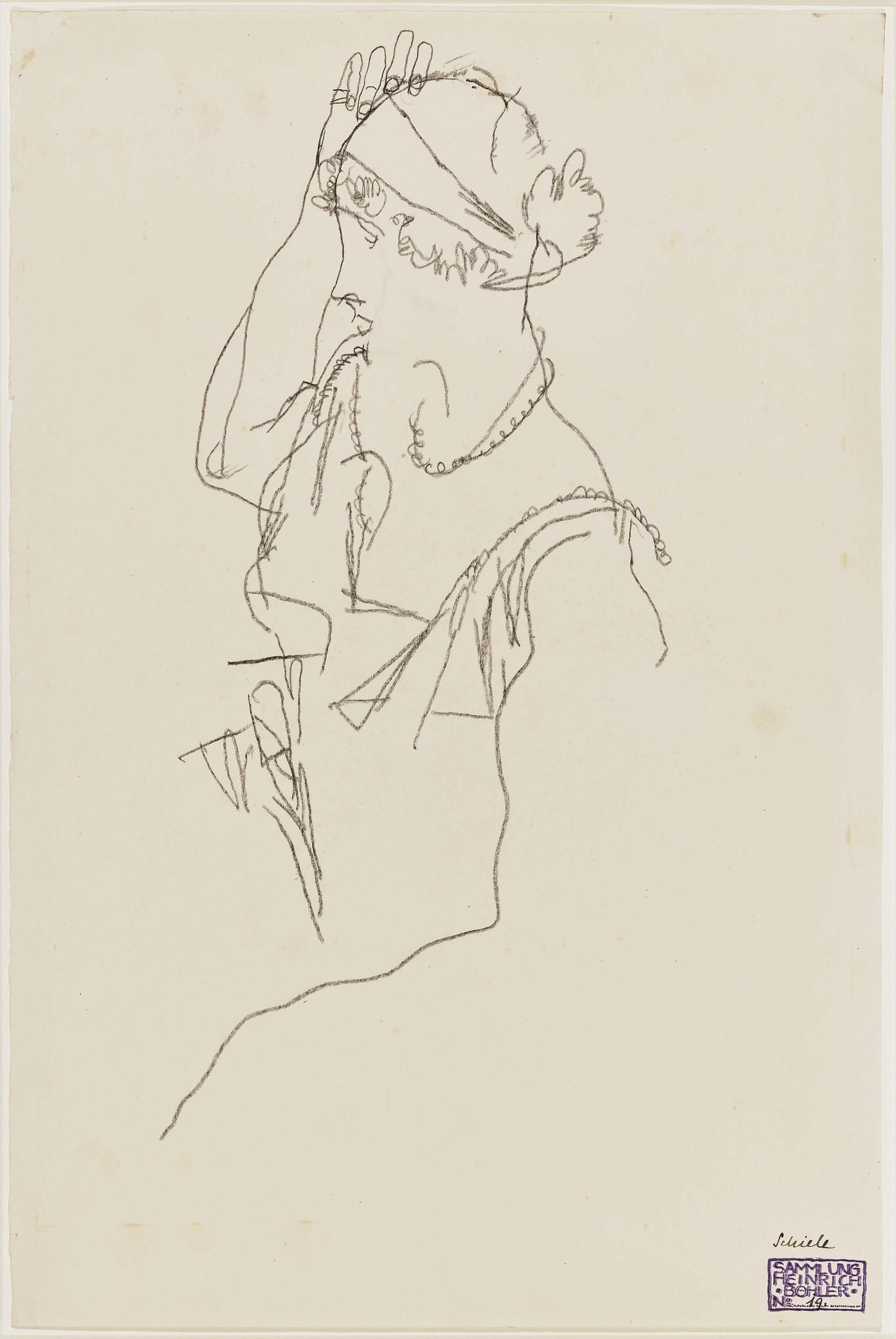
Egon Schiele
Seated Woman (Sitzende Frau), 1914
Pencil on paper
48.2 × 32 cm
Auctioned at Im Kinksy in 2017 for € 128,000
(Kallir d1518a)
This sketch highlights a striking lean toward minimalism that contrasts with more complex works from the same period. Relying on just a few continuous, elegant pencil contours, the artist gives the subject an airy, almost weightless quality. The simple addition of a hand resting against the temple introduces a quiet, unscripted gesture that feels entirely private. Rather than injecting drama, this movement deepens the figure’s inner world while keeping the overall calm intact. Minimal details like the necklace and headscarf follow this same rhythmic understatement, never demanding attention as mere ornaments. The final composition feels both deliberate and spontaneous, proving an absolute trust in the emotional power of a solitary line.
The piece marks a deeply reflective phase in the painter’s journey. This was a direct reflection of 1914 acting as a massive turning point. Historically, the outbreak of the First World War caused a pivot from raw adolescent tension toward a more mature, structured realism. The artist’s personal life was equally turbulent: this was the year he met his future wife, Edith Harms, and watched his sister and longtime muse, Gerti, marry their mutual friend Anton Peschka.
Amidst these times of upheaval, a vital sense of stability arrived through Heinrich Böhler, who entered the inner circle during this exact year. As an artist, photographer, and heir to a prominent Austrian steel fortune, Böhler was much more than a traditional patron. He employed the painter for drawing lessons, granted a steady monthly stipend throughout the war years, and even accompanied him on landscape painting trips to Krumau. Over time, Böhler curated a vast private collection that included several oil paintings and roughly fifty drawings. A quiet, contemplative aesthetic connects many of the works he acquired, and Sitzende Frau represents the peak of that taste—a modest, deeply focused drawing that finds its stillness entirely from within.
Leave a Reply