Vienna Secession: Hugo Henneberg:
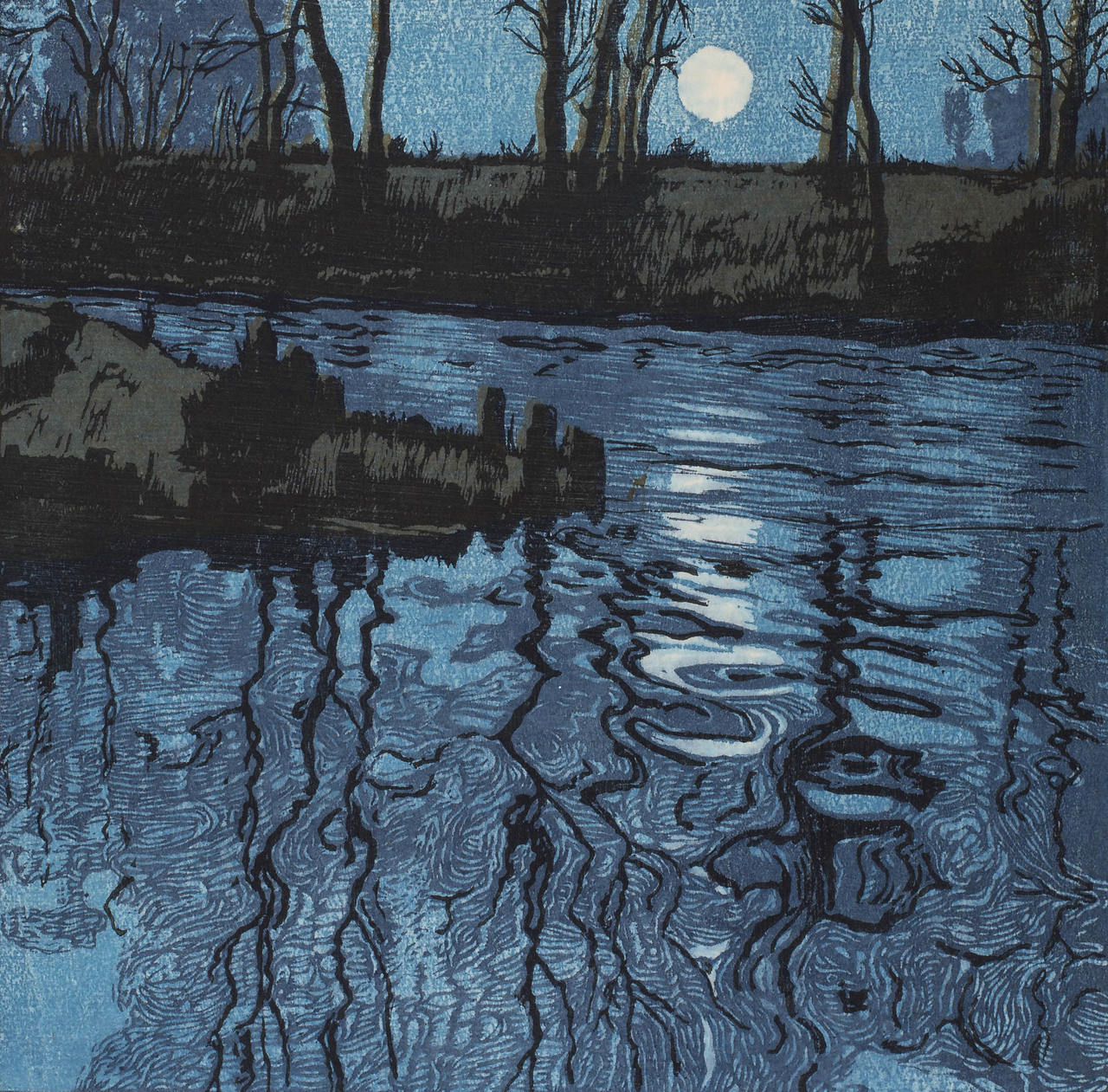
The Blue Pond (Der blaue Weiher), 1904
Linoleum cut from four plates (blue, purple, black, brown) on Japanese paper
29.4 × 29.8 cm
Private collection
A quiet pond lies under a full moon, its surface broken into long, swirling reflections that seem to move even in stillness. The bare trees on the far bank stand like dark shapes against the deep blue of the night, and the water carries the moonlight in soft, rippling bands. Henneberg lets the scene unfold slowly, with each plate adding its own tone: the cool blue of the sky, the purple shadows along the bank, the brown warmth of the earth, and the black that holds everything together. The print has the calm of a moment observed with care, yet the water’s movement gives it a gentle pulse, as if the night itself were breathing.
Hugo Henneberg (1863-1918) belonged to that small group of Secession‑era photographers — Heinrich Kühn and Hans Watzek among them — who believed that photography could be as atmospheric and expressive as painting. Their work shaped Viennese Pictorialism, with its soft transitions, careful compositions, and deep interest in mood. But Henneberg did not stay within one medium. Around 1904, when he made this print, linoleum was still a simple industrial material, used mainly for cutting wallpaper patterns. It had not yet found a place in fine‑art printmaking, and his choice to carve four colour plates from such an ordinary substance shows how open he was to trying new things. Whether the idea came from Japanese prints, from Secession design, or simply from his own curiosity, the result feels fresh and direct: a modern material turned into something quiet and poetic.
The linocut revival of this period, shaped by Japanese influence and by the Secession’s wish for clarity and flatness, gave artists a way to combine simple forms with rich colour. Henneberg used it with unusual sensitivity, building up a scene that feels both graphic and atmospheric, both shaped and gently observed. In The Blue Pond, this new medium deepens his relationship to landscape. The print holds the same stillness found in his photographs, but the carved lines give the water a rhythm that photography could not provide. The moonlit surface becomes almost musical, a pattern of curves and reflections that guide the eye across the sheet. The Japanese paper softens the colours, letting them settle into one another with a quiet glow. Henneberg’s belief in the unity of the arts — a central Secession idea — is present throughout: the print feels balanced and carefully made, yet it keeps the intimacy of a real place seen at night.
Although Henneberg’s photographs have long been recognised, his colour linocuts have only recently begun to receive the attention they deserve. They sit between photography, printmaking, and the Secession’s decorative vision, and they show how deeply he understood the emotional possibilities of light and shadow. In this moonlit pond, with its slow reflections and its gentle balance of colour, Henneberg captures a moment that feels both calm and alive — a small, glowing piece of the night, held quietly on paper.


Leave a Reply