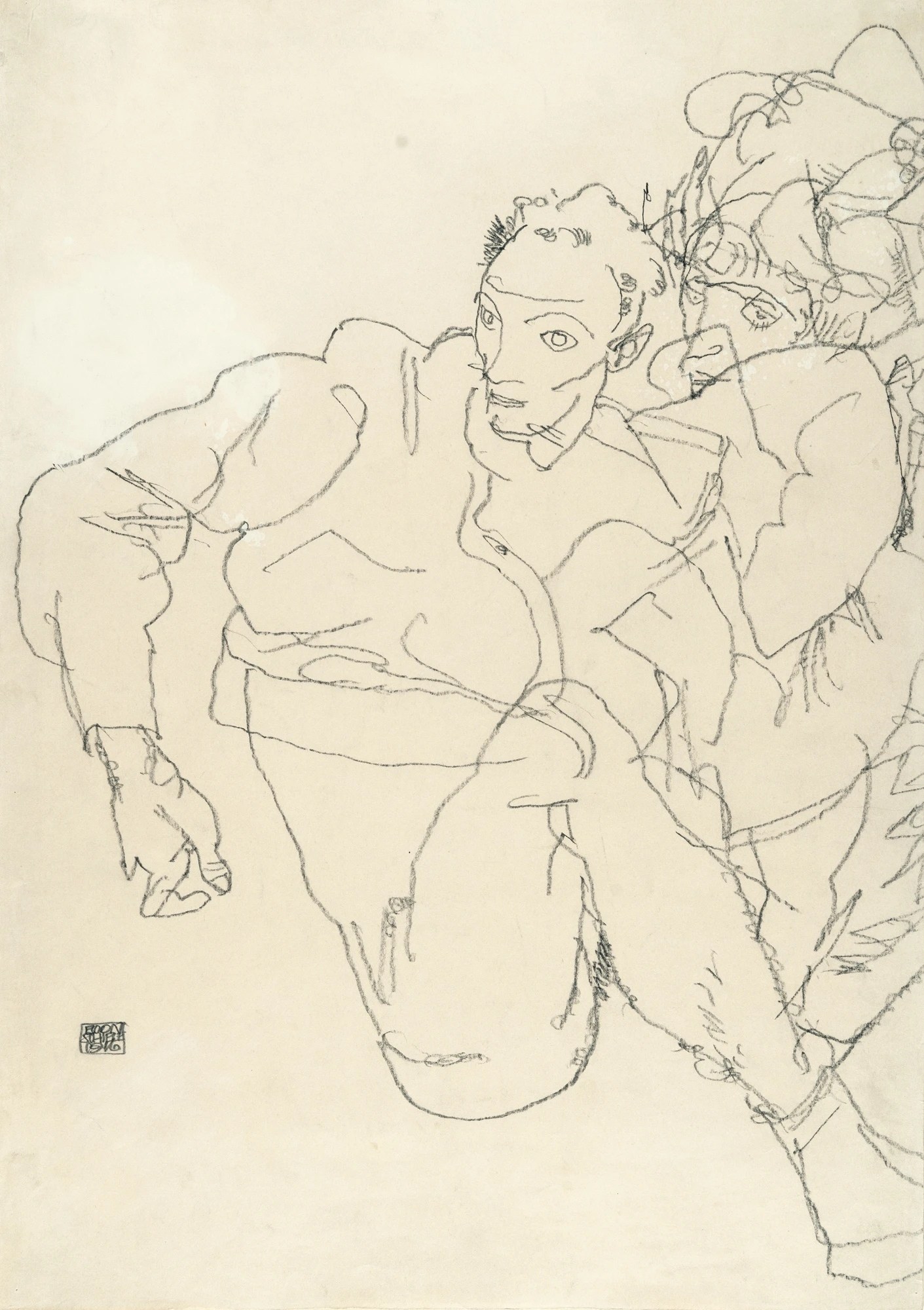
Egon Schiele:
Seated Couple, Schiele and His Wife (Sitzendes Paar, Schiele und seine Frau), 1916
Pencil on cream paper
48.5 × 34 cm
Auctioned at Karl & Faber in 2023 for €254,000 (Kallir d1856)
This drawing is one of Schiele’s most intimate and uneasy double portraits, showing himself with his young wife Edith in the first year of their marriage. Although it is dated 1916, the sheet almost certainly goes back to 1915, when their relationship was still new and unsettled. The theme of two figures leaning into one another runs through Schiele’s work, but here the closeness feels fragile rather than tender.
Schiele sits low to the ground, his body folded inward, as if caught in a moment of tension rather than collapse. His right arm is bent close to his side, not hanging loose, and the whole pose feels tight and guarded. Behind him, Edith leans in with her hair pinned back, her presence close but not physically supporting him. Their bodies touch lightly, yet the space between them carries a quiet strain. Both appear partly undressed, which softens the idea of one being more exposed than the other. The drawing shows a couple searching for balance, each holding their own weight, the closeness real but not entirely settled. It is a moment that feels both shared and solitary, and it leads naturally back to the early, uncertain beginnings of their relationship.
Their story had begun a few years earlier on Hietzinger Hauptstrasse in Vienna, where Schiele kept his studio. In 1913 the Harms family moved into the building opposite, and from his window Schiele could see the two daughters, Adele and Edith. He tried to catch their attention by waving drawings and making strange gestures, which only frightened them off. It was Wally, his former lover, who eventually persuaded the young women to meet him in secret in 1914. Schiele drew both sisters, but he was drawn to the quieter, younger Edith. The seriousness of the relationship unsettled him, and the drawings from this period show how he struggled with the idea of giving himself over to another person. In a related gouache in the Albertina, Edith holds him as if he were a puppet hanging in her arms, and the same feeling appears here. Schiele shows himself half‑naked and exposed, while Edith remains more composed, a contrast that heightens the sense of imbalance between them.
These works were Schiele’s way of thinking through what it meant to share a life with someone, to accept closeness and the vulnerability that comes with it. He married Edith in 1915, just before being called up for military service, and the drawings from this moment capture both the intensity and the uncertainty of that step.
Leave a Reply