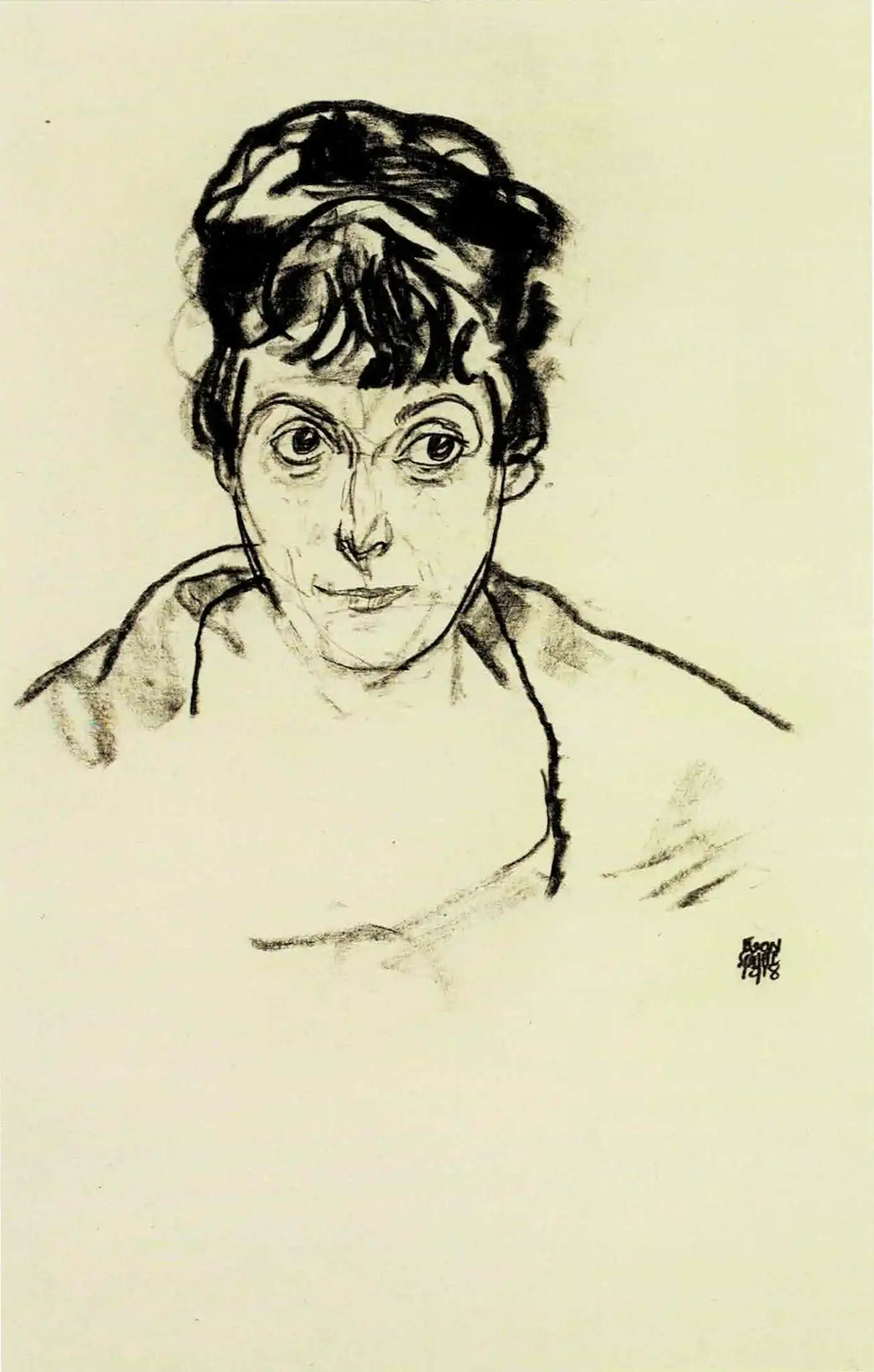
Egon Schiele:
Portrait of a Black‑Haired Woman (Porträt einer schwarzhaarigen Frau), 1918
Black crayon
46.7 × 29.5 cm
Private collection
(Kallir d2231)
Portrait of a Black Haired Woman is one of those late drawings where Schiele’s line feels steadier, almost calmer, as if he were really taking his time with the sitter. The black crayon moves with a sure hand, cutting in around the eyes, nose, and mouth with strokes that have a quiet confidence to them. Her gaze meets the viewer without hesitation, clear and direct, and that simple honesty gives the portrait its strength. The dark hair is built up in broad, rough strokes that sit heavily around the head, framing the face in a way that feels natural and unforced. You can sense Schiele letting the crayon do the work, thickening in some places, loosening in others, creating a gentle weight at the top of the sheet that settles the whole drawing.
The clothing is barely there — just a few lines for the neckline and a soft suggestion of the shoulders — and the rest of the body fades into the paper. This keeps everything centred on the face, which carries the whole presence of the drawing. Schiele doesn’t shade in the usual way, but the small changes in pressure give the cheeks, brow, and mouth a clear shape. The drawing feels like it was made in one sitting, the crayon responding directly to the woman’s expression. His signature and the date, “Egon Schiele 1918,” sit firmly at the lower right, marking it as a work from his final year, when his line had become both simpler and more assured.
By 1918, Schiele’s world had tightened. The war was dragging to its end, Vienna felt worn down, and Klimt’s death earlier that year had left a space that couldn’t be filled. Yet the portraits from these months often feel more open, more human, as if he were looking at people with a clearer, steadier eye. The sharp angles of his earlier work soften; the line becomes fuller and more patient. In this portrait, the woman’s expression isn’t dramatic or tense — it’s simply present, held with a quiet dignity. The direct gaze, the strong features, and the bold crayon strokes give the drawing a sense of truth, as if Schiele were trying to meet her without distance.
The sheet stays open and uncluttered, the background untouched, letting the portrait breathe. Its strength lies in its simplicity: a face, a gaze, a handful of sure strokes. It is a late work that shows Schiele at his most mature, using the black crayon not for effect but for clarity, shaping a portrait that feels close and lasting. Even with so few lines, the woman’s presence is unmistakable — steady, grounded, and fully alive on the page.
Leave a Reply