Gustav Klimt:
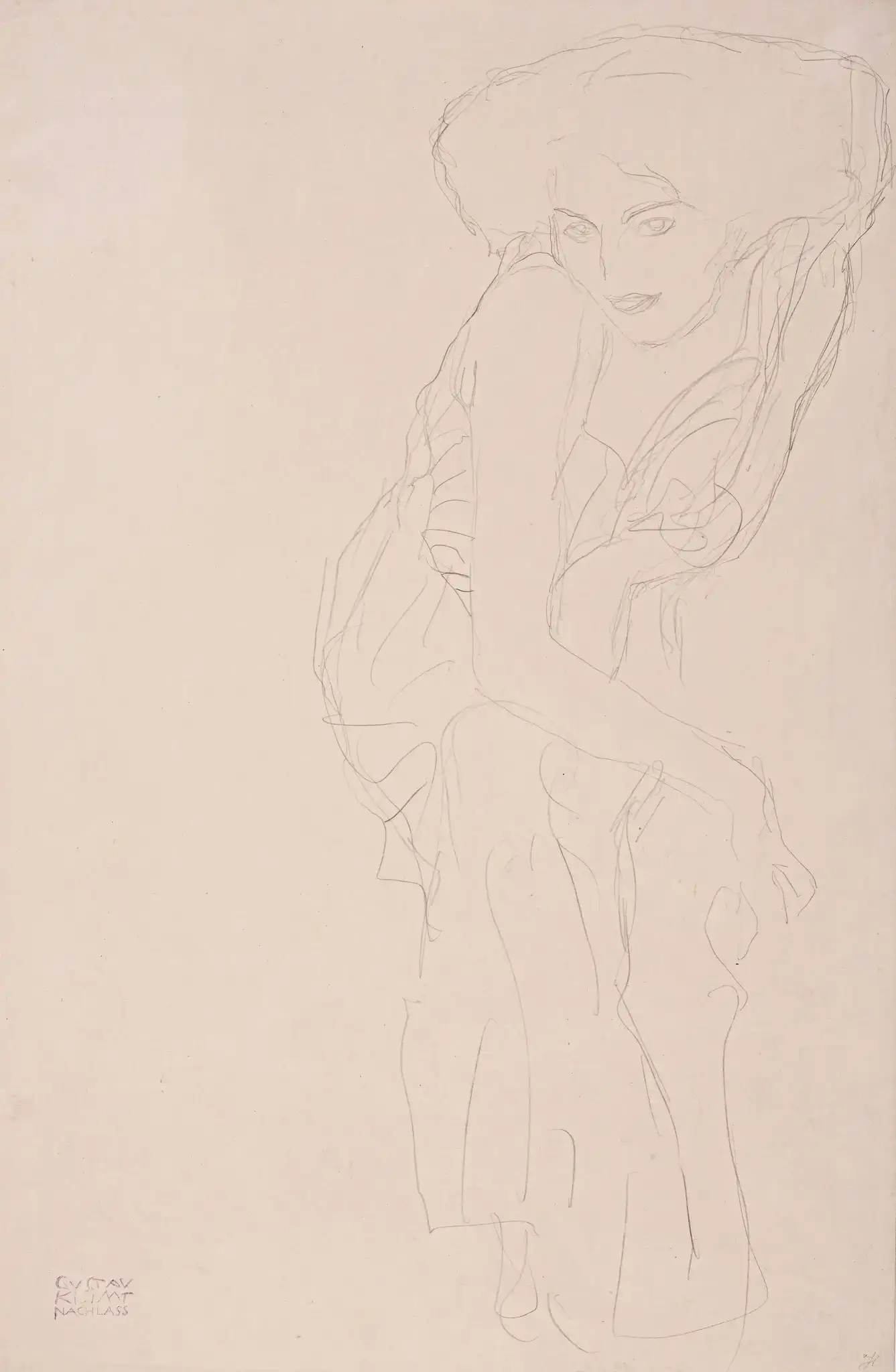
Seated Female in Turned Position, Bending Forward (Sitzende Frau in gedrehter Haltung, sich vorwärts beugend), 1909/10
Pencil on Japanese paper
56.7 × 37.2 cm
© Leopold Museum, Vienna
(Strobl s1941)
Seated Female in Turned Position, Bending Forward has the light, fluent touch Klimt often used when he was working quickly from a model, catching a pose before it shifted. The woman sits turned slightly away, her upper body bending forward in a soft, natural movement. Klimt’s pencil barely presses the Japanese paper; the contours glide across the surface, describing the tilt of her head, the fall of her hair, and the gentle curve of her back with a few confident strokes. Her undershirt is only lightly marked in, just enough to place her in the studio without pulling attention away from the body’s quiet rhythm. Her face, turned toward the viewer, is drawn with minimal means, yet the direct gaze gives the sheet its sense of immediacy.
The museum notes that this drawing is closely related to a more elaborate portrait now in Leipzig, one of the few sheets Klimt actually dated to 1910. That comparison matters because it anchors this study in the same moment and suggests that both works may show the same model in a similar pose, with the same hairstyle and the same gentle, inward expression. The Leipzig sheet is more finished, almost an independent work, while the Leopold drawing keeps the freshness of a first idea — the quick, searching strokes of a study made in the flow of the session.
Klimt rarely dated his drawings, so the Leipzig sheet provides a useful point of reference for placing this one around 1909/10. The Japanese paper adds to the delicacy: its smooth surface lets the pencil move freely, giving the contours their unbroken, almost calligraphic quality. Klimt’s interest here is not in detail or shading but in the movement of the pose — the slight twist of the torso, the forward bend, the way the head turns back toward the viewer with a calm, open look.
What gives the drawing its life is the sense of closeness. The strokes feel quick but sure, as if Klimt were working from a model who held the pose only briefly. There is no attempt to complete the figure; the sheet remains open and airy, full of the immediacy of the moment. Yet within this simplicity, the drawing holds a gentle intimacy. The model’s direct gaze meets the viewer without hesitation, and the softness of her posture gives the sheet a quiet warmth. Klimt’s line behaves almost like touch here — light, attentive, and responsive — capturing not just the form but the mood of the sitter.
Leave a Reply