New Objectivity / Degenerate Art: George Grosz
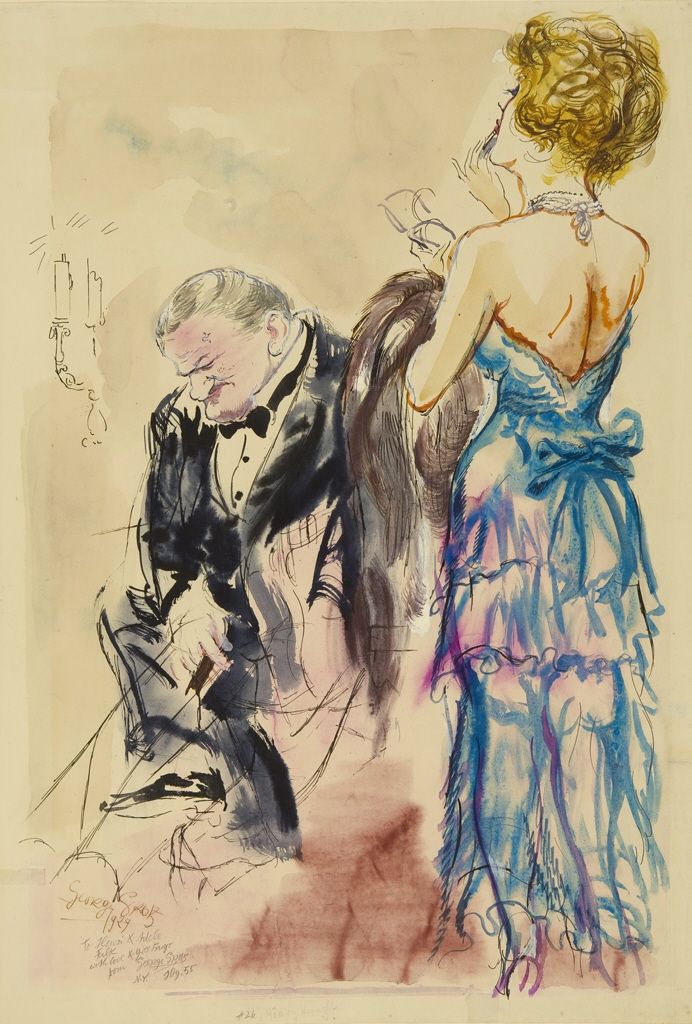
Heavy Thoughts (Gewichtige Gedanken), 1929
Watercolor, gouache, ink pen
60.1 × 42.1 cm
© Kunsthalle Mannheim, Germany
Grosz captures a moment of inwardness that feels unusually gentle for an artist so often associated with razor‑sharp satire. The seated figure leans slightly forward, as if the thoughts pressing on him have a physical weight, and Grosz lets the washes of watercolor settle softly around the form while the ink line keeps everything alert and precise. There is a faint tremor beneath the calm, a sense that the figure is not only thinking but bracing himself, as if the world outside the frame is already beginning to darken. The watercolor drifts softly around him, but the ink line keeps him tethered, held upright against thoughts that seem heavier than his posture can quite carry. Even in this quiet pose, there is a sense of the world intruding — the fatigue of a society between wars, the heaviness of someone who has witnessed too much and cannot quite set it aside. The drawing belongs to the late 1920s, when Grosz’s New Objectivity had cooled into a clear, steady gaze, and the result is a sheet that feels both intimate and unsparing. A slight tension hangs in the air, the kind that marked Berlin in the final years of the Weimar Republic, when even private moments seemed touched by a broader unease.
Although less openly satirical than his earlier attacks on Berlin’s political and social elite, the work carries the same moral tension. It reads almost like a pause between battles. By 1929 Grosz had spent years exposing corruption, brutality, and hypocrisy, and the quiet here feels earned — a fragile stillness in which the figure gathers himself before returning to a world he knows all too well. It is a moment that fits naturally within the cooler, steadier gaze of New Objectivity, where artists traded expressionist heat for a more measured clarity. Yet Grosz’s clarity is never cold; his line remains moral rather than merely observational, shaped by the conviction that seeing clearly is itself a form of resistance.
Born in Berlin and trained in Dresden and at the Königliche Kunstgewerbeschule, Grosz came of age in a fractured society. His service in World War I left him deeply disillusioned, and his art became one of the clearest warnings of what Germany was becoming. By 1929, the air in Berlin carried a strange mixture of exhaustion and foreboding, and drawings like this seem to absorb that atmosphere — the pause before events accelerate, the stillness that comes just before a society tips into crisis. When Hitler rose to power in 1933, Grosz understood the danger immediately. He left for New York just in time, taking up a teaching post while the Nazis raided his studio, seized his works, and labeled him a “degenerate artist.” Several pieces were later shown in the 1937 Degenerate Art exhibition, where the regime attempted to shame the very artists who had seen its violence most clearly.
In the United States, Grosz continued to speak against fascism, but his art gradually shifted. The biting satire softened into landscapes, cityscapes, and quieter scenes like this one, as if he were searching for a different register after years of confrontation. Some historians read this change as disappointment that his warnings had gone unheeded; others see it as a natural turning inward, a desire for calm after a lifetime of alarm. Yet even in these later works, the tension remains — the sense of a man who carries the memory of a world that failed to listen. Heavy Thoughts stands at the threshold of this transition, still rooted in Berlin’s moral urgency but already touched by the introspection that would shape his American years.
He returned to Berlin in 1958, hoping to reconnect with the city that had shaped him, but found a place transformed beyond recognition. He died the following year, leaving behind an oeuvre that remains one of the most lucid and humane records of a turbulent century. In Heavy Thoughts, the sharpness of his vision and the tenderness of his hand meet in a single, quiet moment, reminding us that even the fiercest observers need time to sit with the weight of what they know — a rare pause in a decade that seldom allowed one.
Leave a Reply