Egon Schiele:
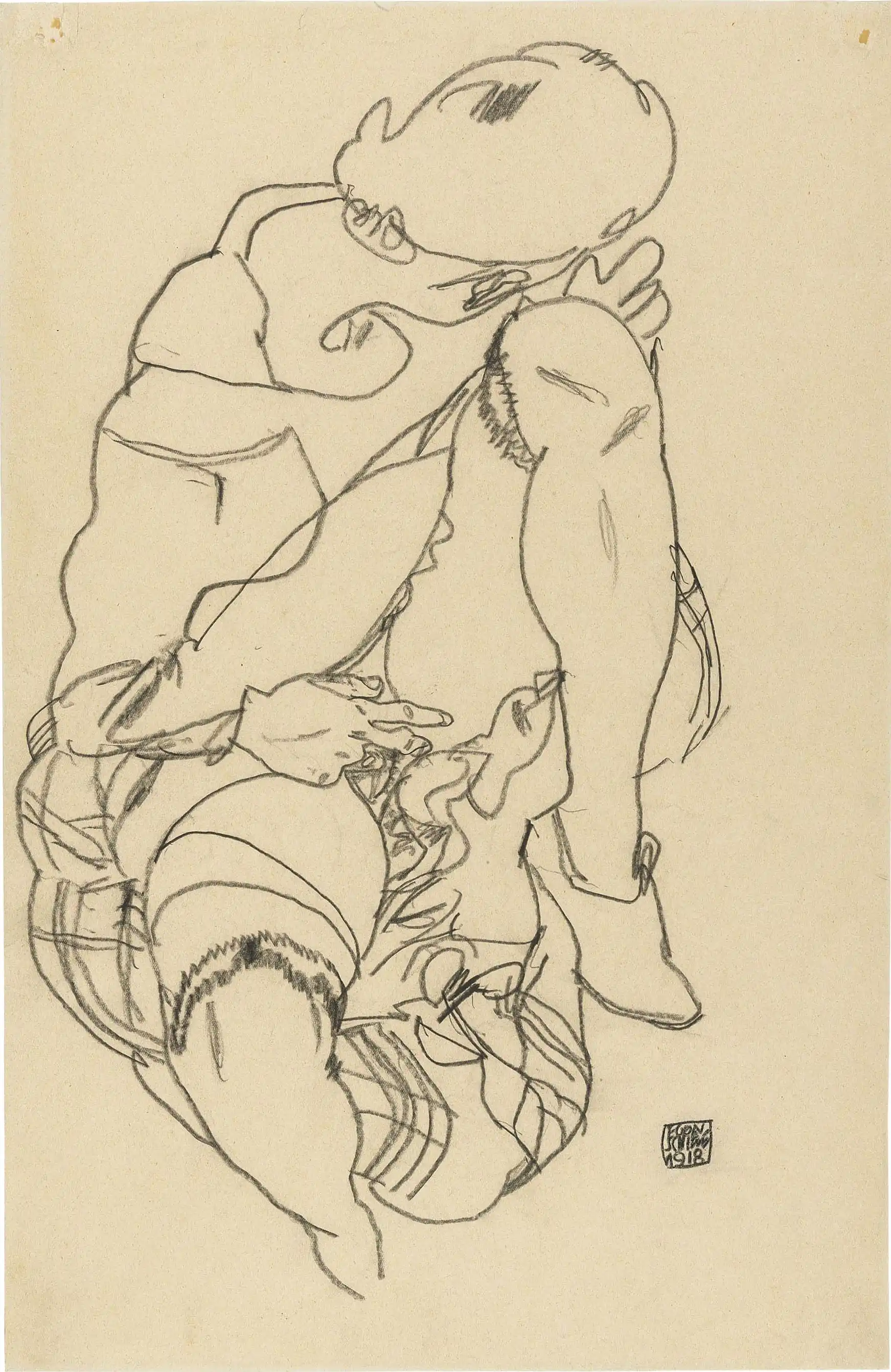
Seated Model with Raised Left Knee (Sitzendes Modell mit erhobenem linken Knie), 1918
black crayon on paper
46 × 29.7 cm (18 1/8 × 11 3/4 in.) Auctioned at Christie’s in 2017 for GBP 245,000
(Kallir d2414)
The model sits in a compact, inward‑folded pose, her left knee raised and her body curling gently around it, as if she has gathered herself into a moment of quiet. Schiele draws her with the softened assurance of his final year, the black crayon moving in long, velvety strokes that hold the figure with a warmth far from the angular tension of his earlier work. The head tilts downward, not in coyness but in a kind of private withdrawal, and the arm drawn across the torso adds a protective note that deepens the mood of introspection. Even in its economy, the drawing feels full: the subtle torque of the torso, the weight of the bent knee, the slight compression of the body all give the sheet a gentle, living tension.
This drawing belongs to the remarkable final phase of Schiele’s career, when his reputation in Vienna had reached its height and his work was being shown and collected with new enthusiasm. The Secession exhibition of early 1918, where he was given the main hall for his recent oils and drawings, confirmed him as the leading painter of the city. The confidence of that moment carries into sheets like this one, where the line becomes more supple, more sculptural, and more attentive to the body’s natural curves. Auction scholarship has often noted how these late studies reveal a shift in his technique — away from the febrile, angular contours of his youth and toward a calmer, more rounded understanding of the figure — and this drawing reflects that evolution with unusual clarity.
The pose itself is intimate but not overtly erotic. It is a moment of inwardness rather than display, a body folding into itself rather than offering itself outward. The downward tilt of the head, the arm drawn across the torso, the compactness of the limbs: all of it suggests a sitter absorbed in her own stillness. That tension between closeness and distance, between the immediacy of the study and the privacy of the moment, is part of what makes these late drawings so compelling. They show Schiele testing how a pose feels rather than how it shocks, exploring the quiet drama of weight, balance, and breath.
By 1918 Schiele was relying more heavily on black crayon, a material that suited the new fullness of his line. It allowed him to build contours that were softer and more responsive to the body’s volume, giving these final drawings their distinctive mixture of strength and tenderness. The medium itself becomes part of the mood: dense enough to anchor the figure, yet flexible enough to let the line drift and soften around her, preserving the immediacy of a moment caught in the studio.
Leave a Reply