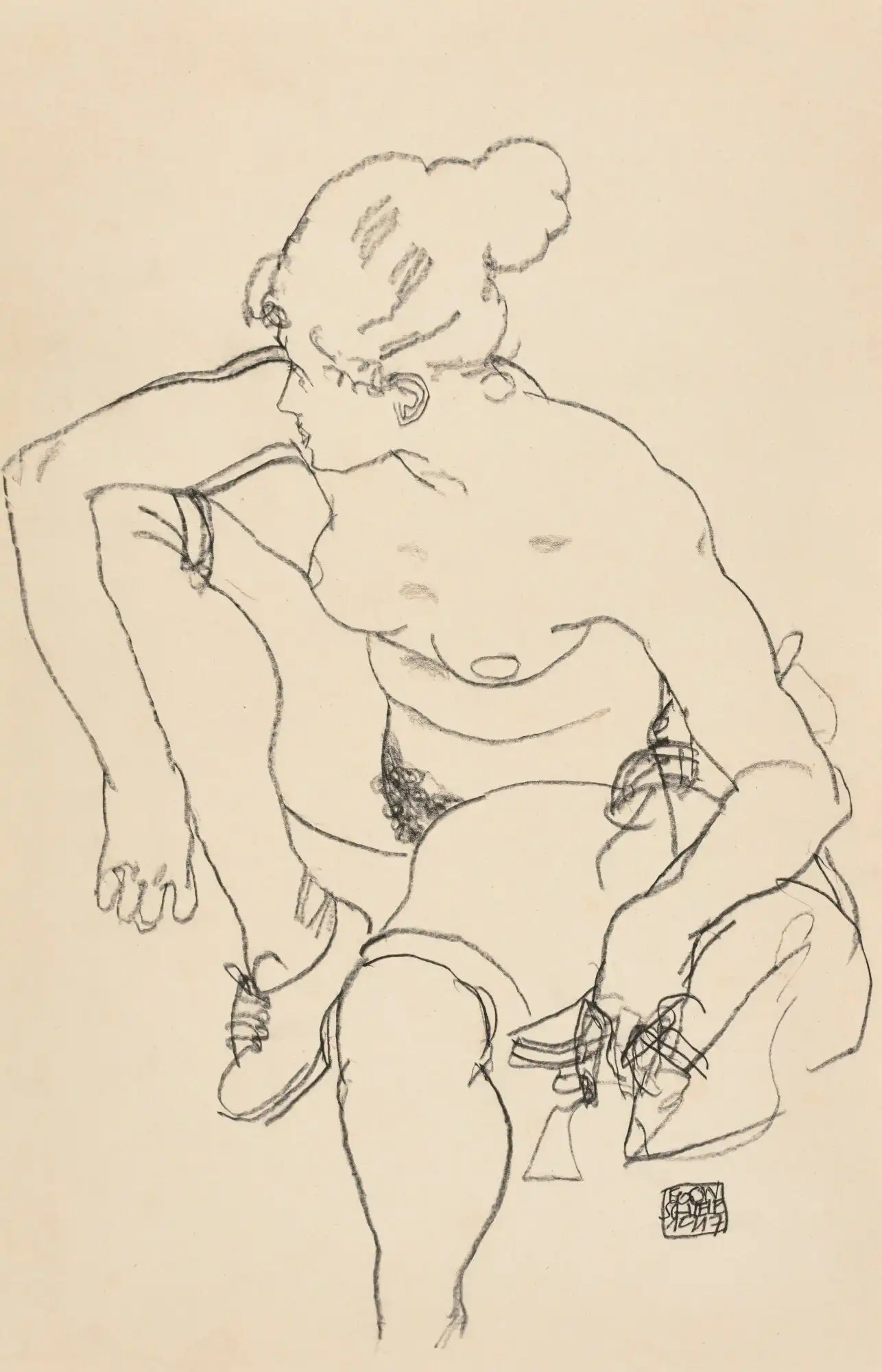
Egon Schiele:
Woman Sitting with Shoes, 1917 (Frau Sitzend mit Schuhen)
black crayon on paper
46 × 29.5 cm (18 1⁄8 × 11 5⁄8 in.)
Auctioned in 2025 for GBP 352,800
(Kallir d2001)
Schiele drew Woman Sitting with Shoes in 1917, at a moment when everything in his work seemed to settle into a new kind of clarity. He was only twenty‑eight, but the confidence of his line, the calmness of his gaze, and the way he understood the human body had reached a rare maturity. The drawing belongs to that brief, brilliant period after his release from military duties, when he returned to Vienna with a renewed sense of purpose and threw himself back into his art with real hunger.
There is a particular tenderness in Schiele’s late drawings, a softening that never dilutes his intensity but gives it a quieter, more human pulse.
The shift from his early years is unmistakable. The sharp, anxious contours of 1910 have softened; the bodies are no longer stretched into expressions of inner turmoil. Instead, they feel grounded, physical, present. His line thickens, steadies, and begins to describe flesh rather than nerves. The sensuality remains, but it is quieter now — more assured, less insistent.
By 1917, Schiele had matured into an artist of extraordinary psychological insight. The war years had changed him; the bravura of his early Expressionism gave way to a steadier, more contemplative gaze.
In this sheet, the sitter’s body opens gently toward us, her face turned away in a moment of private thought. Schiele needs almost nothing to bring her to life: a few decisive strokes for the torso, a subtle fold at the ankle, the soft weight of the abdomen, the loose curl of hair at the nape. The shoes and stockings heighten the intimacy of the pose, emphasising her nudity without ever tipping into provocation. The empty sheet around her gives the figure room to breathe.
The raised knee, the slight twist of the torso, and the concentrated stillness of the pose reveal that late warmth in his line — still unmistakably sharp, still searching, but now breathing with a new softness.
Schiele’s presence is felt in the closeness of the framing. The foot that slips out of view, the tight crop, the absence of setting — all of it draws us into the same space, the same breath of time. It is a shared moment, but a quiet one.
What makes these late drawings so compelling is the way Schiele balances the physical and the psychological with such economy. A tilt of the head, a soft slouch in the shoulders, the slight twist of the torso — these small gestures reveal not just the body, but the person. The sitter’s averted gaze is not modesty; it is interiority. She is absorbed in her own world, and Schiele allows us to sense it without intruding.
It is this refined, empathetic quality — unmistakably Schiele — that gives the drawing its lasting presence.
This is the essence of his late style: a drawing that feels immediate yet timeless, intimate yet dignified, simple in means but endlessly rich in presence.


Leave a Reply