The Belgian Connection: Armand Rassenfosse
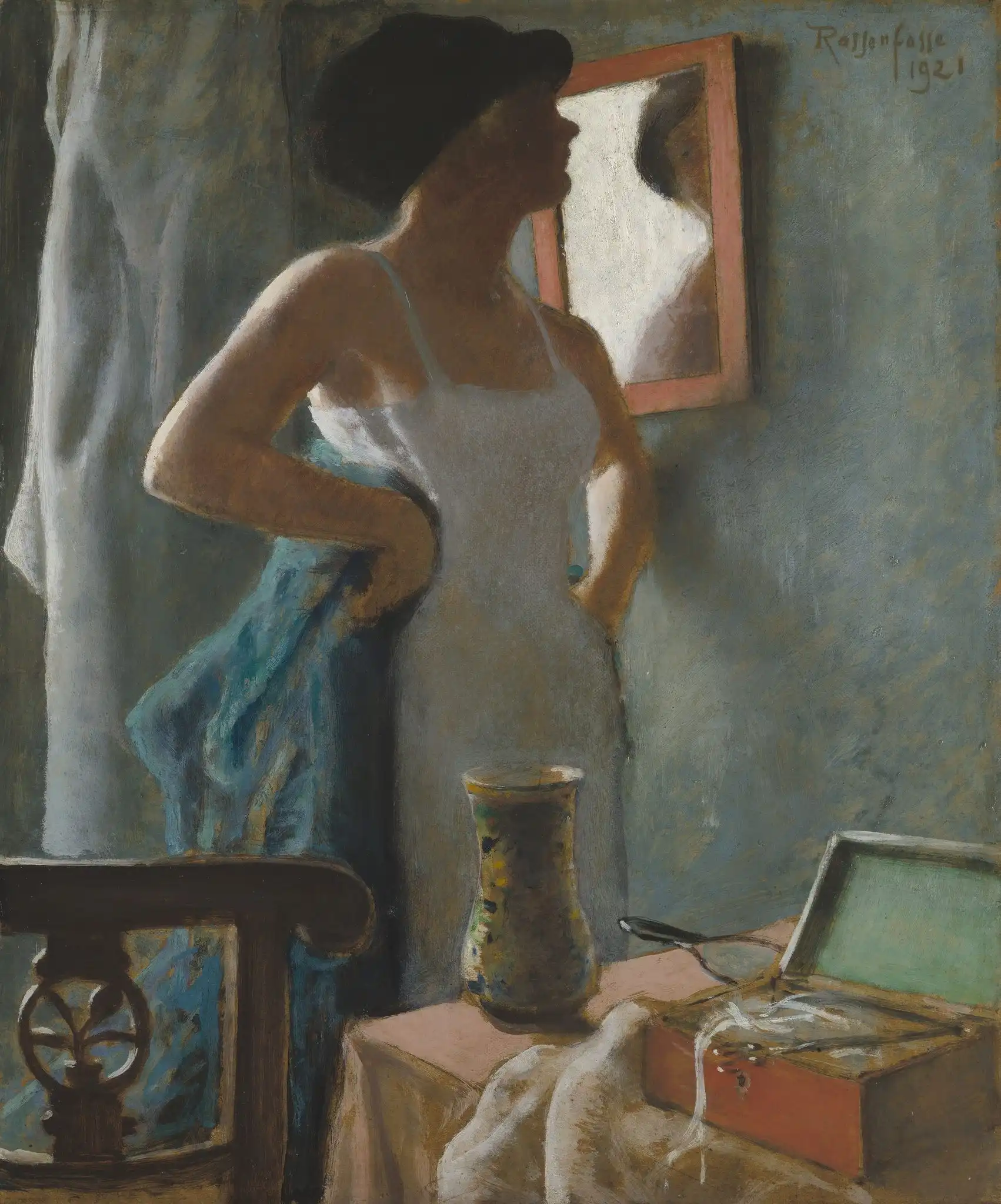
The Woman at the Mirror (La Femme au Mirroir), 1921
oil on board
64.3 × 53.5 cm (25⅜ × 21 in.)
Auctioned at Sotheby’s, London, July 2020; estimated 8,000–12,000 GBP; realized price above mid‑estimate.
Armand Rassenfosse (1862–1934) was one of Belgium’s quietly luminous artistic voices, born in Liège on August 6, 1862. Although he began his professional life in his family’s home‑furnishings and decorative‑arts business, his true calling tugged at him early. Etching—its intimacy, its technical challenge, its capacity for atmosphere—captured his imagination and never let go. A defining moment came when he encountered the work of Félicien Rops. Rops’s mastery of the etched line opened a door for Rassenfosse, who soon developed a personal language that blended Symbolist sensibility with the sinuous elegance of Art Nouveau and occasional touches of Orientalism. His illustrations for Baudelaire’s Les Fleurs du mal remain among the most admired visual interpretations of the poet’s world—moody, refined, and psychologically attuned. Restless and inventive, Rassenfosse experimented constantly. He devised new inks, refined printing methods, and even collaborated with Rops on technical innovations that expanded what etching could express. His subjects often reveal a tender, empathetic eye: young women, workers, and especially the girls employed in the coal industry around Liège. He portrayed them not as types, but as individuals—vulnerable, resilient, and deeply human. Rassenfosse continued to work and innovate until his death on January 28, 1934, leaving behind a body of work that feels both intimate and quietly groundbreaking, the kind of art that finds its strength in the unguarded moments of everyday life.
This painting carries that same quiet strength. A young woman stands in a softly lit room, her white dress catching the gentle fall of light as she holds a blue garment with an unhurried deliberation. Her dark hat casts a soft shadow across her face, giving her an air of inwardness. On the small table beside her, a vase, an open box, and a mirror form a cluster of familiar domestic objects—simple things that speak of a life lived in close, thoughtful rhythms. A carved wooden chair anchors the foreground, its presence adding a touch of craftsmanship and calm. Behind her, the wall mirror reflects her face, offering a second, more private glimpse of her expression. It is a tender detail, as though we are allowed to see both her presence and her quiet interior world at once. The atmosphere is hushed, the light gentle, and the moment feels complete in its stillness. Nothing dramatic occurs, yet the scene carries a quiet poetry—the kind found in the small, unguarded moments of everyday life.

Leave a Reply