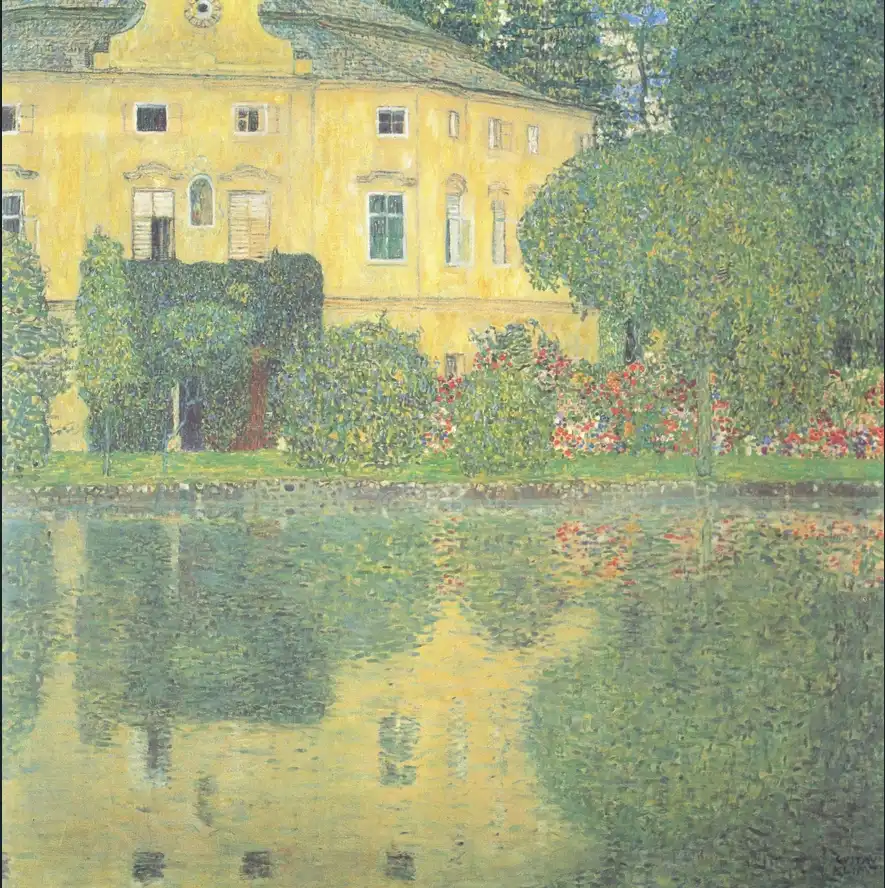
Gustav Klimt:
Kammer Castle on Lake Attersee IV (Schloss Kammer am Attersee IV), 1910
Oil on canvas
110 × 110 cm
Private collection, Vienna
(Natter 191)
Kammer Castle on Lake Attersee IV belongs to the small group of five paintings in which Klimt explored Schloss Kammer from different angles and under shifting conditions. In this fourth version, the castle’s yellow façade rises above the lake, softened by climbing ivy and framed by flowering shrubs that push forward with vibrant color. Tall trees stand like sentinels on either side, and the still water below carries a diffused reflection of the entire scene, rendered with the shimmering, mosaic-like touch that defines Klimt’s mature landscapes.
Klimt’s bond with the Attersee deepened over many summers, and between 1908 and 1912 he lived in the Oleandervilla, a lakeside house he shared with Emilie Flöge and her sisters Helene and Pauline, along with their family. Helene, widowed after the early death of Klimt’s brother Ernst in 1892, remained closely connected to both Klimt and Emilie, and the summers at the lake became a kind of extended family retreat. The Attersee, nestled in the Salzkammergut near Salzburg, was a favored destination for Viennese society, yet Klimt gravitated toward its quieter edges. He returned almost every summer between 1897 and 1916, finding in the landscape a rhythm that suited his temperament.
Klimt generally painted his landscapes en plein air, working directly before the motif during his summer stays. He came to landscape painting relatively late — his first examples date from the late 1890s — but the genre quickly became central to his artistic identity. From 1900 onward, his landscapes were almost always executed in a square format of roughly one metre per side, a shape that encouraged the calm, balanced compositions that define his mature style.
Contemporary accounts describe Klimt roaming the area with a small ivory viewing tablet in his pocket. He would hold it up to isolate a portion of the scenery through a rectangular opening, testing whether a particular arrangement of trees, water, or architecture might lend itself to a painting. This habit of framing the world through a portable aperture helps explain the tightly composed, almost meditative structure of his landscapes.
Of the five views Klimt painted of Schloss Kammer, the present work is the only one seen from the garden side. This vantage point gives the building a more intimate presence, half-emerging from the surrounding vegetation rather than standing apart from it. The ivy softens the geometry of the façade, the flowering bushes add bursts of color, and the reflection in the lake becomes a gentle echo of the world above — not a literal mirror, but a shimmering counterpart shaped by Klimt’s layered brushwork.
The painting is generally dated to 1910, a conclusion first proposed by Marie-José Liechtenstein based on stylistic evidence and recollections from Emilie Flöge. Later scholars largely accepted this dating, though some have suggested Klimt may have begun the work slightly earlier. Whatever the precise moment of execution, the painting clearly belongs to the mature phase of his landscape production, when he created all five of his Kammer Castle compositions.
After its completion, the work was consigned to Galerie Miethke in November 1911 and purchased shortly thereafter by Karl Wittgenstein, one of Vienna’s most influential collectors. Today, it remains in a private Viennese collection, part of the small, cohesive group of paintings in which Klimt returned to Schloss Kammer with a deepening sense of familiarity and affection.
For the painting Kammer Castle on Lake Attersee III see here: https://schieleandklimt.com/2026/01/20/kammer-castle-on-lake-attersee-iii-1909-1910-gustav-klimt/

Leave a Reply