Der Blaue Reiter: August Macke
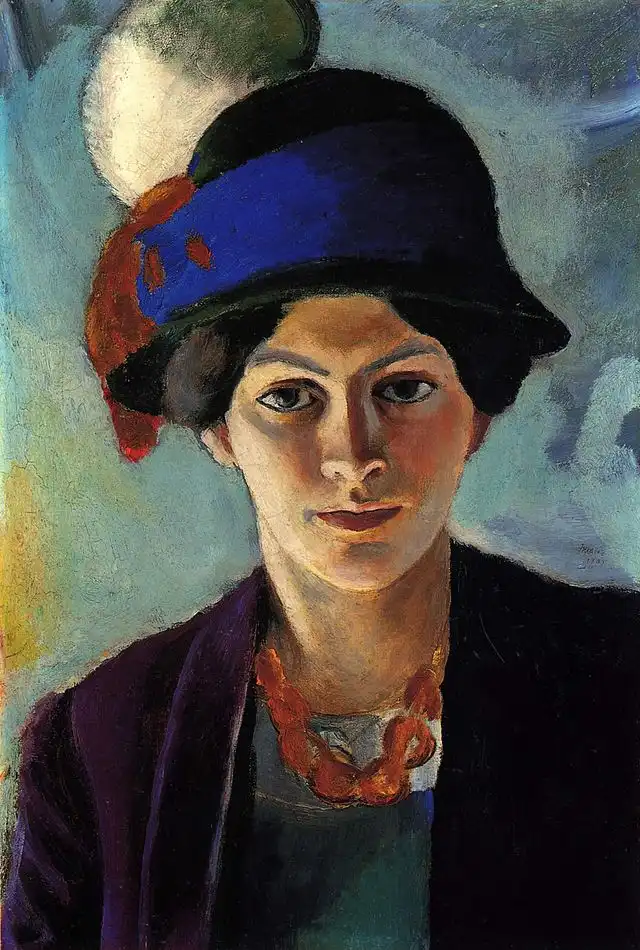
Portrait of the artist’s wife with a hat (Bildnis der Frau des Künstlers mit Hut), 1909
Oil on canvas
49.7 × 34 cm
Westphalian State Museum of Art and Cultural History, Münster
August Robert Ludwig Macke (1887–1914) was one of the leading members of Der Blaue Reiter, the circle of artists that reshaped early 20th‑century painting through a new language of color and spiritual expression. Alongside Wassily Kandinsky, Franz Marc, Gabriele Münter, Paul Klee, and Marianne von Werefkin, he helped define a movement that was brief but profoundly influential. His closest artistic companion was Franz Marc — their correspondence reveals a shared belief in the emotional power of color — and the war would claim them both. Macke fell first: Germany entered the First World War on 1 August 1914, and he was killed just seven weeks later, on 26 September, during the early fighting in Champagne. Marc, who mourned him deeply, would be killed less than two years later, on 4 March 1916, at Verdun. Kandinsky later wrote that Macke’s death “tore a hole in the heart of the group.”
Central to Macke’s life and legacy was Elisabeth Erdmann‑Macke (1888–1978), his wife, confidante, and later the guardian of his memory. During his lifetime she provided the emotional steadiness and intellectual companionship that shaped his artistic development. After his death she preserved his letters, diaries, and artworks, published her memoir Erinnerungen an August Macke, and worked tirelessly to ensure that his place within German Expressionism remained visible. Much of what we know about Macke’s inner world survives because she carried it forward with extraordinary devotion.
This portrait of Elisabeth belongs to the moment when Macke was beginning to define his own artistic language. Her face emerges softly from a background of cool, atmospheric blues and greens, the brushwork dissolving into gentle transitions that give the painting its quiet luminosity. The wide, dark hat — accented with a vivid blue band and touches of red and green — frames her features and introduces a burst of color that anticipates the harmony and brightness of Macke’s mature Expressionist palette.
Her expression is calm and inward, a mixture of poise and intimacy that reflects the closeness between artist and sitter. The reddish bead necklace adds a warm counterpoint to the cooler tones around her, grounding the composition and drawing the eye back to the center. Macke models the face with delicacy, while allowing the hat, garment, and background to remain more painterly and open, creating a subtle tension between realism and expressive color.
Painted in 1909, the work stands at the threshold of Macke’s mature style: rooted in observation, enriched by color, and animated by a sense of inner life that feels both modern and deeply personal — all the more poignant knowing how brief his trajectory would be, and how faithfully Elisabeth would carry it into the future.
Leave a Reply