Egon Schiele:
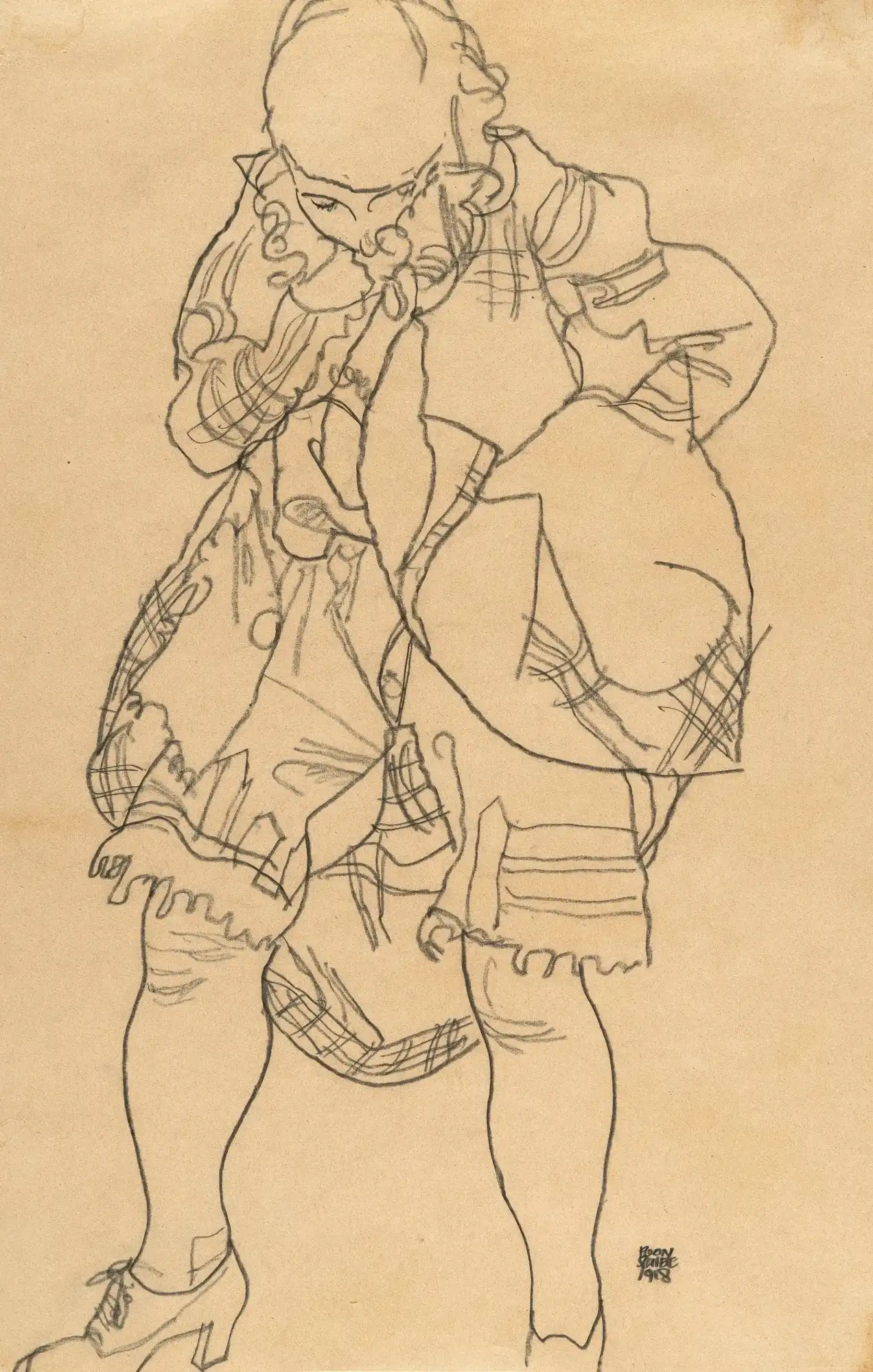
Standing woman with raised skirt (Stehende Frau mit erhobenem Rock), 1918
Black chalk on brownish wove paper
45.5 × 29 cm
Auctioned at Karl & Faber in 2024 for €146,050
(Kallir d2412)
This drawing carries the unmistakable quiet intensity of Schiele’s final year — a moment where confidence and vulnerability meet on the page. The woman stands in a pose that is both intimate and consciously staged: legs apart, one hand lifting the fabric, the other resting on her hip, her gaze turned inward. It’s a gesture that feels less like provocation and more like a private reckoning with her own body, a kind of self‑awareness Schiele captured better than anyone.
The black chalk is handled with extraordinary sensitivity. Schiele lets the line swell and fade, shifting from deep, velvety blacks to the palest grey. He uses the full expressive range of the medium — thick, thin, firm, trembling — and the drawing breathes because of it. The brownish wove paper warms the entire sheet, giving the figure a soft radiance that seems to rise from within.
What anchors the drawing in his late style is the blend of realism and stylization. Schiele lingers over the small, telling details: the reinforced heel of the stocking, the laced shoe, the faint suggestion of a checked pattern in the skirt and jacket, the lace edging of the bloomers. These touches bring a grounded, almost tactile presence to a figure that simultaneously strains against the edges of the paper, as if she were too alive to be contained by it. The flowing, undulating strokes give the pose a spirited energy, a reminder of how much mastery he had achieved in these final years.
And the sheet has lived a life among people who understood that mastery. It first belonged to Frederic Knize (1890–1949), one of Vienna’s early champions of modernism — a collector whose taste was as bold as the era he helped shape. Decades later it entered the world of Serge Sabarsky (1912–1996) in New York, whose devotion to Schiele and Austrian Expressionism shaped the way America came to understand them. After his death, it remained with the Vally Sabarsky Foundation, ensuring the drawing stayed within a circle of deep connoisseurship. To pass through such hands is to be recognized, not merely owned. The drawing carries that quiet authority: it has been seen, valued, and cared for by those who truly knew what they were looking at.
Leave a Reply