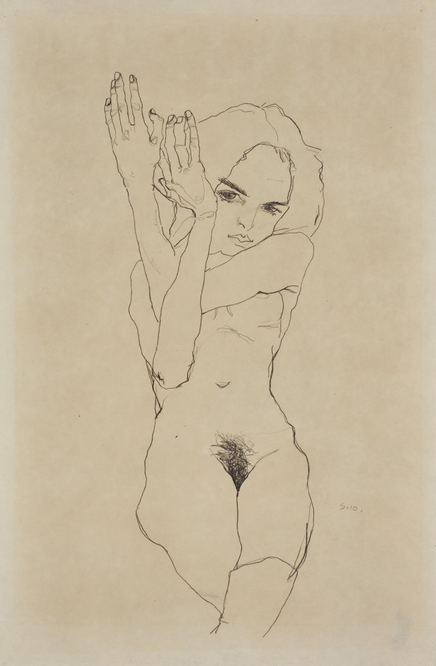
Egon Schiele:
Nude Girl with Folded Arms Raised to the Right Side of Head (Junges Mädchen mit verschränkten, seitlich rechts zum Kopf erhobenen Armen), 1910
pencil on paper
55.3 by 37 cm (21¾ by 14½ in.)
auctioned at Sotheby’s in 2024 for 552,000 GBP
(Kallir d580)
From 1910 onward, Schiele began to move away from the landscapes, clothed figures, and Klimt‑inflected compositions of his earliest years, turning instead toward the unguarded human body as a site of psychological and artistic exploration. This shift marked a decisive moment in his development: the nude became a means of probing tension, vulnerability, and the expressive potential of line.
His choice of models reflected both necessity and circumstance. Without the means to hire professional sitters and without intimate relationships that might have provided them, Schiele often drew women living on the margins of Viennese life or, at times, patients at the clinic of Dr. Erwin von Graff, who allowed him to sketch during examinations. These sessions enabled him to push beyond academic training and experiment with a more charged, searching approach to form. Many of the nudes from 1910 avert their faces or turn away, functioning less as portraits than as studies in gesture, distortion, and emotional intensity.
Nude Girl with Folded Arms Raised to the Right Side of Head embodies both the artistic breakthrough and the ethical complexity of this moment. The sitter’s youth is unmistakable, and contemporary viewers often feel a deep unease when encountering such images — an unease that deserves to be acknowledged with care. While the drawing belongs to a historical context in which studio practices differed sharply from our own, that context does not erase the vulnerability of the model or the power imbalance inherent in the situation.
The drawing itself reinforces this more reflective reading. The sitter’s downward gaze and the protective lift of her arms create a sense of inwardness rather than display, and Schiele’s attention to the contour of the hands and the tension of the pose suggests an artist focused on structure, gesture, and psychological presence. Nothing in the sheet seeks to eroticize the figure; instead, it aligns with the exploratory, searching quality that characterizes Schiele’s work from 1910. This interpretation also resonates with the Sotheby’s auction note, which situates the drawing within Schiele’s early engagement with the nude as a vehicle for expression rather than sensuality.
The first recorded owner of the drawing was Wolfgang Gurlitt (1888–1965), the German dealer, publisher, and collector who became a significant advocate for modern art. After assuming control of his father’s Berlin gallery in 1912, he maintained close relationships with many of the artists he represented, including Schiele.
Following the Second World War, Gurlitt settled in Austria and collaborated with the city of Linz to establish what would become the Lentos Museum, contributing hundreds of works from his own holdings. This drawing was among the works he lent to the 1948 Schiele retrospective at the Graphische Sammlung Albertina, a landmark exhibition that helped reestablish Schiele’s reputation in the postwar years.
When Gurlitt later left Linz and opened a new gallery in Munich, he took his private archive and collection with him, including a substantial group of Schiele works on paper. Because the business records of Galerie Gurlitt were destroyed in a 1943 bombing raid, reconstructing the early provenance of works from his collection — particularly works on paper, which were not always meticulously documented — is often challenging. This sheet is one of the pieces whose survival and exhibition history can still be linked to Gurlitt’s stewardship.

Leave a Reply