
Finnish Modernism: Helene Schjerfbeck
The Red‑Haired Girl II (Punainen pää II), 1915
oil and graphite on canvas
37 × 36 cm (14½ × 14¼ in.)
auctioned at Sotheby’s in 2016 for GBP 1,205,000
A work of remarkable quietude, The Red‑Haired Girl II belongs to the moment in Schjerfbeck’s Hyvinkää years when her art reached a new level of distilled clarity. After leaving her teaching post at the Finnish Art Society Drawing School in 1902 due to ill health, she withdrew to Hyvinkää with her mother, where the stillness of daily life allowed her to refine the pared‑down modernist language that would define her later career. Hyvinkää, a quiet town just north of Helsinki, gave her a gentler rhythm of life — a place where the days slowed enough for her to listen closely to her own work again. The present painting is one of the most eloquent expressions of that evolution: a subtle interplay of graphite line and soft, breathing colour, held together by the inward, contemplative presence of the sitter.
The motif of the red‑haired girl became increasingly central to Schjerfbeck during this period. In 1913 she painted Red Headed Girl (19.5 × 23 cm, private collection), and the same distinctive profile appears again in the left‑hand figure of Sisters from that year (31 × 42 cm, private collection).
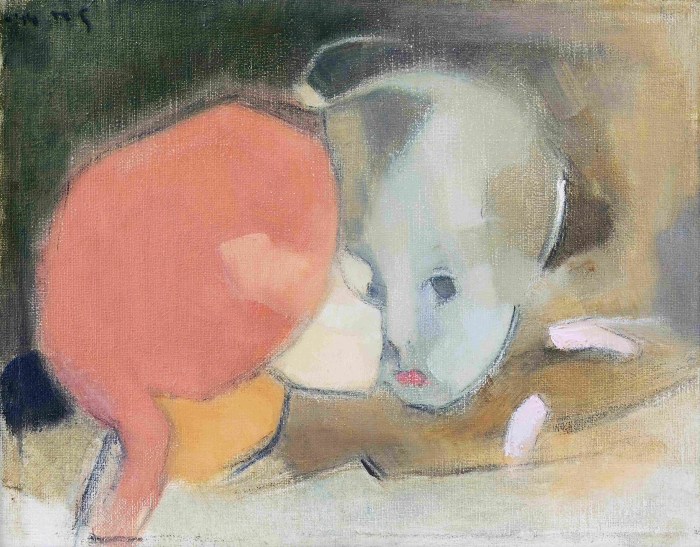
The downward, reflective tilt of the head that defines The Red‑Haired Girl II first emerges in the three‑quarter‑length figure of Outside the Sauna (Diana), painted between 1915 and 1917 (65 × 52 cm, Hämeenlinna Art Museum). The charcoal and gouache study for that composition already hints at the tenderness of the moment, but it is only when Schjerfbeck isolates the head alone that the full serenity of the figure becomes visible.
Seen as the culmination of this reductive process, The Red‑Haired Girl II reveals how Schjerfbeck continued to refine the ideas first explored in Red Haired Girl I. The present canvas is slightly larger—37 × 36 cm compared with 31 × 31 cm—and the graphite delineation of the forehead, nose, and mouth is both more precise and more delicate. The contrast between the warm tone of the right cheek and the red of the hair is more clearly articulated, and the small bob of hair falling across the left side of the face is rendered with greater definition. What she achieved so beautifully in the earlier painting is here brought to a point of extraordinary refinement, marking a luminous conclusion to this sequence of portraits and giving rise to an image that has become emblematic of her vision of womanhood.
The importance of The Red‑Haired Girl II within Schjerfbeck’s oeuvre was underscored when it was chosen as the cover image for the landmark retrospective at the Helsinki Ateneum in 1992. Decades later, it remains one of the works through which the public most readily recognises her mastery—an enduring testament to the quiet power and emotional precision of her late style.


Leave a Reply