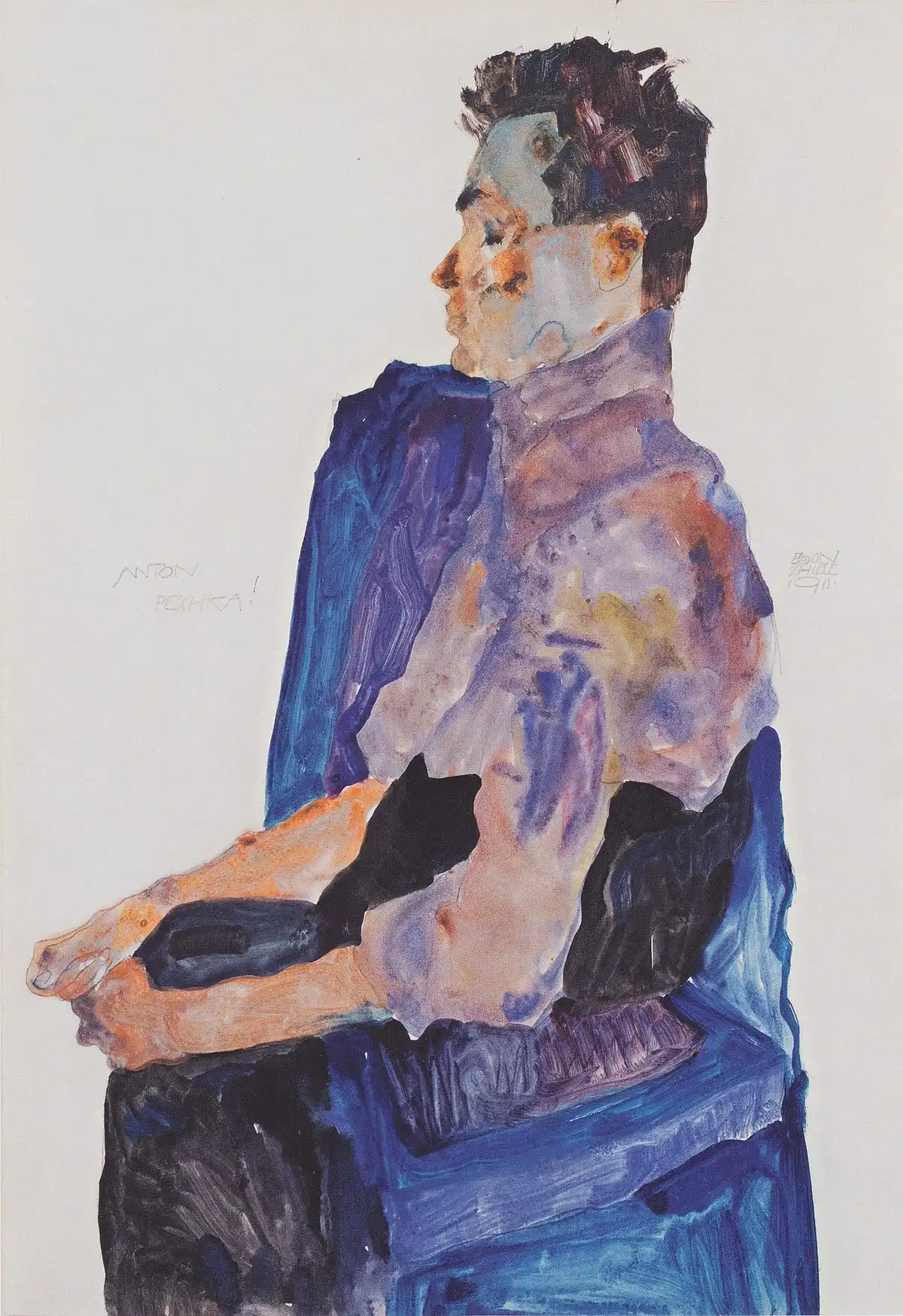
Egon Schiele:
Portrait of painter Anton Peschka (Bildnis des Malers Anton Peschka), 1911
Gouache, watercolor, and pencil on paper
44.7 × 30.9 cm
Private collection
(Kallir d934)
This vivid portrait of Anton Peschka, painted in 1911, captures the intensity of Schiele’s early expressionist phase and the closeness of their artistic bond. Peschka was not only Schiele’s friend and fellow rebel at the Academy, but also his future brother‑in‑law: in 1912, he would marry Schiele’s sister Gertrude, who in the early years became his preferred model and an important presence in his work.
The drawing is striking for its theatrical immediacy. Peschka sits in profile, eyes lowered, rendered in bold washes of blue, violet, and orange that pulse against the stark white ground. The stylized contours and exaggerated shadows heighten the emotional charge, while the handwritten “ANTON PESCHKA!” and emphatic signature anchor the sheet in Schiele’s personal world. It’s not just a portrait—it’s a declaration.
There is also a remarkable immediacy to this sheet. The thick, sculptural contour still carries traces of Schiele’s 1910 “black‑line” period, while the blue–violet–orange palette reflects his early experiments with expressive, non‑naturalistic color. Peschka’s downward gaze and closed posture create a quiet, inward tension that plays against the electric chromatic energy around him. And the emphatic inscription gives the drawing an almost poster‑like presence, as if Schiele were announcing his friend to the world. It is one of the most psychologically charged male portraits of this period, revealing how deeply Schiele valued Peschka within his inner circle.
Just a year or two earlier, Schiele had painted Peschka in a very different mode: a full‑length portrait in profile, set against a gold‑toned, patterned background that echoes Klimt’s ornamental style. That earlier painting, with its decorative restraint and stylized elegance, shows Schiele still working within the influence of Klimt and the Secession. The contrast between the two portraits—one formal and ornamental, the other raw and expressive—marks Schiele’s rapid evolution and the shifting nature of his relationship with Peschka. For comparison, I’ve added a link to that earlier painting, which I posted previously, so the two works can be viewed side by side.
https://schieleandklimt.com/2025/09/02/portrait-of-the-painter-anton-peschka-1909/
And there is even a faint visual kinship with Peschka’s own Man with Hat drawing that I posted earlier in the day, a reminder of how closely their graphic languages once ran in parallel.
Though Peschka’s own drawings occasionally echo Schiele’s graphic clarity, they never reached the same market heights. This portrait, by contrast, has become one of the most recognizable images of Schiele’s circle, a testament to the strange imbalance in their legacies. Schiele’s rendering of Peschka is both homage and assertion: a moment of friendship, intensity, and artistic self‑definition.

Leave a Reply