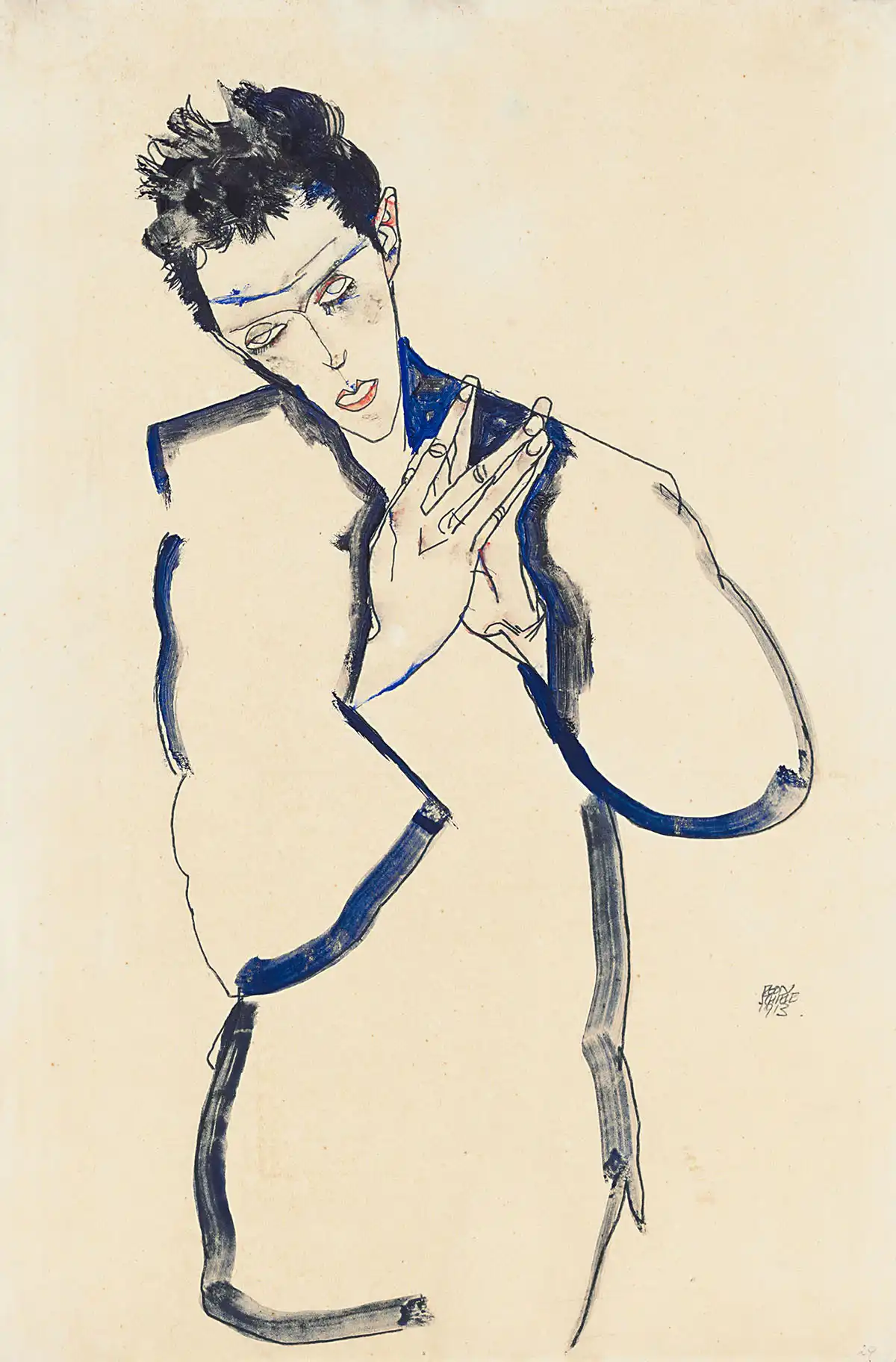
Egon Schiele:
Self‑Portrait with Folded Hands (Selbstbildnis mit gefalteten Händen), 1913
Gouache and pencil on paper
47.5 × 31.5 cm (18 5/8 × 12 3/8 in.)
Auctioned at Sotheby’s in 2004 for GBP 812,000
(Kallir d1423)
This self‑portrait from 1913 belongs to one of the most introspective phases of Schiele’s career, shaped in part by the upheaval of his 1912 imprisonment. As Jane Kallir has shown, that episode left him deeply unsettled, prompting a shift from the provocative eroticism of earlier years toward a more inward, psychologically charged language. During his confinement he drew himself wrapped in a blanket, the body withdrawn; after his release, the emphasis moved to the face, the hands, and the emotional tension they could carry.
In Selbstbildnis mit gefalteten Händen, made when he was just twenty‑three, this new sensibility is unmistakable. The elongated head, the hollow, unwavering gaze, and the fingers pressed together in that distinctive V‑shaped gesture form one of his most recognisable poses. The drawing confirms this: the head is tilted slightly to the left, the eyes wide and unflinching, and the hands held close to the chest in a gesture that feels both protective and exposed. Here he appears clothed in a blue cloak rather than nude, presenting himself as a more self‑possessed, contemplative figure. The wiry contour defines the features with precision, while the translucent gouache lends a fragile luminosity to the skin. Schiele’s focus is no longer on anatomy but on presence: the concentrated modelling of the head, the charged stillness of the hands, and the stark outline that anchors the figure against the page.
The sheet once belonged to Viktor Fogarassy (1911–1989), an Austrian industrialist whose discerning eye made his collection one of the most respected private holdings of modern art in postwar Europe, particularly admired for its exceptional group of Schieles. His ownership adds a quiet layer of historical depth to the work.
Kallir has written that the hand gesture seen here recurs throughout Schiele’s work as a sign of creative tension — the artist “at the mercy of his own creative powers, reaching out as in a trance to find an eternal truth.” It is a gesture that feels both deliberate and involuntary, a physical echo of the intensity that drove his rapid stylistic evolution. That sense of striving, of pushing against the limits of his own experience, is part of what gives this drawing its quiet force.
Its later appearance at Sotheby’s, where it achieved a strong result, reflects the enduring regard for these self‑portraits, which capture Schiele at a moment when ambition, vulnerability, and artistic clarity converged. The drawing’s minimal palette — primarily blue and black — heightens its emotional charge, allowing the fluid lines and stark contrasts to carry the weight of expression. In this drawing, those elements gather with remarkable subtlety: the folded hands, the tilted head, and the unblinking stare create a presence that feels both fragile and fiercely alive.


Leave a Reply