The Italian Connection: Enrico Lionne:
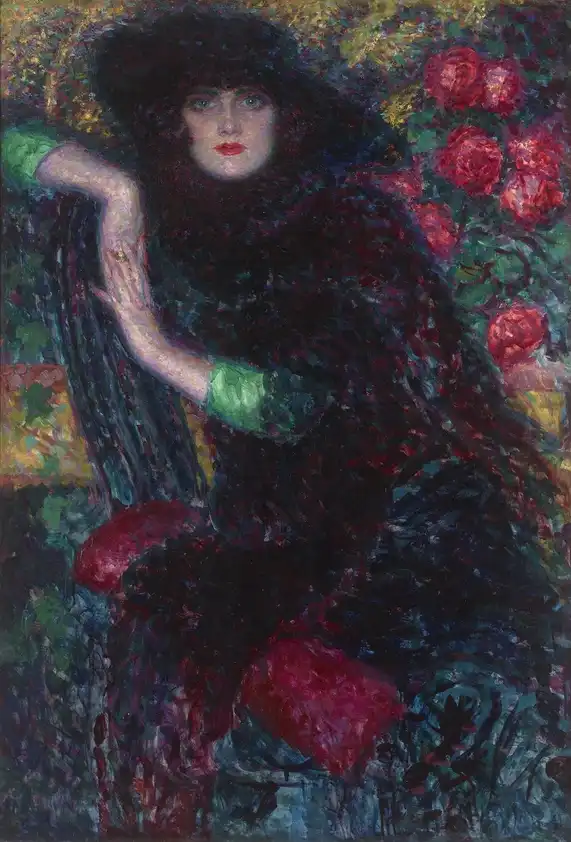
Red Roses (Rose Rosse), 1914–15
Oil on canvas
115.6 × 79.4 cm (45 1/2 × 31 1/4 in)
Handled on the art market, including by M.S. Rau (New Orleans / Aspen)
Enrico Lionne (1865–1921), born Enrico Della Leonessa in Naples, was one of the artists who carried Italian Divisionism into a more intimate and decorative direction. After moving to Rome at twenty, he built a career that moved fluidly between illustration, caricature, and painting, always guided by a sharp eye for contour and a fascination with the expressive possibilities of color. His years in Paris left their mark as well, sharpening his sensitivity to light and the chromatic experiments of the French Neo‑Impressionists.
Red Roses (Rose Rosse), created around 1914–15, belongs to a small group of works in which Lionne placed a single female figure amid a lush field of flowers. The woman here — with her heavy‑lidded gaze, brilliant blue eyes, and quietly self‑possessed posture — was one of his recurring models, a presence he returned to repeatedly. Her dark clothing, accented by vivid green cuffs, sets up a striking contrast with the cascade of red roses and dense greenery surrounding her. The surface is alive with expressive, flickering strokes that lend the composition its chromatic shimmer and emotional depth.
Lionne was drawn so strongly to this motif that at least two closely related versions of the composition are known today. They share the same model and the same enveloping field of roses, yet each canvas carries its own emotional inflection. A slight change in the tilt of her head, a different tension in the resting hands, or a subtle shift in the rhythm of the flowers is enough to give each painting its own atmosphere. Having seen both images before, the pairing feels almost like a quiet dialogue — variations on a theme that clearly held Lionne’s attention during these years.
The painting was exhibited at the Panama-Pacific International Exposition in San Francisco in 1915, where Lionne received the Gold Medal for the Italian Section. Contemporary critics singled out Red Roses as the clearest expression of his luminous, variegated style — a work that demonstrated how French chromatic theories could be transformed into something distinctly Italian. Lionne’s approach, shaped in part by O. N. Rood’s Modern Chromatics, relied on fluctuating touches of spectral color rather than the strict pointillism of Seurat or Signac. In Rome, where he lived and worked, this technique was applied to scenes grounded in daily life and direct observation, rather than the symbolic narratives favored in northern Italy.
What makes Red Roses so compelling is the way Lionne wove these scientific ideas into a composition that feels deeply personal. The figure’s relaxed posture, the gentle tilt of her head, and the enveloping field of roses create a mood that is both contemplative and quietly theatrical. It is a painting that reveals Lionne’s gift for merging realism with a decorative sensibility — a balance that became one of his signatures.
The work later passed through the hands of M.S. Rau, the New Orleans– and Aspen‑based gallery known for its careful selection of European modernist works. Its presence there reflects the growing appreciation for Lionne’s contribution to early twentieth‑century Italian painting, especially among collectors drawn to the more lyrical side of Divisionism.
Lionne continued to exhibit widely — in Rome, at the Venice Biennale, and abroad — until his death in 1921. Today his works are held in major Italian institutions, including the Galleria Nazionale d’Arte Moderna e Contemporanea in Rome and the Accademia di Belle Arti in Naples. Red Roses, with its blend of chromatic brilliance and emotional quietude, stands among the finest achievements of his career.


Leave a Reply