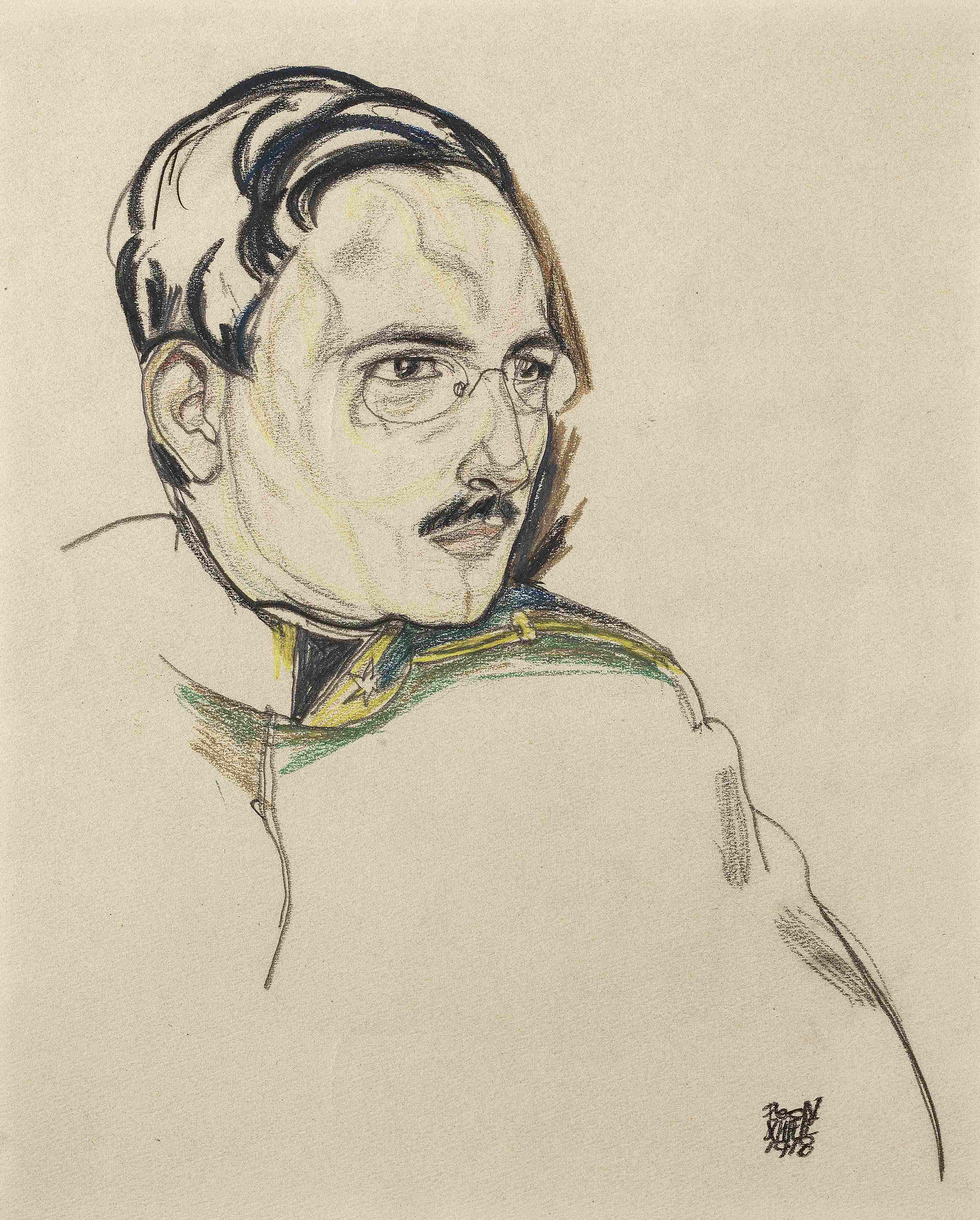
Egon Schiele:
Officer’s Portrait (Offiziersporträt), 1918
coloured pencil and pencil on paper
29.9 × 23.9 cm (11 3/4 × 9 7/16 in)
Auctioned at Bonhams for £88,500
(Kallir d2432)
By the later years of the First World War, the distance that once separated artists from the front had all but disappeared. Schiele was drafted just three days after his wedding, pulled abruptly from the world of the Secession into the machinery of the army. His weak heart and beautifully clear handwriting kept him away from direct combat, and he moved through a series of administrative posts — guarding prisoners, sorting documents, performing the quiet, necessary tasks that filled the days. These roles were modest, but they gave him something essential: small pockets of time in which drawing remained possible.
A turning point came in January 1917, when the young officer Karl Grünwald arranged for Schiele’s transfer to the Military Supply Depot in Vienna. The change allowed him to work with a steadier rhythm again. Under the watch of his commanding officer, Hans Rosé, he was even asked to document the depots — a bureaucratic assignment that nonetheless reopened a space for artistic concentration. Grünwald would later become a friend and patron, eventually acquiring Welke Sonnenblumen (Herbstsonne II), a major painting that vanished for decades before its restitution and celebrated sale in 2006.
This drawing, made in 1918 — perhaps after Schiele’s transfer to the Army Museum and shortly after his success at the Vienna Secession — portrays one of the officers with whom he served. The two were photographed together, suggesting a familiarity that softens the formality of the uniform. It may well have been a commission; Schiele often sketched his comrades, offering them portraits that balanced respect with his instinctive sensitivity to posture and mood. Here, the officer’s quiet composure becomes the heart of the sheet — a stillness Schiele captures with the pared‑back clarity that defines his late style.
The sheet is modest in scale, and the coloured pencil reflects the shortages of wartime Vienna, where artists worked with whatever materials they could secure. Yet the drawing carries a quiet warmth. Schiele’s line is steady and attentive, alert to the slight lift of the shoulders and the composed stillness of the sitter. The uniform recedes; what remains is the person — someone holding himself together in difficult times, allowing a brief moment of openness before the artist.
Schiele’s final year was marked by an extraordinary clarity of touch. Even amid scarcity and uncertainty, his late drawings have a gentleness and directness that feel like a final summation of his gifts. This Offiziersporträt belongs to that moment: a small, human work shaped by proximity, shared experience, and the deepening maturity of Schiele’s last months.

Leave a Reply