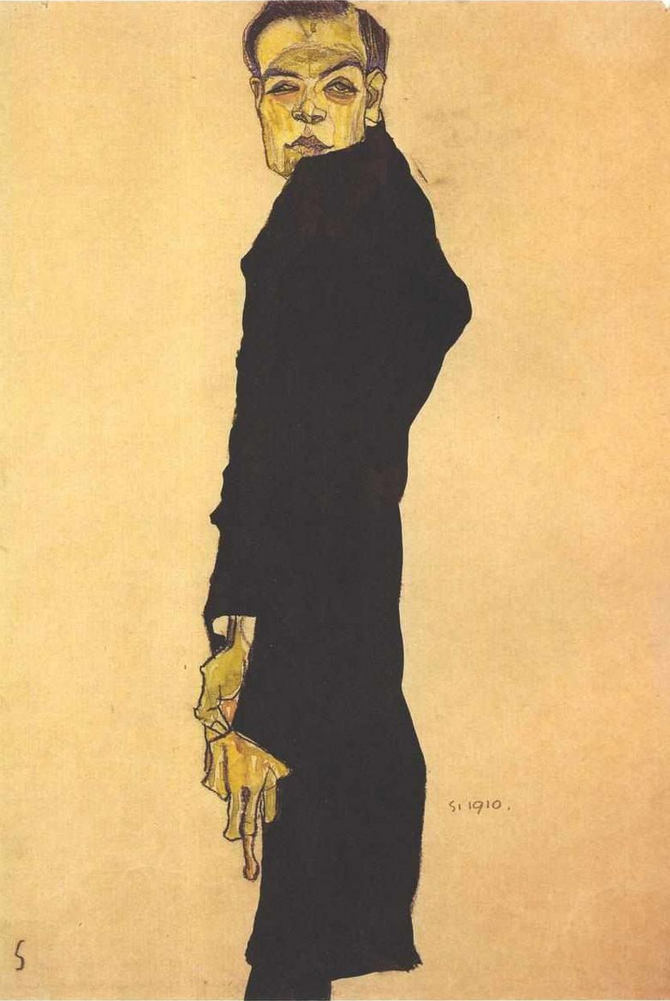
Egon Schiele:
Portrait of Painter Max Oppenheimer (Bildnis des Malers Max Oppenheimer), 1910
Gouache, watercolor, ink and black crayon
45.1 × 31.7 cm
© Serge Sabarsky Collection
(Kallir d588)
In 1909, Oskar Kokoschka and Max Oppenheimer helped forge a new direction in Viennese portraiture. They stripped away the decorative settings that traditionally framed the sitter and focused instead on psychological intensity, nervous line, and the charged presence of the figure itself. Schiele, only nineteen at the time, absorbed this shift immediately. Of the two, it was Oppenheimer — “Mopp,” as he was known — whose influence cut closest to the bone.
Schiele and Oppenheimer shared a studio for a period, and their exchange was direct, competitive, and mutually sharpening. Oppenheimer’s wiry contour, his abrupt simplifications, and his insistence on the sitter as a raw, exposed presence all left their mark on Schiele’s drawings of 1909–1910. These works show him breaking decisively with Klimt’s ornamental Art Nouveau elegance and moving toward a more angular, restless, and psychologically charged language.
This portrait is one of the clearest results of that encounter. Signed “S. 1910” in the lower right corner, it belongs firmly to Schiele’s breakthrough year — the moment when his line becomes taut, exposed, and unmistakably his. He renders Oppenheimer as a tall, tense figure, the body turned slightly away while the gaze confronts the viewer directly. That subtle twist — evasive body, direct eyes — creates a guarded, almost combative stillness. The yellow glove in his hand becomes a small, vivid accent against the muted field, a note of life in an otherwise stripped-down world.
The background is left blank, the figure suspended in open space. The mixed media — gouache, watercolor, ink, and black crayon — heighten the immediacy of the encounter. There is no softness, no decorative cushioning. Instead, Schiele captures a kind of electric immobility, as if Oppenheimer were held in place by the intensity of his own presence.
This drawing stands alongside other portraits from 1910 — tense, pared back, and searching — in which Schiele redefined what a portrait could hold. In depicting Oppenheimer, he was also tracing the contours of his own emerging style, one that would soon become unmistakably his.


Leave a Reply