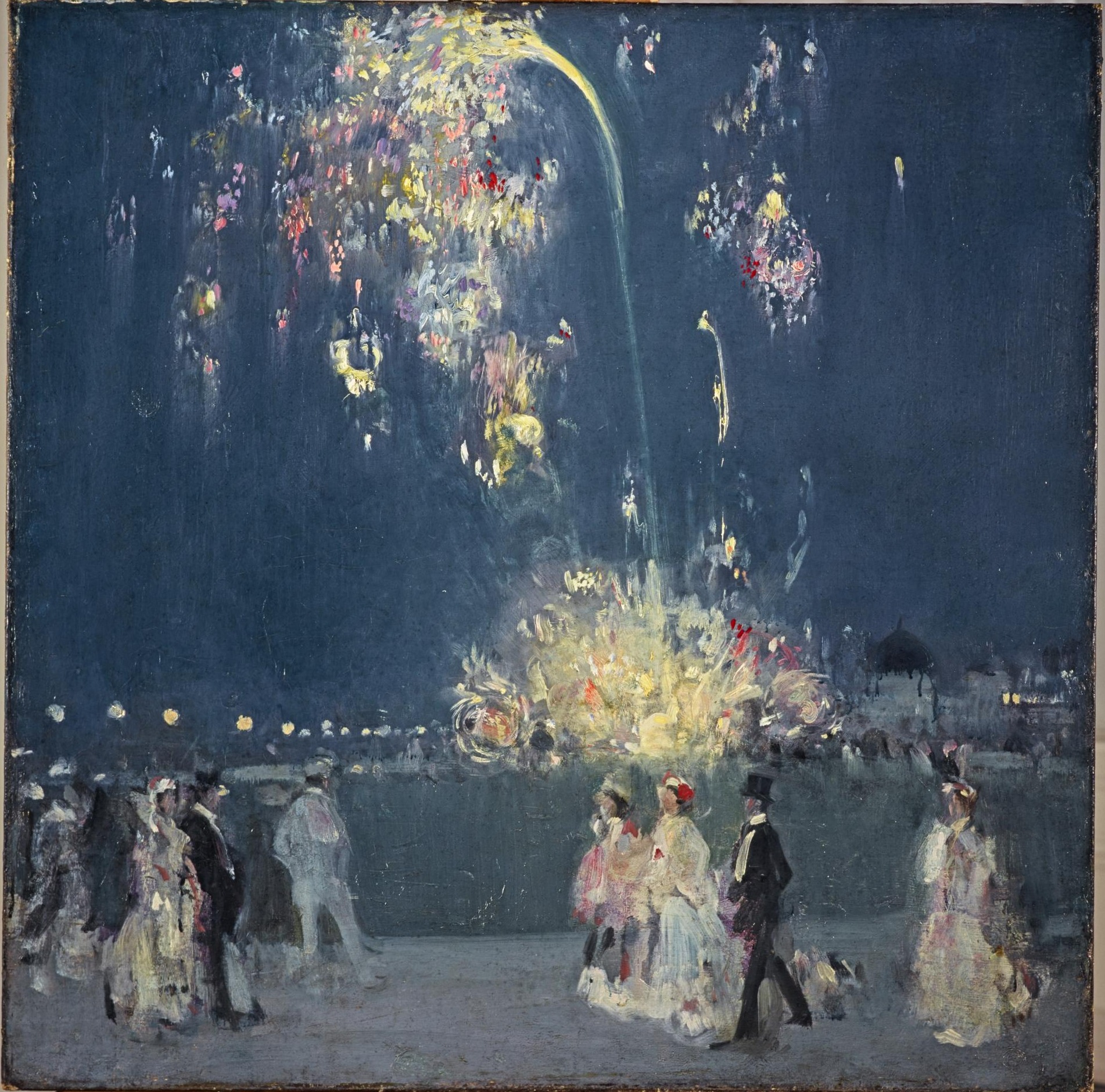
Scottish Colourists: John Duncan Fergusson
Dieppe, 1914
Oil on canvas
76.80 × 76.80 cm
© Fergusson Gallery, Perth, Scotland
Dieppe had long been a lively meeting point of artists, holidaymakers, and working harbour life — a place where the rhythms of modernity and the ease of a seaside town coexisted. Fergusson’s return to the Normandy coast in the years leading up to 1914 marked one of the most decisive phases in his development. The atmosphere of Dieppe — its sharp Channel light, its promenades, its mingling of locals and summer visitors — aligned perfectly with his increasingly modern, rhythm‑driven approach. There is a quiet warmth in these works: planes of colour set with assurance, silhouettes pared down to their essential gesture, and a palette that still carries the heat of Fauvism even as it cools toward the maritime tones of the coast. Even the simplest subjects — a harbour edge, a café terrace, a stretch of beach — feel touched by the easy movement of summer life.
The outbreak of war later that year forced Fergusson to leave France, closing a chapter that had shaped his artistic identity. Paintings associated with Dieppe in 1914 stand at this hinge: the last expression of pre‑war exuberance and the threshold of a more reflective, post‑Paris period. In this canvas, the square format heightens that sense of transition, holding luminous colour and rhythmic silhouettes in a poised, almost tender balance. It reads as both culmination and farewell — a final articulation of pre‑war clarity before the rupture that redirected the arc of his practice.
Fergusson’s position within the Scottish Colourists is distinctive. While Peploe, Cadell, and Hunter each absorbed French modernism in their own ways, Fergusson was the one who lived it most fully. Paris was not simply an influence but a home, and his engagement with Fauvism, dance, fashion, and the wider avant‑garde gave his work a cosmopolitan warmth that sets him slightly apart from the others. Margaret Morris, whose ideas about movement and rhythm were already shaping his thinking, added another layer to this openness — a sense that painting could carry the vitality of the body as much as the brilliance of colour.
The Scottish Colourists are introduced more fully elsewhere on this site, offering readers a broader sense of how Fergusson’s openness to French modernism both aligned him with the group and set him slightly apart. Where Peploe sought structure and Cadell refinement, Fergusson pursued rhythm — a living, breathing quality that runs through his Dieppe works as surely as through his portraits and still lifes. Dieppe, 1914 captures that spirit at its most open and generous, on the eve of a world about to change.
Leave a Reply