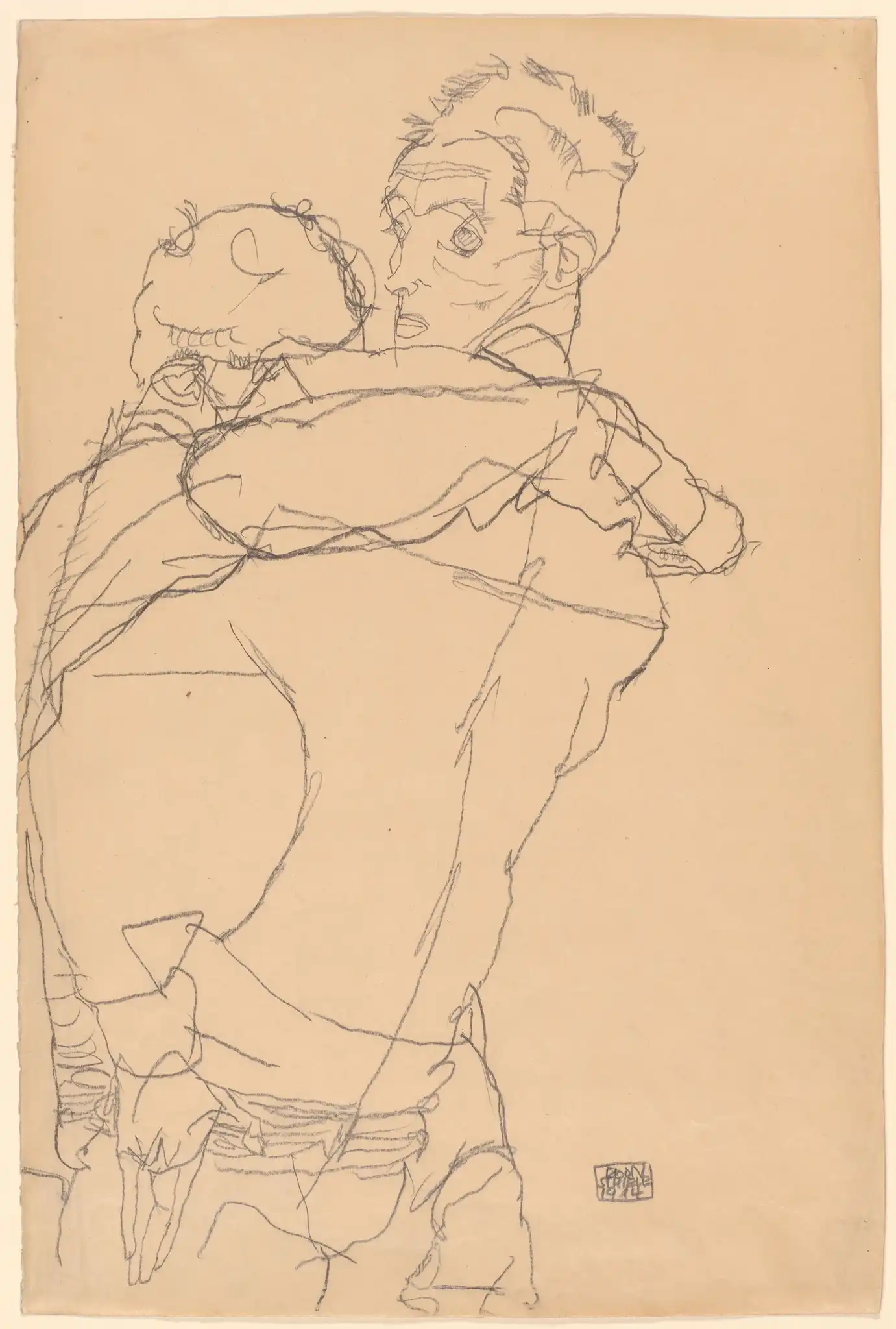
Egon Schiele:
Embrace (Umarmung), 1914
Graphite on wove paper
48.5 × 32.3 cm (19 1/8 × 12 3/4 in.)
© The Morgan Library & Museum, New York
(Kallir d1674)
This entry draws on the Morgan Library & Museum’s curatorial note, which offers a clear and sensitive reading of the drawing’s emotional and formal complexity.
Schiele was an extraordinarily prolific draftsman—at times producing nearly a drawing a day—and by the time of his death at twenty‑eight during the 1918 influenza pandemic, he had created around three thousand works on paper. Gustav Klimt played a crucial role in his early development, encouraging him to move beyond the constraints of academic training and toward a more personal, expressive language.
In his earliest drawings, Schiele relied on simple contour, with little shading or modeling. But around 1910, a decisive shift occurred: he abandoned Klimt’s decorative surface in favor of a rawer, more direct approach, where line itself became a vehicle for psychological intensity. Embrace belongs fully to this mature phase.
The drawing shows two figures locked in an embrace—one facing away, the other gazing out with wide, searching eyes. The man, understood to be Schiele himself, turns his head from the woman who holds him, creating a subtle but unmistakable tension. The couple is pushed to the left edge of the sheet, and the woman’s body is abruptly cropped. This asymmetry heightens the sense of imbalance, as though the closeness is both desired and resisted.
Seen in the light of 1914, the drawing carries an added resonance. This was the year Schiele was conscripted, and many works from this period seem to hover between intimacy and uncertainty, as if the emotional ground beneath his figures had begun to shift. In Embrace, that unease is present but understated—held quietly in the taut line, the turned head, the fragile space between two bodies.
Schiele’s contour is jagged, searching, and emotionally charged. There is no shading, no modeling—just line and the tension it holds. The result is a moment that feels both tender and unsettled, rendered with astonishing economy and honesty.


Leave a Reply to smitty415Cancel reply