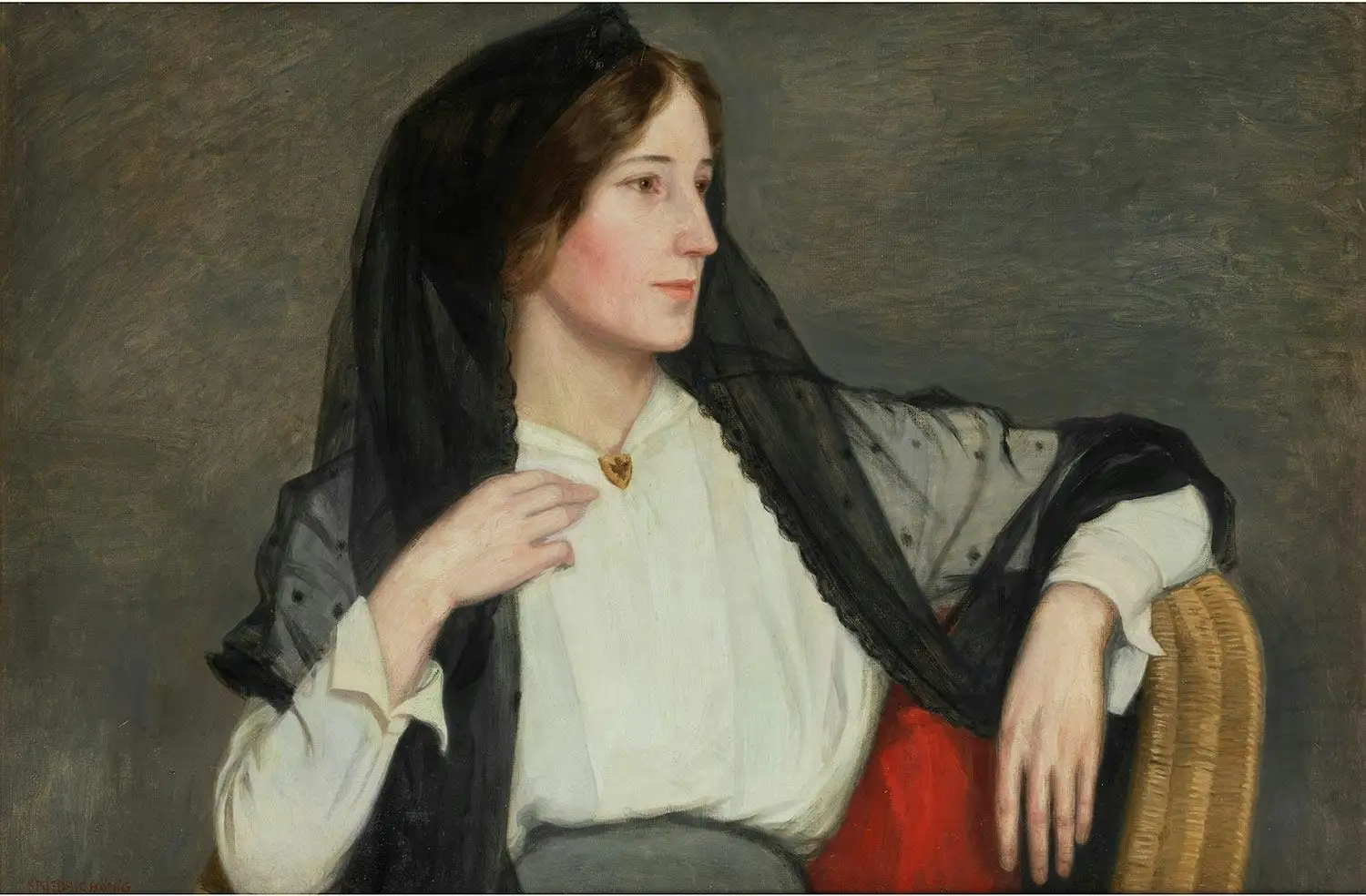
Vienna Secession: Friedrich König
Portrait of a Lady, ca. 1912–1915, (Portrait einer Dame)
Oil on canvas
66 × 79.5 cm
Auctioned at im Kinsky, Vienna, 2009
Friedrich König (1857–1941) was an Austrian painter, illustrator, and designer whose life and work were deeply woven into the fabric of the Vienna Secession. Born in Vienna, he trained at the Kunstgewerbeschule and later at the Academy of Fine Arts under Christian Griepenkerl, August Eisenmenger, and Carl von Blaas. Further studies in Munich and wide-ranging travels through Italy, Germany, Spain, and France gave him a broad artistic vocabulary and a sensitivity to the currents of European modernism.
In 1897 König stood among the founding members of the Vienna Secession, a group determined to break free from academic convention and open the door to new artistic languages. His role was not only as painter but also as designer and editor: he shaped the visual identity of the Secession’s journal Ver Sacrum, where his decorative clarity and organic motifs echoed the ideals of Art Nouveau.
The painting Portrait of a Lady, created between 1912 and 1915, belongs to his mature period. It shows König’s gift for combining psychological presence with stylistic restraint. The sitter is rendered with quiet atmosphere rather than overt ornament, embodying the Secessionist preference for elegance and balance. In this respect, the work resonates with Josef Engelhart’s portraits of Viennese women, which similarly merge individuality with stylized clarity, and with Maximilian Lenz’s depictions of female figures, where atmosphere and rhythm dominate. Together, these artists reveal how the Secession approached portraiture with nuance and modern sensitivity in the years before the First World War.
Beyond his own canvases, König was a devoted teacher at the Kunstschule für Frauen und Mädchen (Art School for Women and Young Women), opening professional paths for female artists at a time when opportunities were limited. He remained close to fellow Secessionists such as Engelhart, Rudolf Bacher, and Lenz, and his works were shown internationally, helping to establish Vienna’s reputation as a center of avant-garde art.
König’s legacy lies in his dual mastery of painting and design. His portraits, illustrations, and decorative works embody the Secession’s dream of a Gesamtkunstwerk, a “total work of art” where boundaries between disciplines dissolve. The 2009 auction of Portrait of a Lady at im Kinsky is one of several reminders that his art continues to be valued not only for its elegance and atmosphere but also for the way it captures the spirit of Viennese modernism. Until his death in 1941, König remained a vital figure in Austrian art, remembered for the refinement and warmth that defined his oeuvre.


Leave a Reply