Egon Schiele:
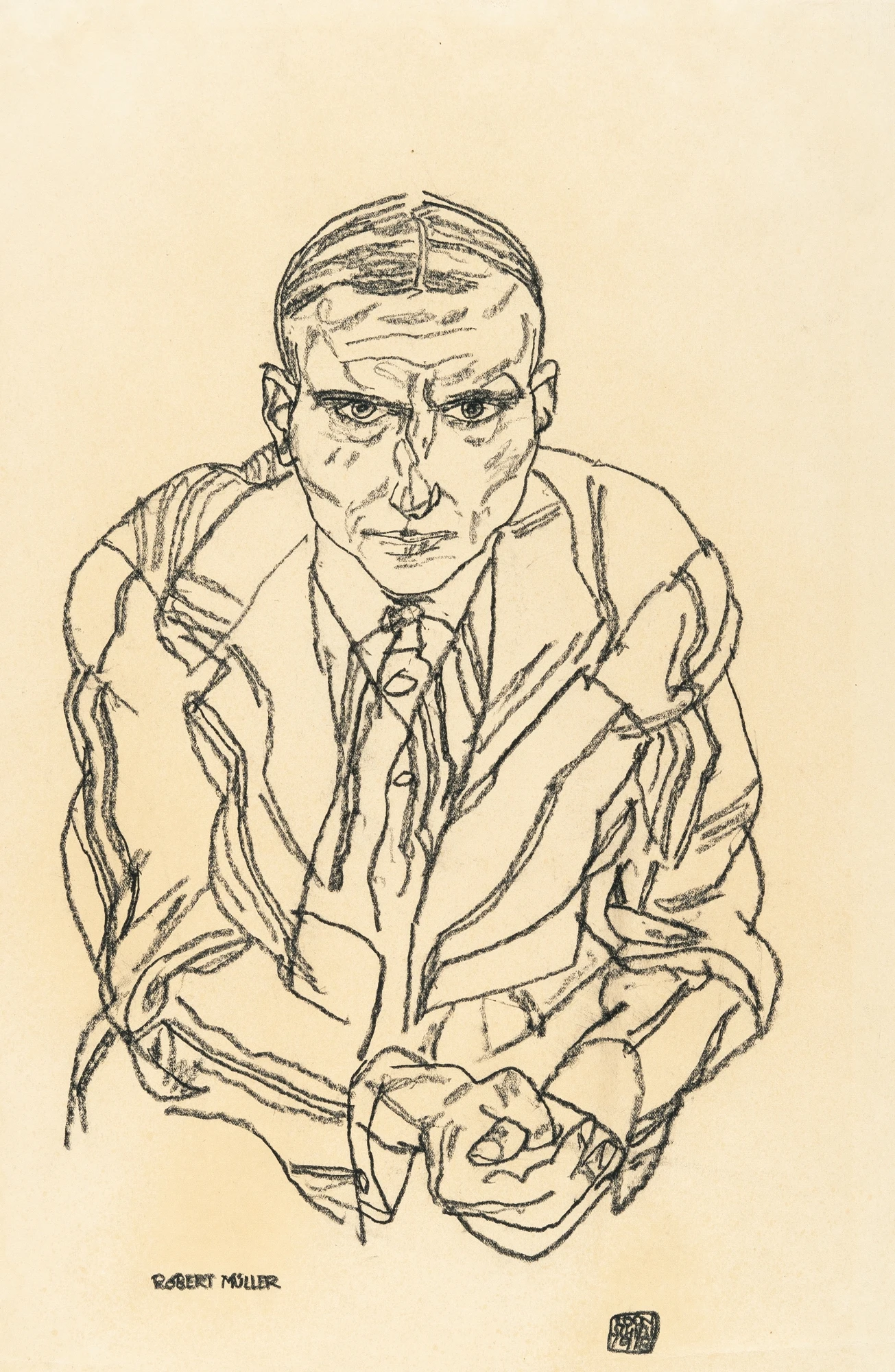
Portrait of Robert Müller (Porträt Robert Müller), 1918
Chalk on chamois‑colored drawing paper
45.5 × 29.5 cm
Auctioned at Karl&Faber in 2023
(Kallir d2436)
The figure depicted here is the Austrian writer, journalist, and publisher Robert Müller (1887 – Vienna – 1924). After studying German literature and philology in Vienna from 1907 to 1909, Müller traveled to the United States in 1910/11, where he was taken in by his uncle Wilhelm Emmert in Brooklyn. Through his uncle, who worked for the New Yorker Herold in Manhattan, Müller found employment, among other things, as a reporter. In the autumn of 1911 he returned to Vienna. Thanks to his many publications and his eccentric lifestyle, he quickly became one of the most striking representatives of Vienna’s expressionist literary scene.
In 1914 Müller published his first book, Irmelin Rose. The Myth of the Great City. His travel novel Tropen (1915) was reissued twice in the 1990s. During the First World War, Müller suffered a nervous breakdown at the front in August 1915 and was subsequently declared unfit for service. Within Vienna’s artistic and literary circles he met the young Egon Schiele.
In 1918 Schiele produced two studies of his friend for a planned painting. A further, very similar chalk drawing is today held by the Historical Museum of the City of Vienna (Kallir d2435). The painting Portrait of the Writer Robert Müller was begun by Schiele in January 1918, but remained unfinished due to his early death in October of that year. It is now in private ownership (Kallir P321).
From early January 1918 Müller sat for Schiele as a model. The portrait shows the writer in a suit with his hands folded, his arms resting loosely on his thighs. Müller fixes the viewer with a stern and penetrating gaze. Schiele captured his friend with flowing dark strokes on paper; no color was needed to convey the intensity. The portrait lives entirely through its dynamic and expressive line, a testament to Schiele’s mastery of draftsmanship, which came to an abrupt end in the year of its creation.
In a series of revolutionary portraits, Egon Schiele succeeded in breaking away from traditional notions of portraiture and redefining the genre. Toward the end of his life he gained increasing public recognition and, alongside Klimt, became one of the most important portraitists of Viennese modernism.
(Auction note at Karl & Faber, translated from German)
Leave a Reply