Egon Schiele:
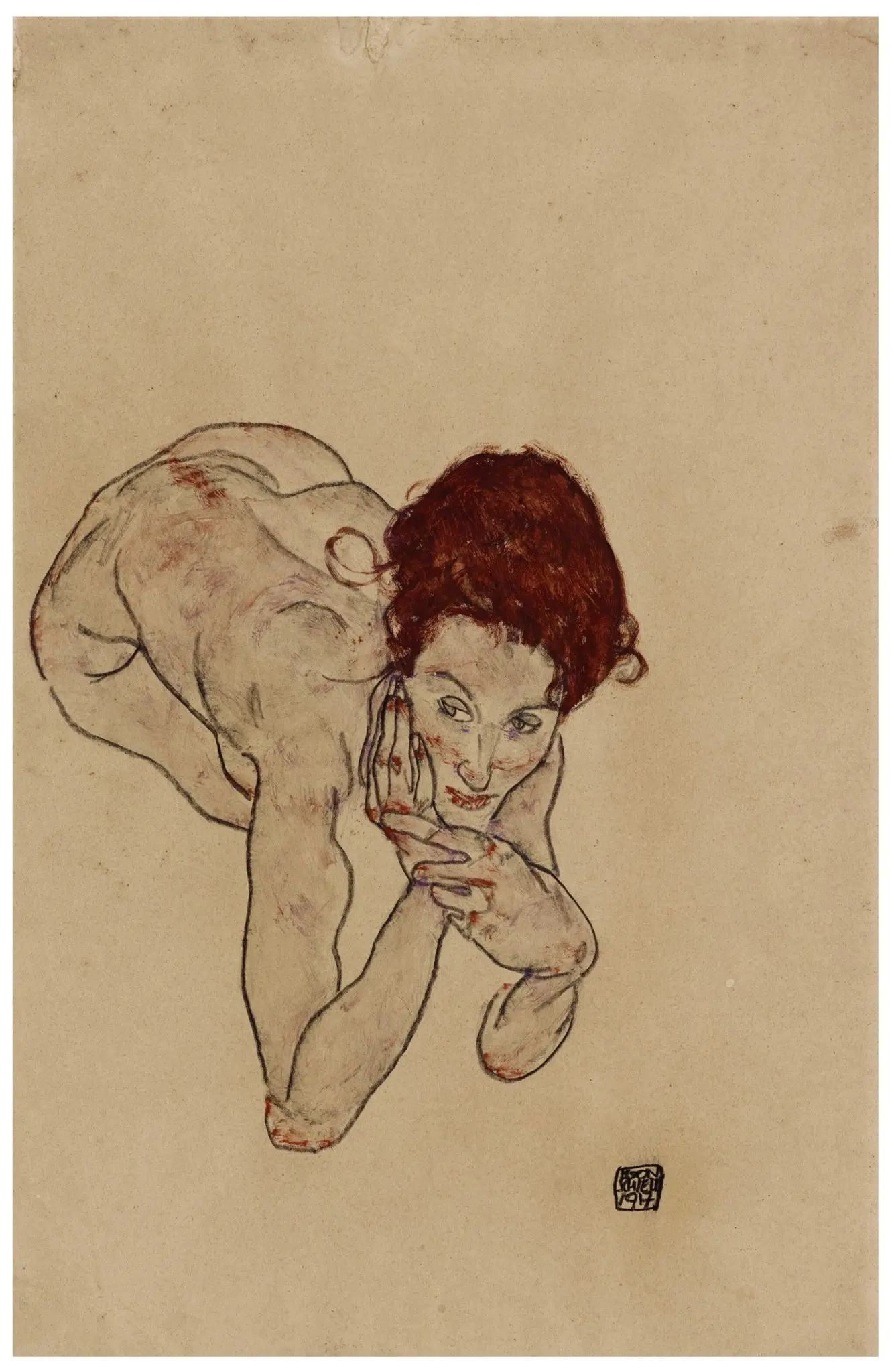
Crouching Female Nude, 1917 (Weiblicher Akt in Hockstellung)
Gouache, watercolor, and pencil on paper
45.9 × 29.7 cm
© Museum Ludwig, Cologne
(Kallir d1997)
In 1917, Egon Schiele’s work began to shift. He had married Edith Harms and spent time in the army, and his drawings started to reflect a quieter, more human side. The sharp, provocative energy of earlier years gave way to something more grounded—less about shock, more about presence.
Drawing became his main focus, and with access to professional models, he no longer had to rely on family or friends. Edith didn’t want to pose nude, though Schiele offered to change her features if she agreed. Her sister Adele was more open to modeling, but it’s not clear whether she ever posed unclothed. The two looked alike, and Schiele wasn’t always precise with faces—he was more interested in how a body moved or folded in space.
This crouching figure could be either sister—or someone else entirely. Adele had dark hair, Edith was blonde, but Schiele sometimes gave either reddish tones. The same face appears in other drawings from the year, suggesting he worked from memory or blended features from different models.
The use of gouache and watercolor softens the lines here. There’s a warmth to the pose, a sense of inwardness. Compared to his more upright or twisted nudes from the same period, this one feels quieter—almost private.
When the drawing went to auction in 2017, it was expected to sell for €700,000 to €1,200,000. It ended up fetching €2,345,000—a sign of how much Schiele’s late work still resonates.
(Thanks to Jane Kallir for her careful observations.)


Leave a Reply to Harold van de LaarCancel reply