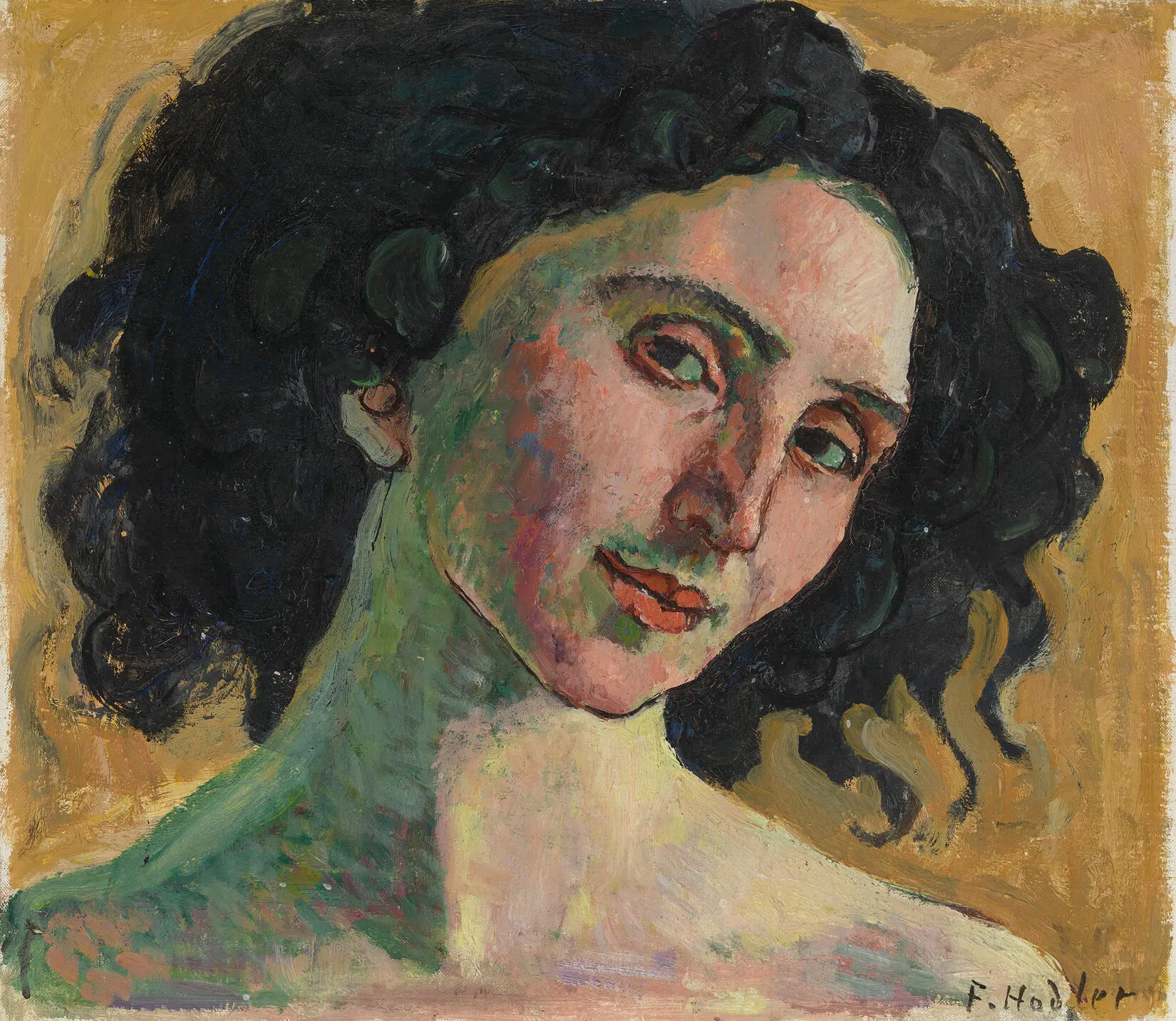
The Swiss Connection: Ferdinand Hodler
Portrait of Giulia Leonardi (Italian Woman) (Bildnis Giulia Leonardi [Italienerin]), 1910/1911
Oil on canvas
35 × 40 cm
Private collection
(© SIK 861)
Giulia Leonardi was an Italian singer and dancer working in Geneva around 1910. Hodler first saw her in a café and was struck by her presence—graceful, expressive, and full of energy. He asked her to model for him, and over time she became one of his most important collaborators during his final creative period.
Their relationship seems to have been professional. There’s no strong evidence of a romantic connection; instead, they shared a focus on art. Giulia’s ability to hold a pose and convey emotion matched Hodler’s interest in rhythm, gesture, and psychological depth.
This portrait, painted between 1910 and 1911, shows Giulia with her head tilted slightly, dark curls framing her face. The background is a muted ochre, and the brushwork is loose but deliberate. Hodler uses green and pink tones in the skin—not for realism, but to heighten the emotional charge. Her gaze is steady, maybe a little distant. It’s not theatrical, but it holds something back, which makes it all the more compelling.
The painting belongs to Hodler’s late phase, when he was moving away from naturalism and toward a more stylized, symbolic approach. It’s catalogued by the Swiss Institute for Art Research (SIK-ISEA), which maintains the official record of his work.
Hodler (1853–1918) had a complicated reception in Switzerland, but abroad he found recognition. He exhibited with both the Berlin and Vienna Secessions, and his 1904 show in Vienna was a turning point. His work influenced many artists in the Viennese modernist circle—Klimt, Kokoschka, Schiele—but Koloman Moser, especially after 1910, responded most directly to Hodler’s sense of structure and spiritual tone.


Leave a Reply