Gustav Klimt:
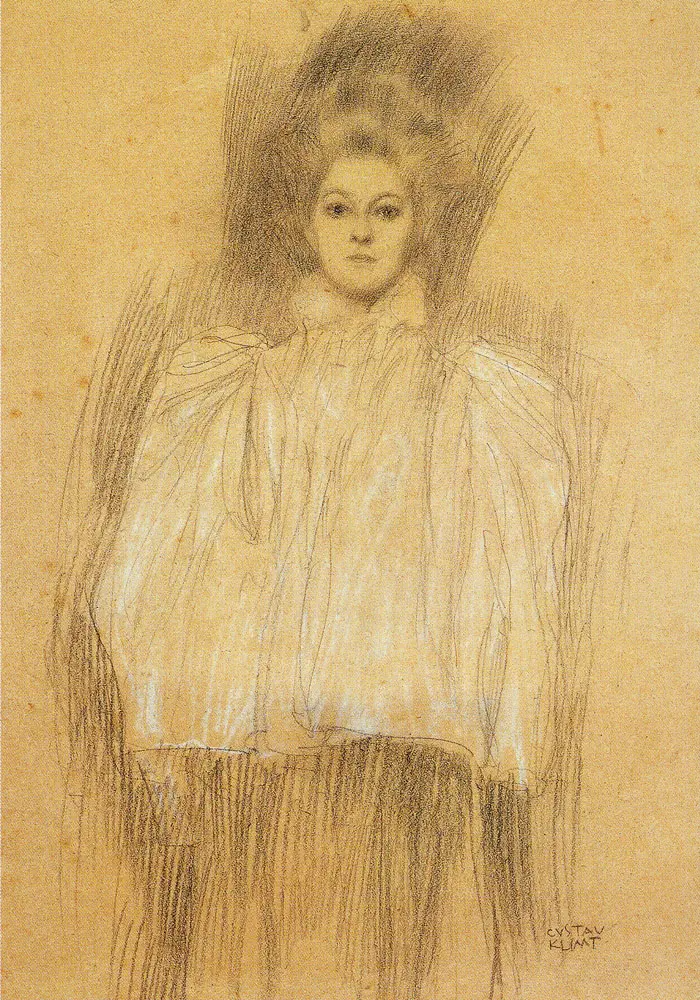
Standing Woman in Cape, Frontal View (Stehende Dame mit Cape von vorne), 1895
Pencil with white heightening on paper
44.1 × 29.8 cm (17 3/8 × 11 3/4 in.)
Private collection
(Strobl s270)
This drawing captures a quiet moment — a woman standing still, wrapped in a flowing cape that seems to hold her in a gentle embrace. Her gaze is soft, her posture composed, and there’s a subtle grace in the way her figure emerges from the page. Klimt’s pencil lines are delicate and assured, and the touches of white heightening bring a gentle glow to the folds of the garment, as if the light is just brushing against her.
There’s something timeless about her presence. She’s not posed for drama or ornament — she simply stands, calm and self-contained. The cape, drawn with loose, rhythmic strokes, gives her a sculptural silhouette, but it also adds a sense of mystery. We see her, but we don’t fully know her. That tension — between intimacy and distance — is part of what makes the drawing so quietly compelling.
Made in 1895, this piece sits at a turning point in Klimt’s career. He was beginning to move away from grand commissions and toward a more personal, expressive style. You can feel that shift here: the drawing isn’t trying to impress, it’s trying to understand. The woman isn’t a symbol or a society figure — she’s simply herself, rendered with care and restraint.
Though it lives in a private collection and isn’t often seen, this drawing speaks volumes. It’s a study in stillness, in presence, in the way a single figure can hold space without saying a word. And it reminds us that Klimt’s genius wasn’t just in gold leaf and ornament — it was in the quiet honesty of his line.
Leave a Reply