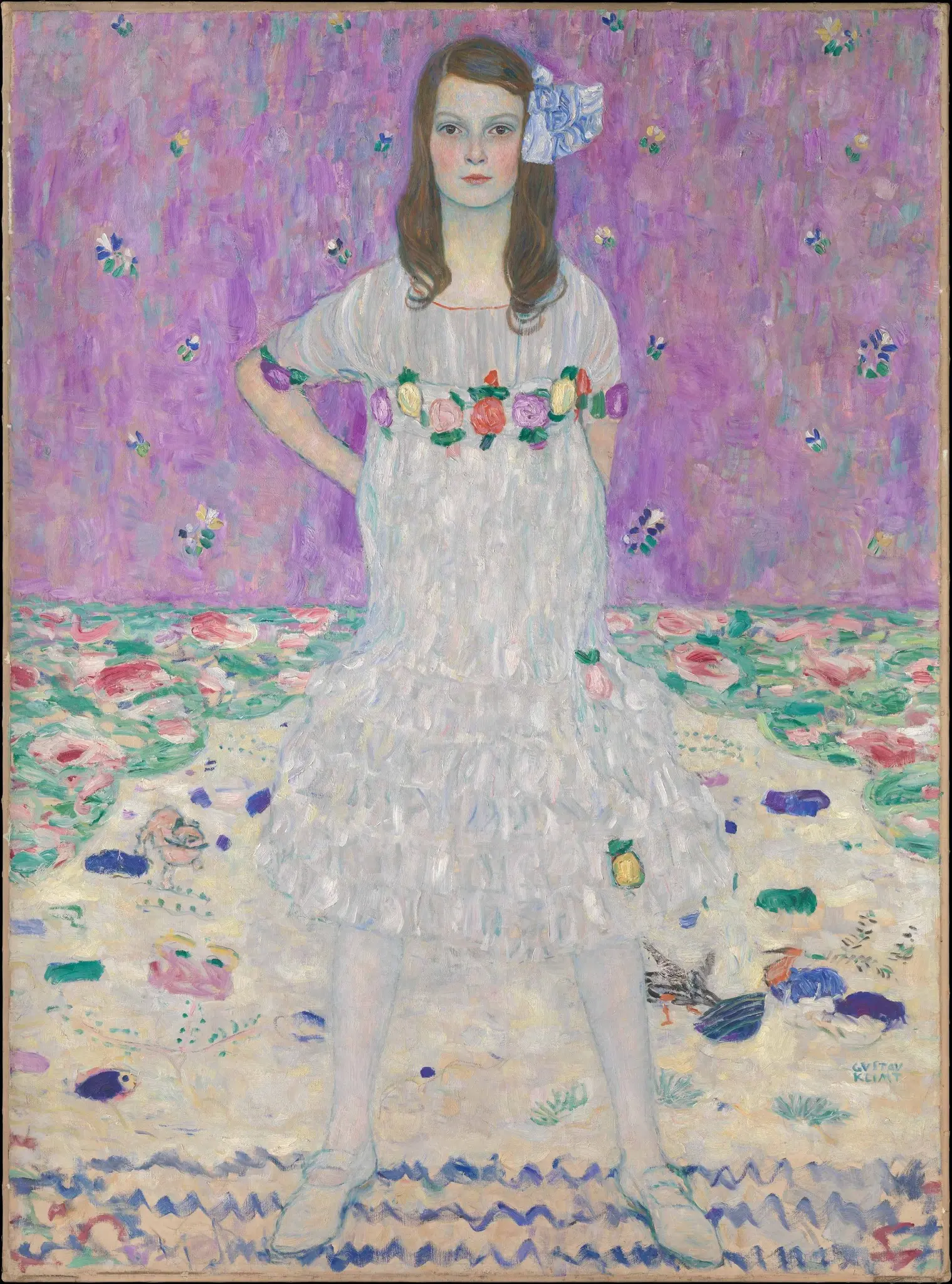
Gustav Klimt
Portrait of Mäda Primavesi (Bildnis der Mäda Primavesi), 1913
Oil on canvas
149.9 × 110.5 cm (59 × 43 ½ in.)
© The Metropolitan Museum of Art, New York
(Natter no. 202)
Painted in 1913, Portrait of Mäda Primavesi (Bildnis der Mäda Primavesi) stands apart within Gustav Klimt’s late portraiture. It is his only full-length depiction of a child on such a commanding scale, and it captures a moment of youthful defiance with striking clarity. Mäda, nine years old at the time, appears upright and self-assured in a custom-made white dress, her gaze direct, her stance unyielding. Family recollections describe her as strong-willed and tomboyish—traits Klimt neither softens nor exaggerates, but quietly affirms through posture and presence.
The portrait emerged from a meticulous process. Klimt produced numerous preparatory sketches, testing variations in pose, costume, and setting. The final composition surrounds Mäda with springlike ornament—floral rhythms, soft greens, and decorative motifs that echo the visual language of the Wiener Werkstätte. These elements do not distract from the sitter; they extend her world, amplifying her vitality without overwhelming her figure.
Stylistically, the work belongs to Klimt’s post-Golden Period, when his surfaces grew less gilded and more organic. The flattened space, patterned backdrop, and textile-like integration of figure and ground reflect his continued engagement with Japanese prints and Secessionist design. Compared to earlier portraits such as Adele Bloch-Bauer I, the Primavesi canvas feels less ceremonial, more immediate—its ornamentation not a veil but a frame for individuality.
The scale itself is unusual. At nearly 150 cm tall, the canvas elevates Mäda to adult-like stature, challenging conventional expectations of how children are portrayed. Klimt’s contours blur the boundary between child and environment, allowing Mäda to inhabit a stylized, cultivated space. Her dress, designed specifically for the portrait, anchors the composition with crisp clarity, acting as both garment and visual counterpoint.
The commission came from Otto Primavesi, a Moravian banker and industrialist, and his wife Eugenia, both active patrons of the Viennese avant-garde. Their support extended beyond Klimt to the broader Secessionist and decorative arts movements, including Josef Hoffmann and Dagobert Peche. Their Vienna residence reflected this commitment to progressive design. Klimt would later paint Eugenia’s portrait as well—an elegant counterbalance to Mäda’s youthful energy—now housed in the Toyota Municipal Museum of Art in Japan.
Together, the portraits of mother and daughter form a rare familial pairing in Klimt’s oeuvre. Mäda’s portrait, in particular, remains unmatched in its scale and intimacy. It is not simply a depiction of a child, but a study in individuality, modern femininity, and the evolving role of portraiture in early 20th-century Vienna.
The painting’s provenance includes a difficult chapter. In 1938, during the Nazi annexation of Austria, the work was seized from Jenny Pulitzer Steiner, a member of Vienna’s cultural elite. It was one of many Klimt works looted from Jewish collectors. After the war, following years of restitution efforts, the painting was returned to Steiner in 1951—a rare act of recovery amid widespread cultural loss. The case echoes other restitutions, such as that of Adele Bloch-Bauer I, and underscores the complex legacy of Klimt’s reception and ownership.
Mäda herself lived through the upheavals of the century. She emigrated from Austria after the Second World War and settled in Canada, where she remained until her death on 25 May 2000. With her passing, the last living person to have sat for Klimt was gone. Her portrait endures—a luminous record of youth, resilience, and the quiet radicalism of Klimt’s gaze.


Leave a Reply