Egon Schiele:
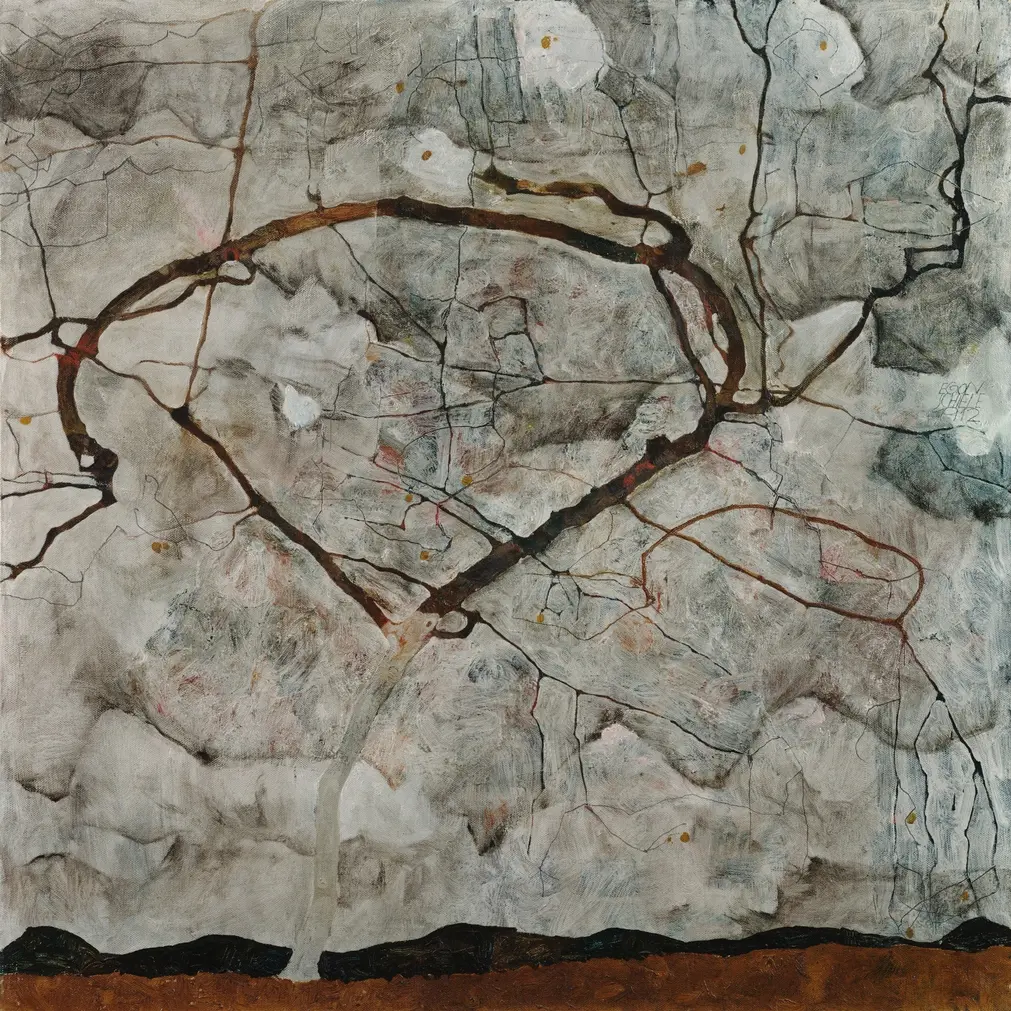
Autumn Tree in Stirred Air (Winter Tree) (Herbstbaum im bewegten Wind), 1912
Oil, pencil on canvas
80 × 80.5 cm
© Leopold Museum, Vienna
(Kallir P122)
Also known as Winter Tree, this painting’s alternate title underscores the starkness and seasonal exposure at its core. A single bare tree, wind-lashed and luminous, rises into a sky fractured into shifting gray planes. Its bleached trunk nearly dissolves into the background, amplifying the isolation of its wiry, agitated branches—drawn like nerves across the surface. A thin horizontal band at the base suggests the ground in shorthand, while distant hills are reduced to stylized silhouettes, more emotional than topographical.
In his landscapes, Egon Schiele (1890–1918) channels a psychological intensity equal to that of his portraits. Nature becomes a mirror for the human condition: trees, fences, and skies are not passive scenery but charged presences, inscribed with gestures of longing, fragility, and resistance. As in Small Tree in Late Autumn, painted shortly before, Autumn Tree in Stirred Air (Winter Tree) is less a depiction of place than a distilled state of being. The tree’s bareness and solitude evoke exposure, endurance, and the will to persist.
The work was acquired in 1912 by Magda Mautner Markhof (1881–1944), a member of a prominent Viennese industrial family and one of Schiele’s earliest private collectors. Her early support helped bring visibility to Schiele’s emotionally charged landscapes, especially following their debut at the Hagenbund that same year.
In his 1923 essay Egon Schieles Weg und Ziel, written for the artist’s posthumous solo exhibition at the Neue Galerie in Vienna, art historian Kurt Rathe (1886–1952) described Schiele’s landscapes as suffused with “the special atmospheric magic of a moribund nature.” He saw in them “infinitely sensitive organisms,” whose trembling inner life was expressed through fences, telegraph wires, and the filamentous branches of leafless trees.
Here, the tree is not merely a botanical subject—it is a solitary figure, exposed to elemental forces, its form stretched taut with psychic tension. Its presence is both fragile and defiant, a silent witness to the turbulence of its world.
This entry is based on and expands upon a wall note at the Leopold Museum, Vienna.

Leave a Reply