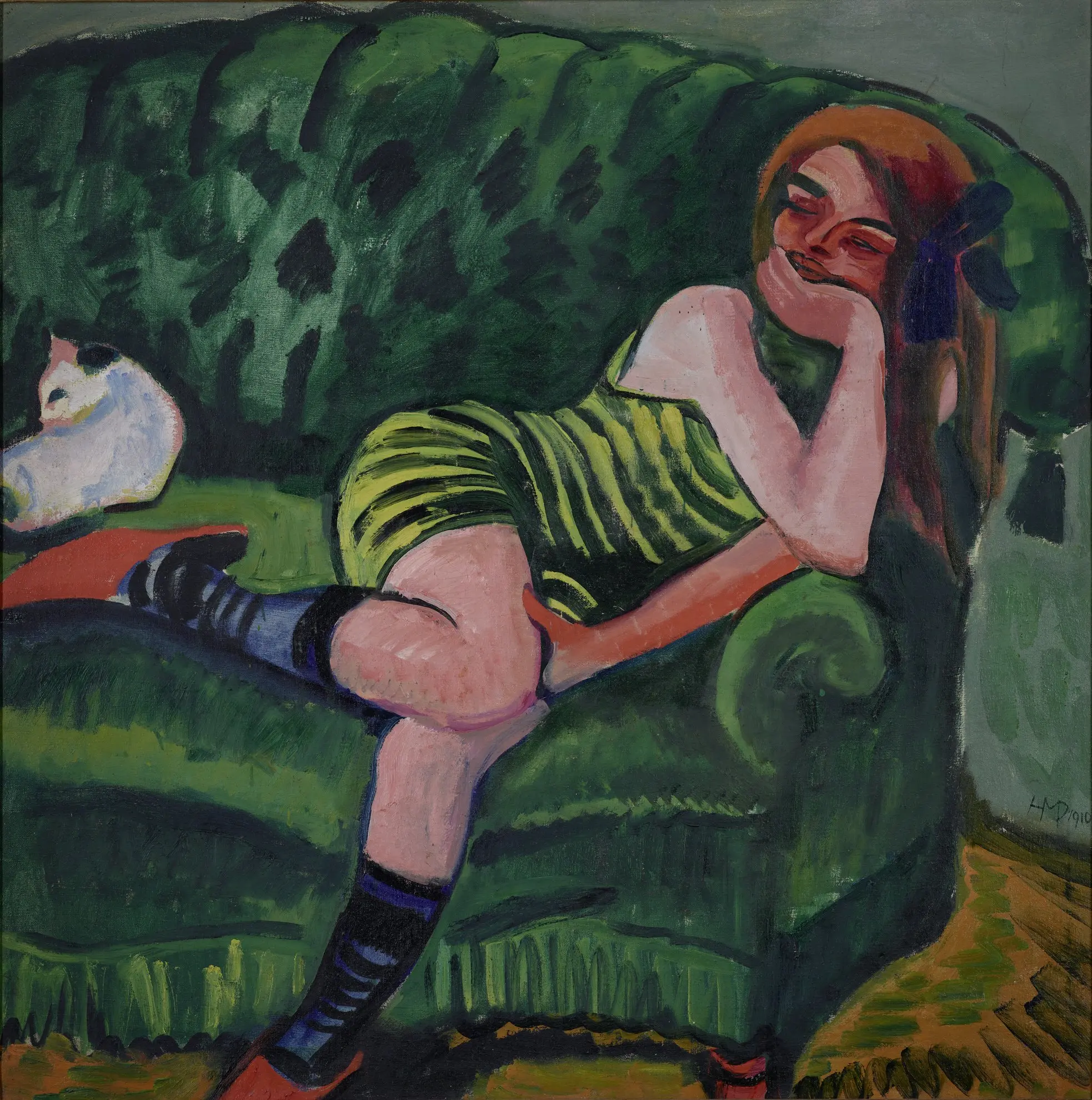
Die Brücke / Degenerate Art: Max Pechstein
The Green Sofa (Das grüne Sofa, 1910) – Max Pechstein
Oil on canvas
96.5 × 96.5 cm
© Museum Ludwig, Cologne, Germany
This painting seems to have a twin—perhaps even a triplet. Viewers often feel they’ve seen it before. That’s because The Green Sofa by Pechstein was echoed in a near-identical composition by Ernst Ludwig Kirchner, painted around the same time. The resemblance is striking: same model, similar pose, and a shared atmosphere of compressed stillness.
In 1905, four architecture students in Dresden—Ernst Ludwig Kirchner, Fritz Bleyl, Erich Heckel, and Karl Schmidt-Rottluff—founded Künstlergemeinschaft Die Brücke, seeking to break free from academic constraints and embrace a rawer, more immediate form of expression. Over the years, the group expanded to include artists like Max Pechstein, Emil Nolde, and Otto Mueller—each with their own rhythm, but often working side by side.
They shared studios, models, summers in Moritzburg, and a belief in the unfiltered gesture. For a time, they even shared Fränzi.
Fränzi—Lina Franziska Fehrmann, born in 1900—entered their orbit in 1909, when she was just eight. She became a recurring figure in their work: sometimes stylized, sometimes stark, sometimes unsettlingly direct.
Decades later, works like The Green Sofa would be labeled “degenerate” by the Nazi regime—condemned for their rawness, their modernism, and their refusal to idealize.
Recent research has focused on the girls who appear in these paintings, with Fränzi at the center. She was portrayed dozens of times, studied by art historians, and remembered—if not always gently—by the artists themselves.
She had two daughters and, by most accounts, a difficult life. In 1926, Kirchner visited her at her home in Dresden and noted in his sketchbook that she seemed sad, though her memories of those early years were dear to her.
Though she became a subject of fascination, Fränzi’s own voice remains faint—preserved only in fragments, sketches, and secondhand notes.
During the bombing of Dresden, she fled with her children. She died of heart failure in 1950. But she remains—immortalized in oil and canvas—as a muse of Die Brücke, and a quiet witness to the contradictions of German Expressionism.
(Credit to the Dutch article by Sjaak van der Vooren.)

Leave a Reply