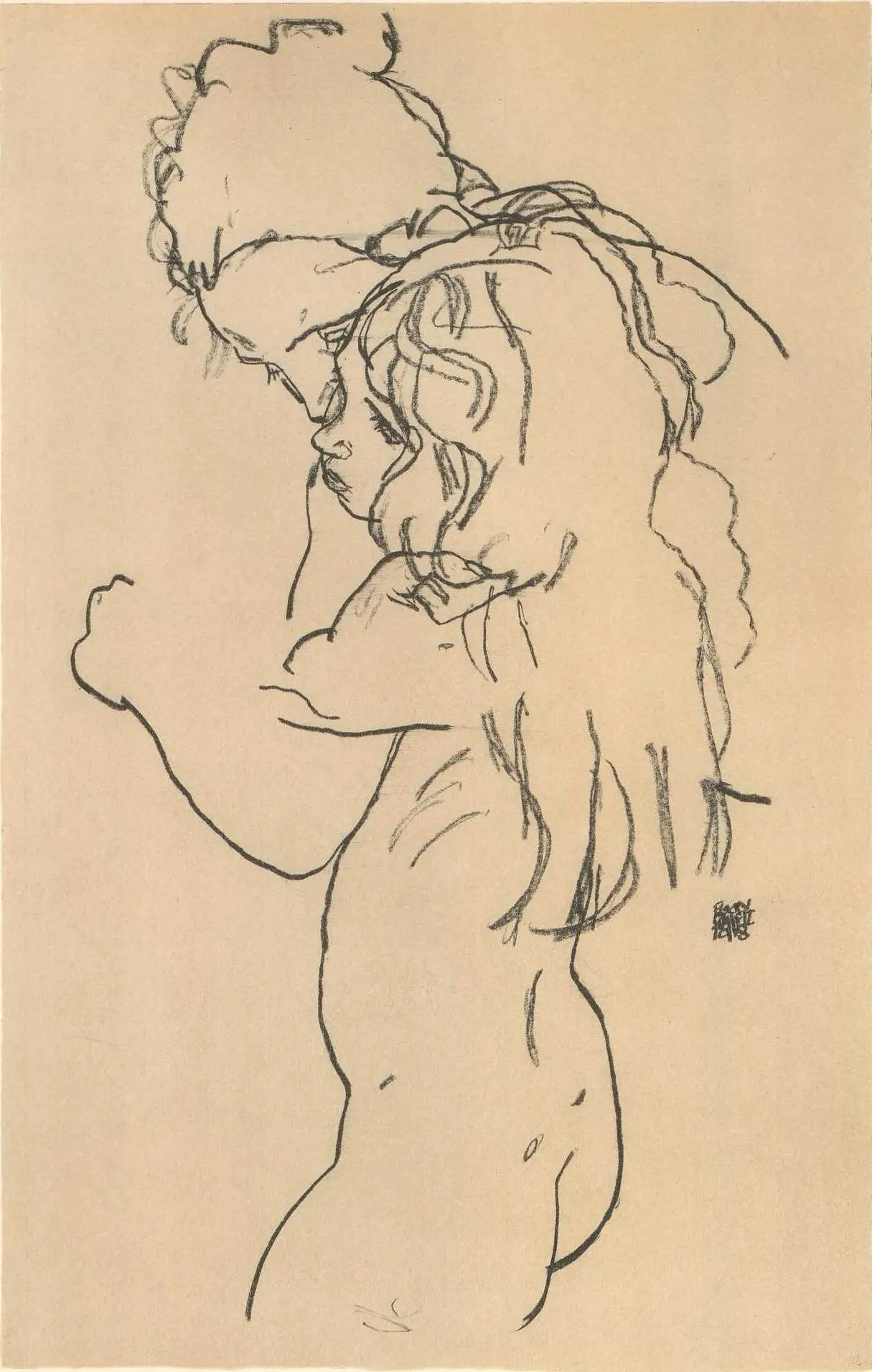
Egon Schiele:
Mother and Child (Mutter und Kind, 1918)
Black crayon
46.2 × 26.7 cm
Private collection
(Kallir d2192)
In 1912, Egon Schiele was arrested in Neulengbach, a small provincial town west of Vienna, where he had moved to live and work with his partner, Wally Neuzil. The charges were serious: seduction and abduction of a minor, and public indecency for displaying erotic drawings where children could see them.
Though the accusations of seduction and abduction were quickly dropped—there was no legal basis, and the girl in question had left home voluntarily—the scandal escalated. Local police raided Schiele’s studio and found dozens of erotic drawings, many featuring young models. These were confiscated and labeled “pornography.”
The trial lasted only a few days, but its impact was lasting. The judge, reflecting the moral outrage of the townspeople, made a symbolic gesture: he burned one of Schiele’s drawings over a candle flame in the courtroom. It was a public condemnation not just of Schiele’s conduct, but of his art.
After the Neulengbach affair, Schiele became more cautious. He never again drew nude minors. The incident marked a turning point in his approach to figuration and intimacy. He understood that exhibiting erotic work—especially involving young subjects—could result in severe punishment, including up to six months of hard labor.
It’s important to view Mother and Child (Mutter und Kind) in light of this history. Created six years after the scandal, and just months before Schiele’s death from the Spanish flu, the drawing belongs to a late series exploring maternal intimacy. There are roughly a dozen works in this group. Some depict the child alone, but they were conceived as part of a mother-child pairing.
The mother’s presence is essential—not just compositionally, but ethically. These drawings are not erotic; they are tender, searching, and quiet. They reflect a shift in Schiele’s emotional register: from provocation to vulnerability, from confrontation to care.
Presenting one drawing in isolation—especially one showing only the child—can lead to misinterpretations we want to avoid. Context matters. In Schiele’s case, it is fragile, often distorted by omission or projection.
This work is not a provocation. It is a farewell.


Leave a Reply