Egon Schiele
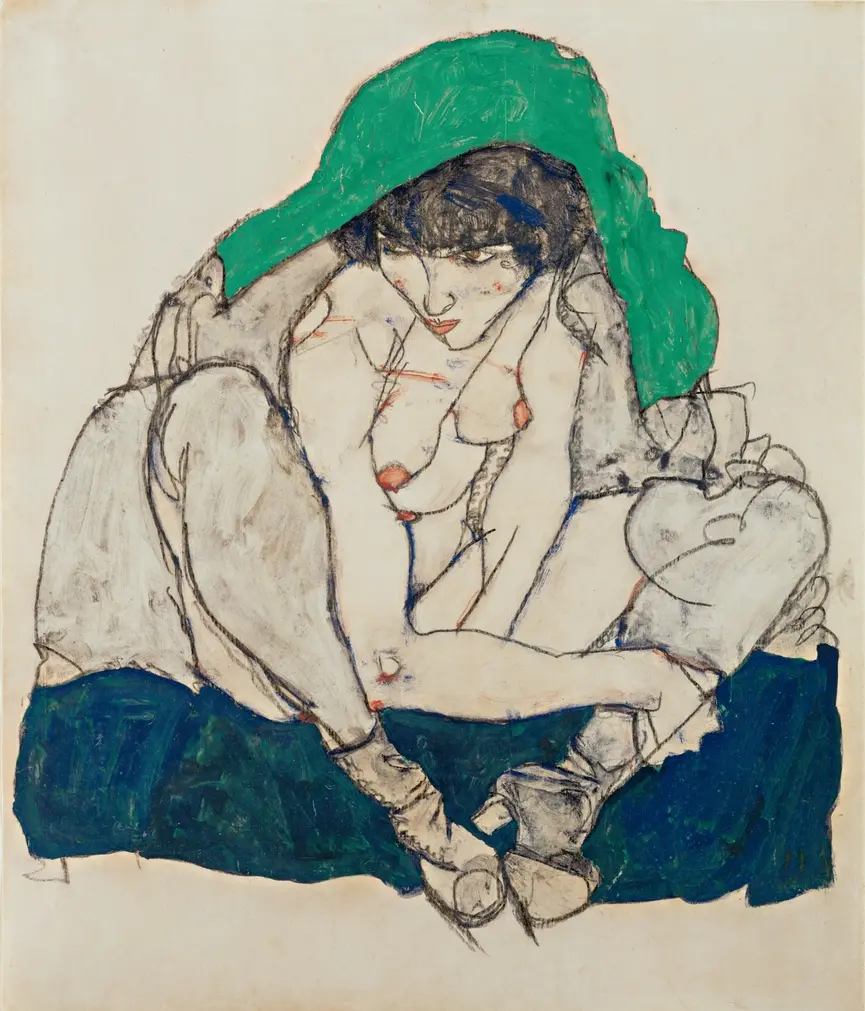
Crouching Woman with Green Headscarf, 1914 (Kauernde mit grünem Kopftuch)
Pencil, gouache on paper
47 × 31 cm
© Leopold Museum (Kallir d1500)
A woman folded into herself—knees drawn close, arms tucked, head wrapped in a green kerchief that anchors the composition like a visual sigh. Schiele’s line is taut, almost surgical, yet never cold. It vibrates with urgency, with the tension of containment. The figure crouches not in fear, but in a kind of defiant introspection. Her posture is protective, yes, but also declarative: this is a body that refuses to perform.
The green headscarf is no mere accessory. It’s a chromatic counterpoint to the pallor of skin and the rawness of pose—a flash of color that holds the eye, even as the rest of the figure recedes into shadow and contour. Schiele’s gouache bleeds into the paper with a kind of bruised tenderness, never quite filling the form, always leaving room for ambiguity.
This work belongs to a moment in Schiele’s career when his figures became less eroticized and more psychologically charged. The crouching woman is not an object of desire but a subject of complexity. Her gaze—if visible—is not directed outward but inward, or perhaps nowhere at all. She is not here to be seen; she is here to exist.
The paper itself bears witness to Schiele’s process: pencil lines that hesitate, gouache that pools and thins, edges that feel torn rather than framed. There’s no theatricality, no decorative flourish. Just the stark intimacy of a woman in a moment of withdrawal, rendered with brutal grace.
This is Schiele at his most honest—unvarnished, unfiltered, and unafraid to show the body as a site of tension, solitude, and resilience.


Leave a Reply to Margarita.Cancel reply