Gustav Klimt:
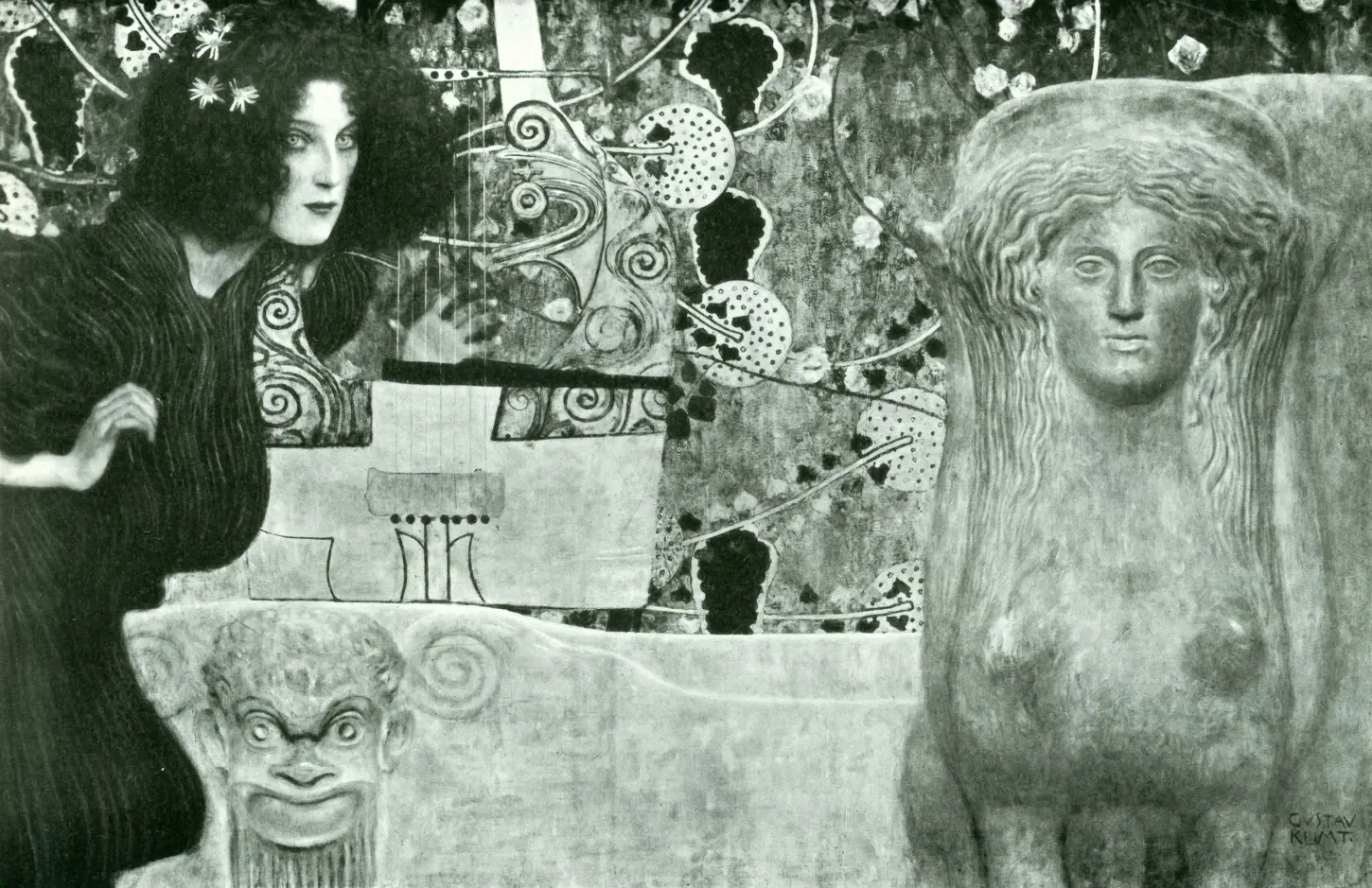
Music (Die Musik), 1897–98
Oil on canvas
150 × 200 cm
Presumed destroyed at Schloss Immendorf, May 8, 1945 (formerly Nikolaus Dumba and August and Serena Lederer collections)
(Natter 101)
Music (Die Musik) is generally believed to have been destroyed in the fire at Schloss Immendorf in Lower Austria in May 1945, one of two monumental overdoor canvases Gustav Klimt painted for the Vienna palace of industrialist Nikolaus Dumba. The painting survives today solely through historical photographs and early photogravure editions. When Klimt unveiled the work in November 1898, its flattened decorative patterns and antique motifs announced his decisive turn toward the symbolist aesthetic of the Vienna Secession.
A Painting for Dumba’s Music Room
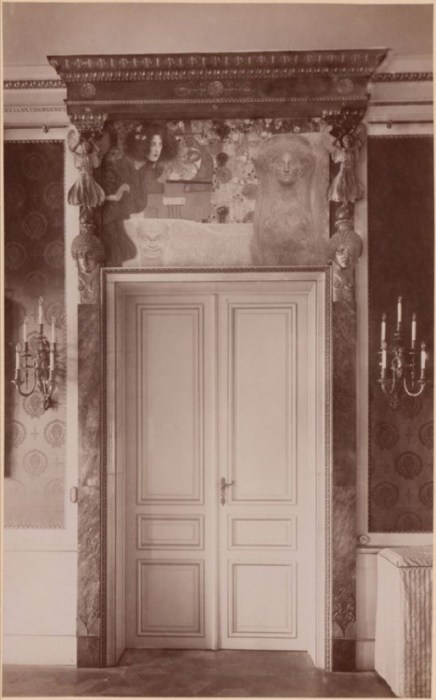
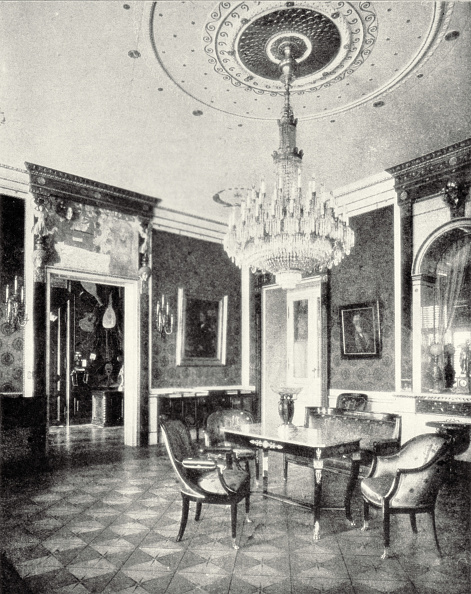
Greek-Austrian industrialist and arts patron Nikolaus Dumba commissioned Gustav Klimt to decorate the music salon of his Ringstraße residence, Palais Dumba, on Parkring 4. The architectural program required two large horizontal overdoor paintings (Supraporten) of identical dimensions: Music (1897–98) and Schubert at the Piano (Schubert am Klavier, 1899). Installed directly above the paneled double doors beneath a heavy cornice flanked by sculpted herms and winged figures, the canvas anchored classical antiquity inside the domestic music room.
Seen in its original setting, the painting appears less like an independent picture and more like part of an immersive decorative ensemble. The ornamental forms within the canvas echo the rich decoration of the room itself, blurring the boundary between painting and architecture. Visitors entering the room would have encountered the painting high above the doorway, where its broad horizontal format echoed the architecture around it.
Comparing Music with Klimt’s surviving 1895 oil sketch in the Neue Pinakothek in Munich reveals how dramatically his style changed within only a few years. In the small Munich study, soft brushwork surrounds the musician inside a conventional historicist space. Three years later, in the full-scale canvas for Dumba, Klimt compressed the spatial depth into a dense ornamental surface, a transformation that also reshaped his preparatory work for Schubert at the Piano.
Symbolist Iconography and Early Photogravure Editions
Along the left edge of the composition, a young woman with dark curls and white blossoms wears a dark pleated gown. She turns her torso toward the right to pluck the strings of a classical kithara with a plectrum while glancing back at the viewer. Although her hands remain occupied with the strings, her attention seems directed elsewhere. Rather than looking at the instrument, she gazes outward, establishing a direct connection with the viewer. Against the pale surface of the kithara and the richly patterned background, her dark figure becomes the visual focus of the entire composition.
Directly beneath the instrument sits a sculpted mask of Silenus Silenus, a mythological figure associated with music, wine, and theatre, with wide eyes and a vertical beard. Opposite the musician, a frontal stone sphinx with long wavy hair anchors the right side of the canvas against a background of winding vine stems and pale perforated discs. The musician, the Silenus mask and the sphinx seem to watch over the scene together. Their presence gives the painting an atmosphere that feels more symbolic and theatrical than purely musical.
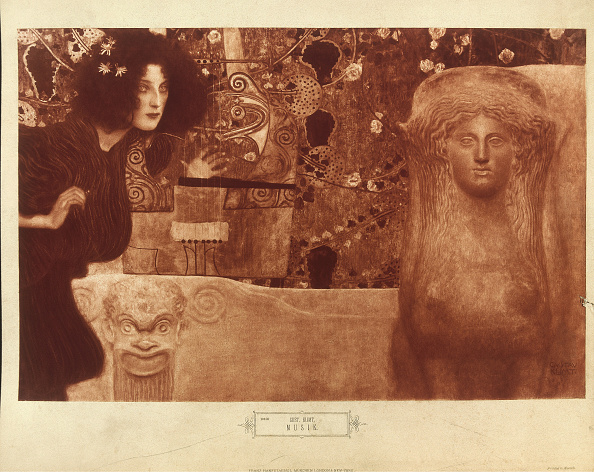
Before installing the canvas in Palais Dumba, Klimt exhibited Music at the second exhibition of the Vienna Secession in November 1898. The show celebrated the opening of Joseph Maria Olbrich’s new Secession building on Friedrichstraße. Many reviewers saw in it the new artistic direction of the Vienna Secession, noting its stylized contours and flat decorative zones. Soon after its debut, Munich art publisher Franz Hanfstaengl issued a large-format sepia photogravure (plate 16150), preserving crisp tonal details of the lost original alongside Josef Löwy’s Viennese photographs preserved in the MAK.
The Lederer Collection and the 1945 Fire
After Nikolaus Dumba died in 1900, Music entered the collection of August and Serena Lederer, Klimt’s foremost Viennese patrons. For nearly four decades, the canvas hung alongside major works by Klimt and Egon Schiele in the Lederer residence on Bartensteingasse. Following the German annexation of Austria in March 1938, National Socialist authorities confiscated the Jewish-owned Lederer holdings and placed Music under state control.
The painting appeared publicly one final time at the 1943 Gustav Klimt retrospective in Vienna. Later that year, officials transferred the confiscated Lederer canvases and Klimt’s three Faculty Paintings to Schloss Immendorf, a remote castle in Lower Austria chosen for wartime storage. On May 8, 1945, retreating SS units set fire to the castle. Music is generally presumed to have been lost there, together with more than a dozen other paintings by Klimt. No trace of the painting has surfaced since.
Although the original painting is generally believed to have disappeared at Schloss Immendorf, photographs and photogravures preserve a vivid impression of its appearance. The musician’s direct gaze, the bearded mask of Silenus, and the silent sphinx still command attention today. Even in reproduction, it is possible to see Klimt searching for a new visual language, one that would soon set his work apart from the historicist traditions of the nineteenth century.


Leave a Reply