Egon Schiele:
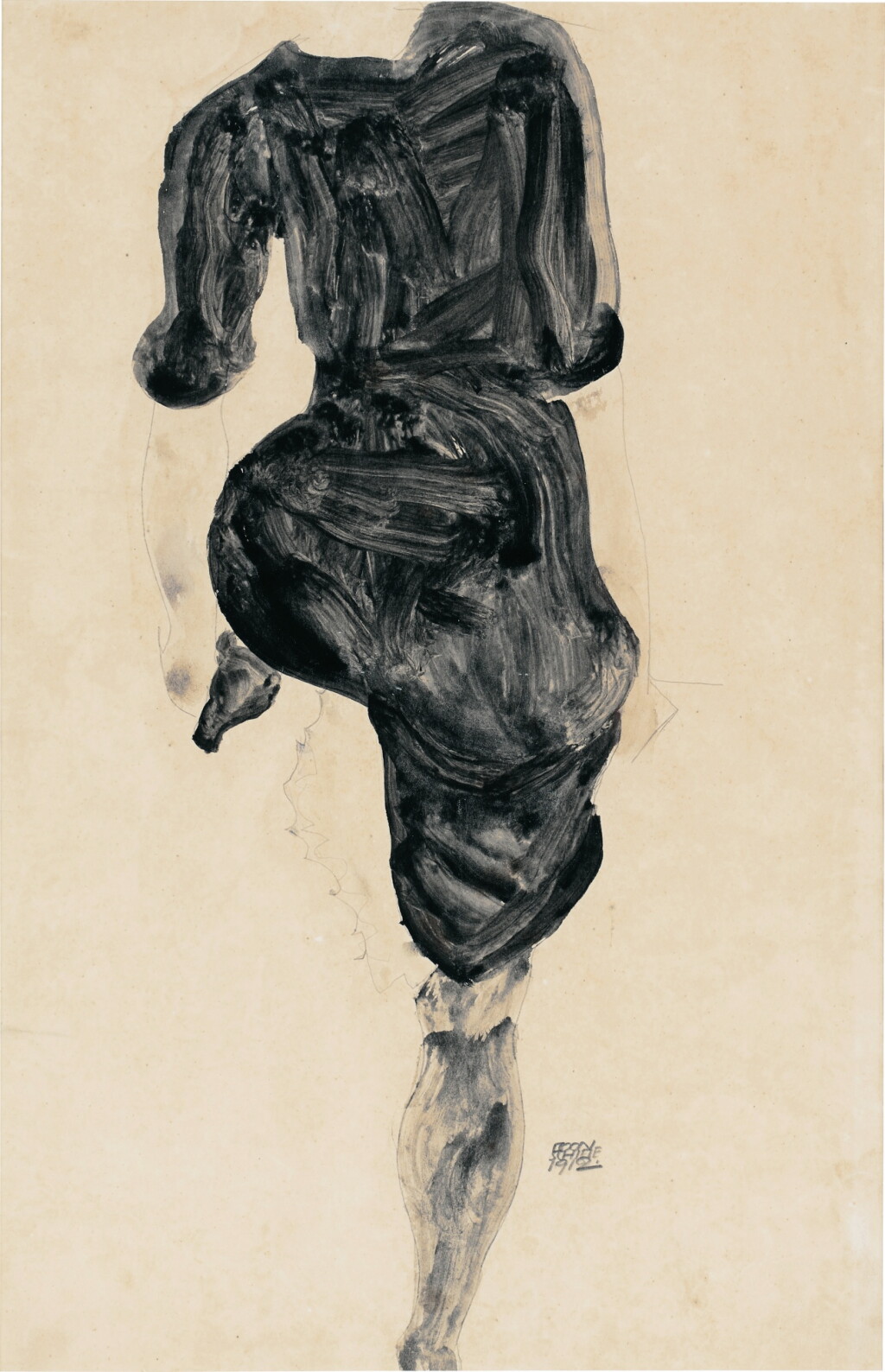
Female Figure in Black (Rückenfigur in Schwarz (Rückansicht), 1912
Gouache, watercolor wash and pencil on paper
47.9 × 32.1 cm (18 7/8 × 12 5/8 in.)
To be auctioned at Sotheby’s New York in 2026 (estimate $300,000–$500,000)
(Kallir d1121)
In this 1912 study, Egon Schiele shows a seated woman almost entirely from behind. Her face remains hidden, while broad sweeps of black gouache dominate the sheet, turning much of the figure into a dark, sculptural presence. Only fragments emerge clearly: a raised arm, a foot, and a hint of hair gathered at the nape of the neck.
Known for decades only from a small black-and-white photograph in Jane Kallir’s catalogue raisonné, the drawing appeared in full color at Sotheby’s New York in November 2026.
Wally Neuzil and a Series of 1912 Studies
Jane Kallir listed this work as D1121 in her 1998 catalogue raisonné, though Sotheby’s November 2026 sale listing accidentally printed the number as D1221. That placement puts the sheet right next to Crouching Female Torso, 1912 and in the same group of studies leading up to Kneeling Woman with a Gray Cape (Wally Neuzil), 1912. Across drawings by Egon Schiele from 1912, seated and kneeling figures often appear alone against blank cream paper.
Schiele’s working method shifted during 1912 after his spring imprisonment in Neulengbach. Instead of the broken, angular outlines he used in 1910 and 1911, he began building figures with larger areas of dark pigment. Here, the model turns her head away so only dark hair pinned at the nape is visible.
The figure is widely believed to be Walburga “Wally” Neuzil, Schiele’s companion and principal model during 1912. The drawing belongs to a closely related sequence of studies from 1912 that includes Kallir D1119, D1121 and D1125, a group in which Wally appears repeatedly in different poses and viewpoints.
Black Paint and a Hidden Figure
Rather than simply describing a garment, the black gouache becomes a pictorial force in its own right. Broad, visible brushstrokes sweep across the back, shoulders and hips, at times defining the body and at other moments almost obscuring it.
The sheet relies on a clear contrast of materials. Thick strokes of matte black gouache form the loose garment across her back and shoulders. Beside that dark surface, thin red-orange watercolor washes add warmth to her neck, raised right forearm, calves, and feet.
One small bare foot protrudes from the dark mass of black paint, a detail that immediately draws the eye. Amid all the dark brushwork, it reminds us that we are looking at a seated woman rather than a purely abstract shape.
Fine pencil lines outline her fingers and toes against the unprimed cream paper. At the lower right corner, Schiele signed his full name and dated the drawing “1912.” in pencil. When Galerie St. Etienne exhibited the work in New York during the 1980s, several checklists misidentified the medium. Before the November 2026 auction, consultation with Jane Kallir at the Kallir Research Institute confirmed the exact combination of gouache, watercolor wash, and pencil.
From Vienna to New York
The drawing first belonged to Schiele’s older sister, Melanie Schiele Schuster, whom he had painted six years earlier in Portrait of Melanie Schiele, 1906. It later entered the Vienna collection of Kurt Rosegg. In 1938, ahead of Nazi persecution, Rosegg emigrated from Austria to Kansas City, taking the drawing with him and keeping it in his family for decades.
In 1982, Galerie St. Etienne in New York acquired the sheet from Rosegg’s descendants. Over the next fourteen years, the gallery included it in seven exhibitions on Austrian Expressionism, from The Human Perspective in 1982 to Breaking All the Rules: Art in Transition in 1996. After passing through private collections in the United States and France, the work joined an American collection by 2015 before appearing at Sotheby’s on November 19, 2026.
Schiele reveals remarkably little. We never see the woman’s face, and much of her body disappears beneath layers of black paint. Yet the drawing feels unexpectedly present. A bent leg, a raised arm and a single bare foot are enough to transform a few sweeping brushstrokes into the unmistakable presence of a living figure.
Leave a Reply