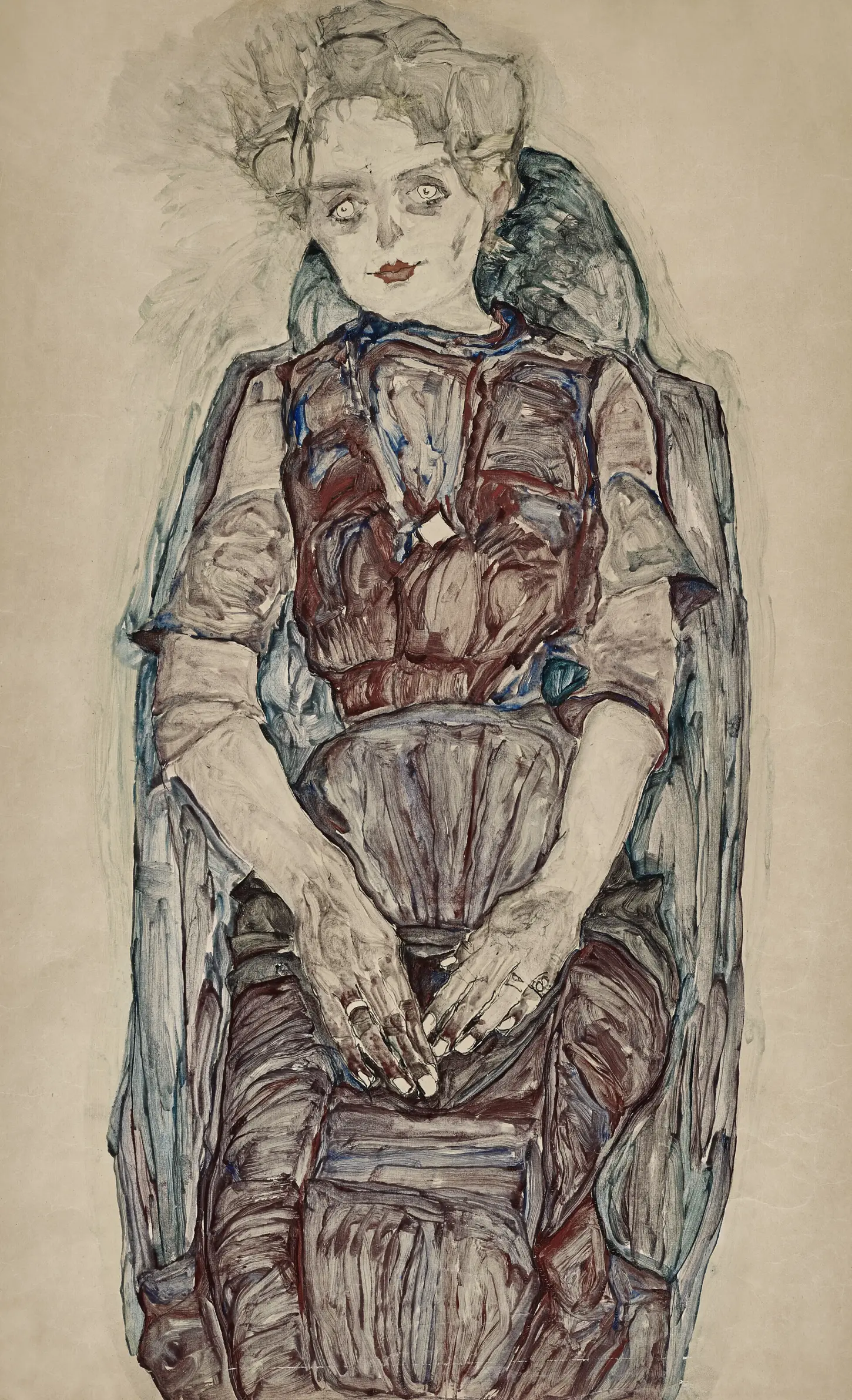
Egon Schiele:
Seated Woman (Sitzende Frau), 1910
Gouache and watercolor over pencil on paper
55.5 x 37 cm
Auctioend at Christie’s, New York in 2023 for $756,000
(Kallir d507)
There is no chair beneath the woman in Seated Woman (Sitzende Frau), no floor beneath her feet, and almost no setting at all. Yet she dominates the sheet completely. Painted in 1910, the figure meets our gaze directly while her long fingers press firmly into her thighs, creating a sense of tension that seems to radiate through the entire composition. Looted from Viennese cabaret star Fritz Grünbaum after 1938, the sheet finally returned to his rightful heirs in 2023.
Breaking Free from Klimt in 1910
Only a year before painting Seated Woman, Schiele had walked out of the conservative Vienna Academy of Fine Arts, tired of rigid rules and plaster casts. Early in 1910, he was still painting under the spell of Gustav Klimt’s shimmering surfaces, yet within months he broke away completely. Writing to his brother-in-law Anton Peschka later that year, Schiele summed up the shift bluntly: “I went by way of Klimt until March. Today, I believe, I am his very opposite.”
You can see that rebellion happening right on this sheet. Schiele drops the bright, acidic tones he used earlier that year and mixes a moody autumn palette of bruised mauves, charcoal blacks, earthy browns, and deep blues. He outlines the figure in pencil, then lets wet washes of watercolor and opaque gouache pool and bleed inside the contours. At the same time, he removes the entire room, leaving the woman suspended in mid-air against the bare white paper without a chair or floor in sight. Schiele would return to that device repeatedly during his breakthrough year. In works such as Self-Portrait (1910), he used empty space not as a background but as a way of intensifying the psychological presence of the figure.
Looking Down from the Ladder
Schiele rarely settled for an ordinary eye-level view when working with live models. In his studio, he often dragged a tall wooden stepladder up to his sitters and climbed several rungs to draw them from above. In Seated Woman, that elevated angle tilts her torso forward, elongates her limbs, and makes her figure feel simultaneously grounded and weightless.
Even though the woman is fully dressed, the portrait carries an unmistakable physical jolt. She locks eyes with the viewer without flinching, her pale skin and shadowed eye sockets contrasting sharply with a slash of crimson lipstick. Her long, angular fingers press down onto her upper thighs, locking her arms into a sharp diamond shape. At a time when Viennese society expected female portraits to look soft and decorative, Schiele painted a woman who looks fiercely real, unbothered by polite taste.
What makes the image so compelling is its refusal to settle into a single mood. The figure appears self-possessed, yet uneasy; physically present, yet strangely isolated. Much of that ambiguity comes from Schiele’s decision to strip away everything except the figure herself.
Fritz Grünbaum and a Long Road Home
Beyond its artistic punch, Seated Woman carries a documented history tied to one of Vienna’s brightest interwar stars. Before 1938, the watercolor hung in the apartment of Franz Friedrich “Fritz” Grünbaum, a beloved Jewish cabaret performer and film actor famous across Central Europe for his razor-sharp humor. Grünbaum assembled an extraordinary private collection of more than four hundred artworks, including over eighty works by Egon Schiele alongside pieces by Albrecht Dürer and Oskar Kokoschka.
When Nazi Germany annexed Austria in March 1938, Grünbaum tried to flee to Czechoslovakia with his wife Elisabeth, only to be arrested at the border and deported to Dachau. While he was imprisoned, Nazi officials forced him to sign a power of attorney allowing his wife to inventory and surrender his art collection. Grünbaum died in Dachau in January 1941, and Elisabeth was murdered at the Maly Trostinec extermination camp the following year. After the war, dozens of Grünbaum’s Schieles surfaced on the international market. Seated Woman appeared at the Swiss gallery Gutekunst & Klipstein in Bern in 1956 before entering the renowned New York collection of dealer Serge Sabarsky. Following decades of archival research, the watercolor was formally restituted to Grünbaum’s heirs in 2023, helping fund a foundation supporting emerging artists in his name.
Today, Seated Woman is admired not only for its remarkable provenance but also for what it reveals about Schiele at a pivotal moment in his career. Painted during the breakthrough year of 1910, the watercolor shows an artist discovering a radically new visual language, one that would soon make him one of the most distinctive voices of early twentieth-century art.
Leave a Reply