Vienna Secesion: Leopold Forstner
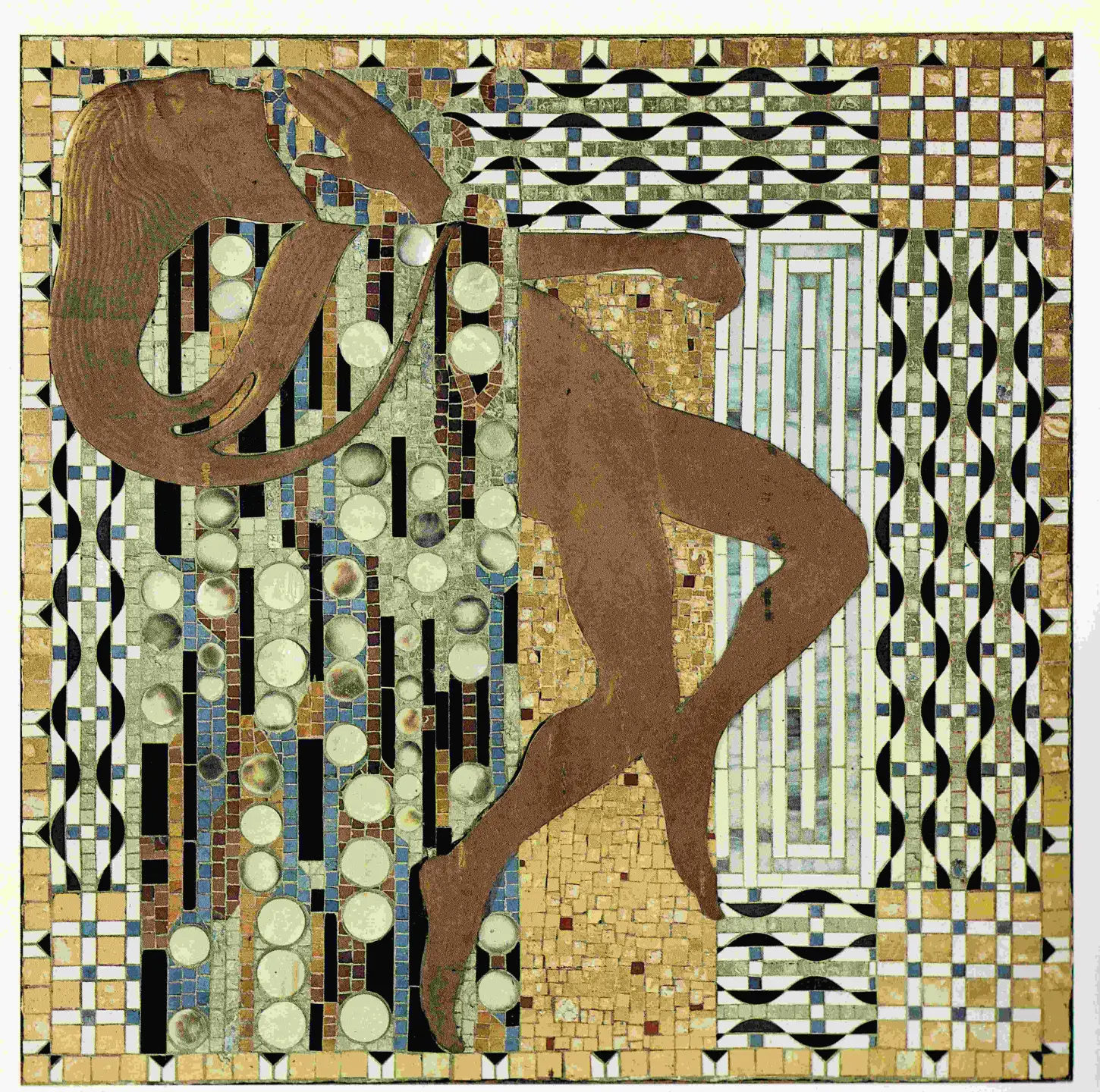
The Dancer (Der Tanz), 1908
Plate mosaic with metal, glass, and mother-of-pearl on mortar
45 × 45 cm
©Lentos Kunstmuseum, Linz
In the summer of 1908, the Viennese art world was moving beyond traditional canvas paintings. The Austrian artist, designer, and mosaic specialist Leopold Forstner (1878-1936) created this panel during a broader shift toward industrial and architectural materials. The artwork features a highly stylized metallic figure set against a geometric pattern of waves and lines. The figure itself was created in collaboration with Austrian sculptor Oskar Thiede, who executed the chased metal form. Seen in its original orientation, the figure appears to dance. Turn the image ninety degrees, however, and the same figure suddenly resembles a swimmer moving through water. This unusual visual ambiguity helped the work become known under two different titles.
From Dancer to Swimmer
This mosaic is unusual because it became known under two different titles. When Forstner exhibited the work at the International Kunstschau in Vienna in 1908, it appeared in the catalogue as Der Tanz (The Dancer). Early black-and-white art publications accidentally reproduced the image rotated ninety degrees clockwise. The change is surprisingly convincing. What first appears to be a dancer suddenly looks like a swimmer moving through the water. Even the circular mother-of-pearl elements begin to resemble bubbles rising to the surface. The alternative title Schwimmende (The Swimmer) soon entered the literature and remained in use for decades.
Looking at both versions, it is easy to understand why the confusion persisted. In one orientation the figure rises and dances; in the other it seems to glide effortlessly through the water.
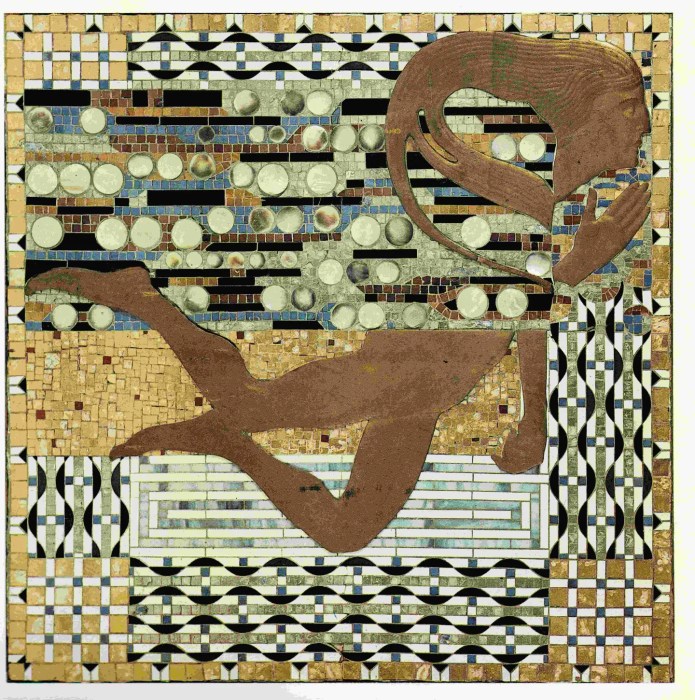
Even today, the mosaic is often published under both titles, reflecting the unusual history of a work whose meaning changed with a simple rotation.
Glass, Metal and Mother-of-Pearl
Forstner did not use the traditional Roman method of mosaic making, which relied on small stone cubes. Instead, he developed the Plattenmosaik technique. He cut large, flat sheets of coloured glass, metal plates, and mother-of-pearl into precise geometric units.
These materials do more than provide colour and texture. They constantly interact with the surrounding light. As viewers move past the panel, the glass, metal, and mother-of-pearl catch and reflect light in different ways, subtly changing the appearance of the mosaic. The effect echoes the reflections and movement of water through the natural properties of the materials themselves.
Like many artists associated with the Vienna Secession, Forstner moved easily between fine art, design, and craftsmanship. He studied painting, graphic art, glasswork, and mosaics, bringing all of those disciplines together in works such as this. Rather than treating mosaics as a revival of an ancient technique, he explored how modern industrial materials could be used to create something entirely new.
Forstner and Klimt
Works such as this established Forstner as one of Vienna’s leading mosaic specialists. During the same years, Gustav Klimt was developing the designs for the Stoclet Frieze in Brussels. Klimt knew that his intricate patterns required specialised glass, metal, and mosaic work to survive on an architectural scale. He turned to Forstner and his Wiener Mosaik-Werkstätte to bring those designs into reality.
Forstner’s workshop transformed Klimt’s designs from drawings on paper into permanent mosaics of glass, stone, and metal. Today, Forstner is best known for his work on Klimt’s Stoclet Frieze, yet mosaics such as Der Tanz show that he was far more than a skilled technician. He was also an inventive artist in his own right.
Looking at Der Tanz today, it is easy to see why Forstner attracted attention. Glass, metal, and mother-of-pearl were transformed into something that still feels remarkably modern more than a century later.
Leave a Reply